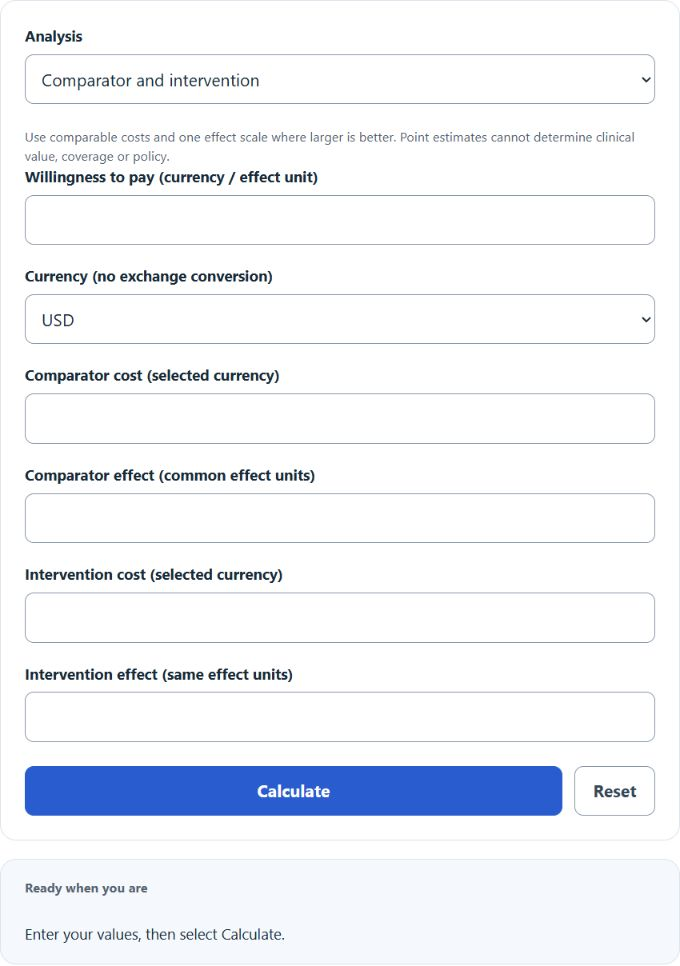
Enter the cost and effectiveness of two different treatments or projects into the calculator to determine ICER.

ICER Calculator

Enter any 4 values to calculate the missing variable

ICER Formula

The incremental cost-effectiveness ratio (ICER) measures how much additional cost is required to produce one additional unit of benefit when comparing one option against another. It is widely used to compare medical treatments, public health programs, insurance strategies, screening plans, and policy interventions.

ICER = \frac{C_A - C_B}{E_A - E_B}

In plain terms, ICER answers this question: if you switch from option B to option A, how much extra do you pay for each extra unit of effectiveness? The result is usually reported in units such as cost per life-year gained, cost per quality-adjusted life year (QALY), cost per hospitalization avoided, or cost per symptom-free day.

Variable Guide

Variable Meaning Typical Unit
CA Cost of option A Dollars or total program cost
CB Cost of option B Dollars or total program cost
EA Effectiveness of option A QALYs, life-years, cases prevented, response rate, or another outcome measure
EB Effectiveness of option B Same outcome unit used for option A
ICER Incremental cost per incremental unit of effectiveness Dollars per unit of effect

What the Result Means

An ICER should never be interpreted in isolation. The sign and size of the ratio only make sense when you also understand whether option A is more effective, less effective, more costly, or less costly than option B.

Situation Interpretation Decision Insight
Option A costs more and is more effective A positive ICER shows the extra cost for each extra unit of benefit Usually compared to a willingness-to-pay threshold
Option A costs less and is more effective Option A dominates option B Usually preferred because it is both cheaper and better
Option A costs more and is less effective Option A is dominated by option B Usually rejected because it is both worse and more expensive
Option A costs less and is less effective There is a trade-off between savings and lost benefit Decision depends on whether the savings justify the reduction in effectiveness

Important: a negative ICER is not automatically good or bad. A negative value can occur when option A is clearly better and cheaper, or when it is clearly worse and more expensive. Always inspect the cost and effectiveness differences directly before making a conclusion.

How to Use the ICER Calculator

  1. Enter the total cost for option A.
  2. Enter the total cost for option B.
  3. Enter the effectiveness for option A.
  4. Enter the effectiveness for option B.
  5. Calculate the ICER to see the incremental cost per additional unit of outcome.

Because the calculator can solve for a missing value, it can also be used in reverse when you know the ICER and want to estimate an unknown cost or effectiveness input.

Example

Suppose treatment A costs $50,000 and produces 3 life-years of benefit, while treatment B costs $30,000 and produces 1 life-year of benefit.

\Delta Cost = 50{,}000 - 30{,}000 = 20{,}000
\Delta Effect = 3 - 1 = 2
ICER = \frac{20{,}000}{2} = 10{,}000

This means treatment A requires $10,000 for each additional life-year gained relative to treatment B.

When ICER Is Useful

  • Comparing two medications with different costs and outcomes
  • Evaluating screening programs or preventive care strategies
  • Comparing surgery versus non-surgical treatment plans
  • Assessing vaccine programs, health campaigns, or public policy interventions
  • Prioritizing limited budgets where decision-makers must balance cost and impact

Common Interpretation Issues

  • Same outcome measure required: both options must be evaluated using the same effectiveness metric.
  • Same time horizon required: a one-year outcome should not be compared against a lifetime outcome unless the analysis is intentionally standardized.
  • Perspective matters: costs may differ depending on whether the analysis uses a patient, payer, provider, or societal perspective.
  • Very small effectiveness differences can distort ICER: if the effectiveness gap is close to zero, the ratio can become extremely large and unstable.
  • Zero effectiveness difference makes ICER undefined: dividing by zero means the ratio cannot be interpreted.
  • ICER is incremental: it compares one option to another; it is not the same as average cost-effectiveness.

Practical Decision Context

In real-world analysis, ICER is usually compared against a decision threshold that represents the maximum acceptable cost for one additional unit of health benefit. If the ICER is below that threshold, the intervention may be considered cost-effective. If it is above the threshold, decision-makers may prefer the alternative unless there are other strategic, ethical, or clinical reasons to adopt it.

Frequently Asked Questions

What are the units of ICER?
ICER is reported as cost per unit of effectiveness, such as dollars per QALY, dollars per life-year gained, or dollars per event avoided.
Is a lower ICER always better?
Usually lower is more favorable, but only if the compared option is actually more effective. The direction of the cost and effect differences still matters.
Can ICER be negative?
Yes. A negative value can mean the new option is cheaper and better, or more expensive and worse. The sign alone does not tell the whole story.
What if option A and option B have identical effectiveness?
The ICER is undefined because there is no incremental effect to divide by. In that case, the lower-cost option is generally more efficient.