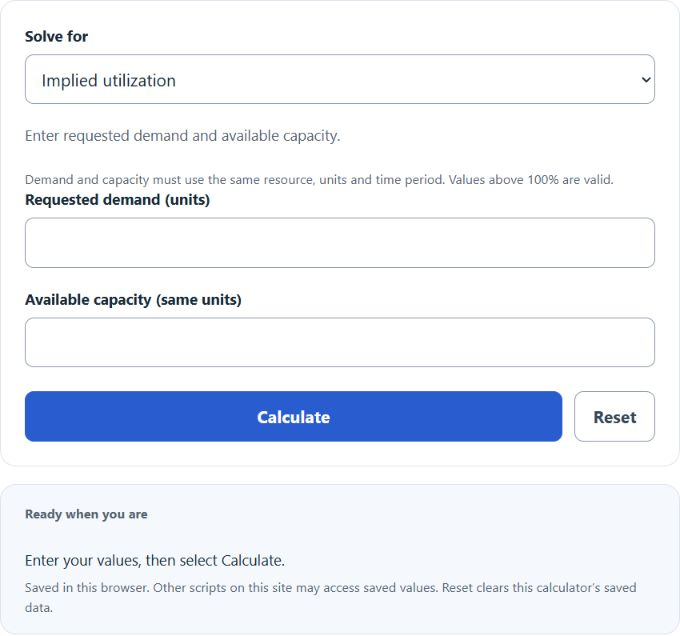
Calculate implied utilization, demand, or capacity from any two inputs to find the missing value in units or percent for planning and analysis.
Related Calculators
- Monthly Revenue Calculator
- Cost of Sales Calculator
- Operating Expense Calculator
- Profit Per Minute Calculator
- All Business Calculators
Implied Utilization Formula
The following equation is used to calculate the Implied Utilization.
- Where IU is implied utilization as a fraction (multiply by 100 for percent)
- UC is requested demand or workload in matching units
- TC is the total capacity
To calculate implied utilization, divide requested demand or workload by available capacity for the same resource and time period.
What is Implied Utilization?
Definition:
Implied utilization is requested demand or workload divided by available capacity for the same resource and time period. It may exceed 100% when demand exceeds capacity; it does not measure actual achieved throughput or efficiency.
How to Calculate Implied Utilization?
Example Problem:
The following example outlines the steps and information needed to calculate the Implied Utilization.
First, determine requested workload. In this example, the work requested requires 8 staff-hours per day.
Next, determine the total capacity. Suppose there are 10 total hours of availability per day.
Finally, calculate the implied utilization using the formula above:
IU = UC / TC
IU = 8 / 10
IU = 0.8 or 80%
FAQ
How can implied utilization help in resource planning?
Implied utilization compares requested workload with available capacity. It helps identify capacity shortfalls or spare capacity when both quantities use matching units and time periods.
What factors can influence implied utilization?
Several factors may influence implied utilization, including fluctuations in demand, variability in staff availability, equipment downtime, and unexpected interruptions or delays in the workflow. Changes in operating conditions, like extended operating hours, can also significantly affect utilization rates.
Is higher implied utilization always better?
Higher implied utilization means more demand relative to capacity, not necessarily greater efficiency. Above 100%, available capacity cannot meet all requested demand. Capacity buffers may help accommodate variation and interruptions.