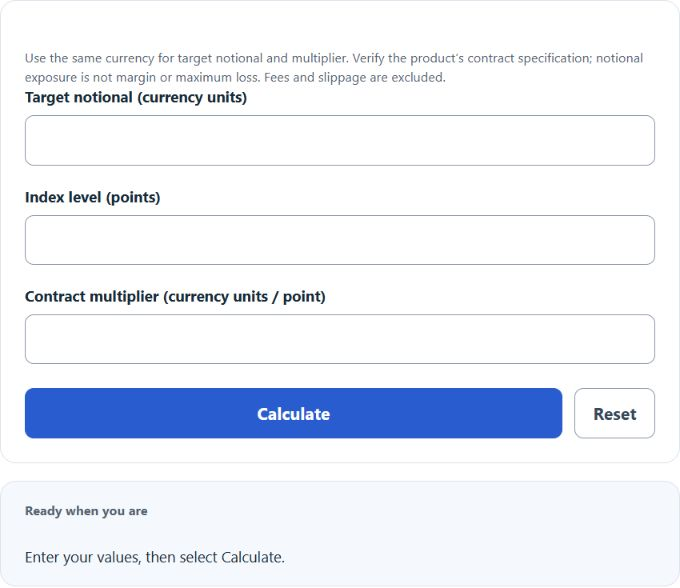
Calculate index contracts needed from target notional, index level and contract multiplier, plus notional per contract and whole contracts.
Index Lot (Contracts) Size Formula
The index lot size calculator determines how many index contracts are needed to reach a target notional exposure. This is useful for position sizing in index products where the contract value depends on the current index level and a fixed contract multiplier.
A helpful way to think about the calculation is to first find the exposure represented by a single contract.
Once the per-contract exposure is known, divide the desired exposure by that amount to estimate the number of contracts required.
Variable Definitions
| Variable | Meaning | Typical Unit |
|---|---|---|
| Target Notional Value | The total market exposure you want to control | Currency |
| Index Value | The current level of the index | Points |
| Contract Multiplier | The currency value of each index point for one contract | Currency per point |
| Contracts | The number of lots or contracts needed to reach the target exposure | Contracts |
How to Calculate Index Lot Size
- Determine the total notional exposure you want.
- Find the current index level in points.
- Identify the contract multiplier for the product.
- Calculate the notional value of one contract.
- Divide the target notional value by the notional value per contract.
- Round the result if the market only allows whole contracts.
Rearranged Forms
If you know any three values, the same relationship can be rearranged to solve for the missing one.
Example Calculation
Assume the target notional value is $200,000, the index is trading at 10,000 points, and the contract multiplier is $10 per point. One contract therefore represents $100,000 of exposure, so two contracts are needed to reach the target amount.
How to Interpret the Result
- Whole-number trading: Many index contracts are traded only in whole contracts, so fractional results usually must be rounded.
- Rounding down: Keeps exposure at or below the target amount.
- Rounding up: Reaches or exceeds the target amount; exact whole-contract targets are unchanged.
- Changing index levels: The notional value of one contract changes as the index moves, so the required number of contracts can change over time.
Common Input Mistakes
- Entering the wrong contract multiplier.
- Using an outdated index level.
- Confusing notional exposure with margin requirement.
- Assuming the calculator accounts for fees, slippage, or tick-size constraints.
- Forgetting to round when only whole contracts are tradable.
Practical Uses
- Sizing an index futures position to match a target exposure.
- Estimating the number of contracts needed for a hedge.
- Comparing exposure across contracts with different multipliers.
- Adjusting portfolio exposure efficiently without buying every underlying component.
Frequently Asked Questions
What does lot size mean here?
In this context, lot size refers to the number of index contracts needed to obtain a specific notional exposure.
Is notional value the same as margin?
No. Notional value is the total market exposure controlled by the contracts, while margin is the capital required to open and maintain the position.
Why does the answer sometimes include decimals?
The formula shows the exact exposure needed, but the market may require whole contracts, so the final trade size may need to be rounded.
Does trade direction change the formula?
No. The sizing formula is the same for long and short positions; only the direction of the trade changes.