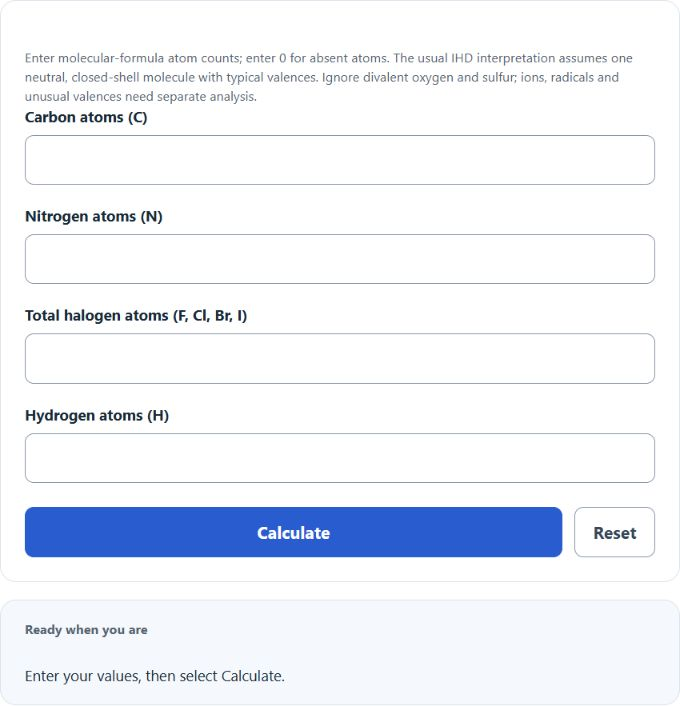
Calculate the Index of Hydrogen Deficiency from carbon, nitrogen, halogen, and hydrogen atom counts in organic chemical formulas and structures.
- All Chemistry Calculators
- Ph To Hydrogen Ion Concentration Calculator
- Hydrogen Lift Calculator
- Um To Ug/Ml Calculator
Index Of Hydrogen Deficiency Formula
The Index of Hydrogen Deficiency (IHD), also called the degree of unsaturation or double bond equivalent (DBE), estimates how many rings and π bonds are present in a molecular formula. It is a fast way to move from a raw formula to likely structural features before drawing possible isomers.
An equivalent form that many chemistry students find easier to evaluate is:
- C = number of carbon atoms
- H = number of hydrogen atoms
- N = number of nitrogen atoms
- X = number of halogen atoms such as F, Cl, Br, or I
This calculator compares your compound to a fully saturated acyclic reference formula. Every time the structure loses two hydrogens relative to that reference, the IHD increases by 1. That missing pair of hydrogens can correspond to a ring, a double bond, or part of a triple bond.
How to Interpret the Result
| IHD Value | Typical Meaning |
|---|---|
| 0 | No rings or multiple bonds; usually a saturated acyclic structure |
| 1 | One ring or one double bond |
| 2 | Two double bonds, or one triple bond, or one ring plus one double bond |
| 3 | Any combination totaling three degrees of unsaturation |
| 4 | Often seen in benzene-like aromatic systems |
Each structural feature contributes to the total as follows:
- One ring = 1 IHD
- One double bond = 1 IHD
- One triple bond = 2 IHD
- An aromatic ring contributes multiple degrees of unsaturation
How to Use the Calculator
- Count the number of carbon atoms in the molecular formula.
- Count the number of nitrogen atoms.
- Count all halogen atoms together and enter that total as X.
- Count the number of hydrogen atoms.
- Click calculate to obtain the IHD.
Divalent oxygen and sulfur do not enter this IHD expression because they do not change the reference hydrogen count. This omission assumes typical valences; sulfur compounds with unusual valences need separate structural analysis.
Quick Chemistry Rules
- Halogens count like hydrogens. Replace each F, Cl, Br, or I with H when thinking about saturation.
- Nitrogen increases the allowed hydrogen count. That is why nitrogen appears with a plus sign in the formula.
- Oxygen is ignored. Alcohols, ethers, aldehydes, ketones, and carboxylic acids are evaluated without O in the IHD expression.
- A valid neutral organic formula usually gives an integer IHD. A fractional answer often means the formula was entered incorrectly or the compound has an unusual bonding pattern.
Examples
Example 1: Benzene, C6H6
An IHD of 4 is consistent with a ring plus three double bonds, which matches the aromatic benzene structure.
Example 2: Cyclohexane, C6H12
An IHD of 1 indicates either one ring or one double bond. Cyclohexane uses that single degree as a ring.
Example 3: Ethyne, C2H2
An IHD of 2 matches one triple bond.
Example 4: Pyridine, C5H5N
The nitrogen changes the calculation, and the result again supports an aromatic unsaturated ring system.
Why IHD Matters
IHD is especially useful in:
- Organic structure identification when narrowing down possible isomers
- Spectroscopy problems alongside IR, NMR, and mass spectrometry data
- Reaction planning when checking whether a product gained or lost unsaturation
- Exam problems where you need a fast first-pass analysis of a formula
For example, if a molecular formula has an IHD of 4, you immediately know the compound cannot be a fully saturated open-chain alkane. It must contain some combination of rings and multiple bonds totaling four degrees.
Common Mistakes
- Forgetting to include halogens in X
- Accidentally counting oxygen in the formula
- Mixing empirical formulas with molecular formulas
- Assuming IHD tells you the exact structure; it only tells you the total unsaturation count
- Interpreting a triple bond as 1 degree instead of 2
Important Limits
The usual rings-and-π-bonds interpretation assumes one neutral, closed-shell molecule with typical valences. Radicals, ions, organometallic compounds and unusual bonding arrangements need separate analysis. The calculator shows negative or half-integer algebraic values with a warning; do not interpret them as physical counts of rings or π bonds. Recheck the molecular formula and atom counts first.
Use the calculator as a fast screening tool: enter the atom counts, compute the IHD, and then combine that result with other chemical information to determine the most likely structure.