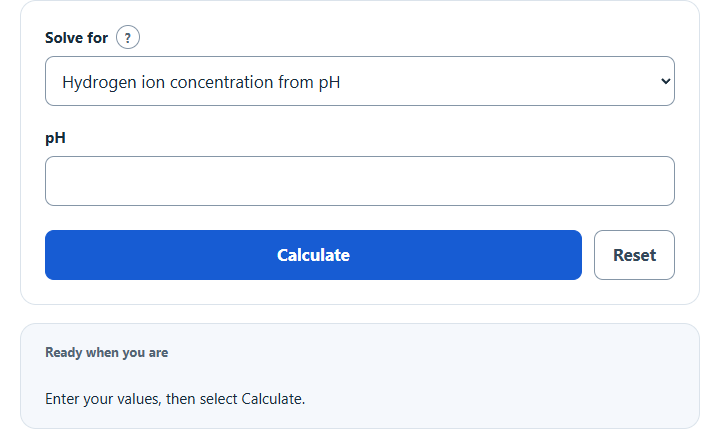
Find hydrogen ion concentration [H⁺] from pH in mol/L, with pOH and [OH⁻], or calculate pH from a known H⁺ or hydronium concentration in mol/L or mmol/L.
- All Chemistry Calculators
- Hydronium Ion Concentration Calculator
- pH to H Calculator
- pH ↔️ pOH Calculator
pH To Hydrogen Ion Concentration Formula
The following formula estimates hydrogen ion concentration from pH for an ideal dilute solution, treating activity as concentration.
Variables:
- [H+] is the hydrogen ion concentration (moles per liter)
- pH is the measure of acidity or alkalinity of a solution
To calculate the hydrogen ion concentration, raise 10 to the power of the negative value of the pH.
What Does “pH to Hydrogen Ion Concentration” Mean?
pH is the negative base-10 logarithm of hydrogen ion activity. In dilute solutions, activity is often approximated by concentration relative to 1 mol/L. The familiar 0–14 scale is not a fundamental limit. Under the ideal 25 °C model, pH 7 is neutral, lower values are acidic and higher values are basic. A lower pH means greater hydrogen ion activity; pH alone does not determine acid strength.
How to Calculate pH To Hydrogen Ion Concentration?
The following steps outline how to calculate the hydrogen ion concentration using the pH value.
- First, determine the pH value.
- Next, use the formula [H+] = 10^-pH to calculate the hydrogen ion concentration.
- Finally, calculate the hydrogen ion concentration.
- After inserting the pH value into the formula and calculating the result, check your answer with a pH to [H+] calculator.
Example Problem:
Use the following variables as an example problem to test your knowledge.
pH = 3