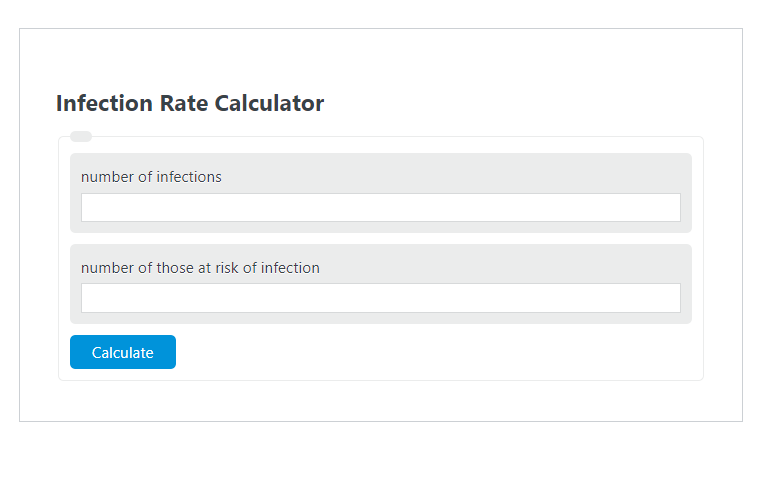
Calculate an infection rate from cases and population or person-time, convert it to percent or per-capita scales, and compare rates between two groups.
- All Health and Medical Calculators
- R0 Calculator
- Attack Rate Calculator
- Incidence Rate Calculator
- Prevalence Calculator
Infection Rate Formula
The infection rate measures what percentage of an at-risk population became infected during the time period you are analyzing. This calculator treats the result as a simple percentage, which makes it useful for comparing groups of different sizes.
- IR = infection rate as a percentage
- I = number of infections
- R = number of people at risk of infection
If you know the infection rate and population at risk, you can also solve for the number of infections. If you know infections and the rate, you can solve for the at-risk population.
How to Calculate Infection Rate
- Choose a clearly defined time period.
- Count the number of infections that occurred during that same period.
- Count only the people who were actually at risk during that period.
- Divide infections by the at-risk population.
- Multiply by 100 to convert the result to a percent.
For accurate results, the numerator and denominator must describe the same population and the same timeframe.
Example Calculations
Example 1: If 1,500 infections occurred in a population of 100,000 people at risk, the infection rate is:
Example 2: If the infection rate is 4% and the at-risk population is 25,000, the number of infections is:
Example 3: If 320 infections occurred and the infection rate was 2%, the at-risk population is:
Quick Interpretation Guide
| Infection Rate | Equivalent Meaning | Interpretation |
|---|---|---|
| 0.1% | 1 per 1,000 at risk | Very small share of the at-risk group became infected. |
| 1% | 10 per 1,000 at risk | Low, but large populations can still produce many cases. |
| 5% | 50 per 1,000 at risk | A meaningful portion of the exposed group became infected. |
| 10% | 100 per 1,000 at risk | High proportion of the at-risk population. |
| 25% | 250 per 1,000 at risk | One out of every four at-risk individuals became infected. |
Some users also like to convert the result into infections per 1,000 people for easier communication.
When to Use This Calculator
- Comparing infection levels across schools, workplaces, hospitals, or communities
- Estimating expected infections from a known infection rate
- Reviewing outbreak summaries for a specific group and time period
- Standardizing raw infection counts so different population sizes can be compared fairly
- Checking whether infection totals are reasonable relative to the exposed population
What Counts as “At Risk”?
The at-risk population should include only people who could realistically become infected during the time period being measured. Using a denominator that is too large will artificially lower the rate, while using one that is too small will inflate it.
- Include: people exposed, susceptible, or otherwise eligible to become infected
- Exclude: groups not exposed, not relevant to the event, or outside the study period
- Be consistent: if infections were measured for one week, the at-risk population should match that same week
Common Input Mistakes
- Using the total population instead of the population actually at risk
- Mixing different time periods between infections and population counts
- Entering a percent as a decimal in one place and a whole number in another
- Counting infection events when the goal is to count infected individuals
- Interpreting a count of infections as if it were already a rate
How to Check Your Result
- If the infection rate is less than 1%, the infected group is a very small fraction of the at-risk population.
- If the infection rate is greater than 10%, review the denominator carefully to make sure it only includes the correct at-risk group.
- If your result is greater than 100%, the inputs are usually inconsistent or the denominator is too small for the number of infections entered.
Comparing Groups Correctly
Raw infection counts can be misleading when population sizes differ. A smaller group can have fewer infections but still have a higher infection rate.
| Group | Infections | At-Risk Population | Infection Rate |
|---|---|---|---|
| Group A | 500 | 50,000 | 1% |
| Group B | 200 | 5,000 | 4% |
Even though Group A has more infections, Group B has the higher infection rate because infections make up a larger share of its at-risk population.
Useful Notes
- This calculator expresses infection rate as a percentage, not a probability between 0 and 1.
- For reverse calculations, enter the rate as a percent value such as 2.5 for 2.5%.
- Keep rounding consistent when reporting results, especially for very small rates.
- Rates are most meaningful when the underlying case definition is clear and applied consistently.