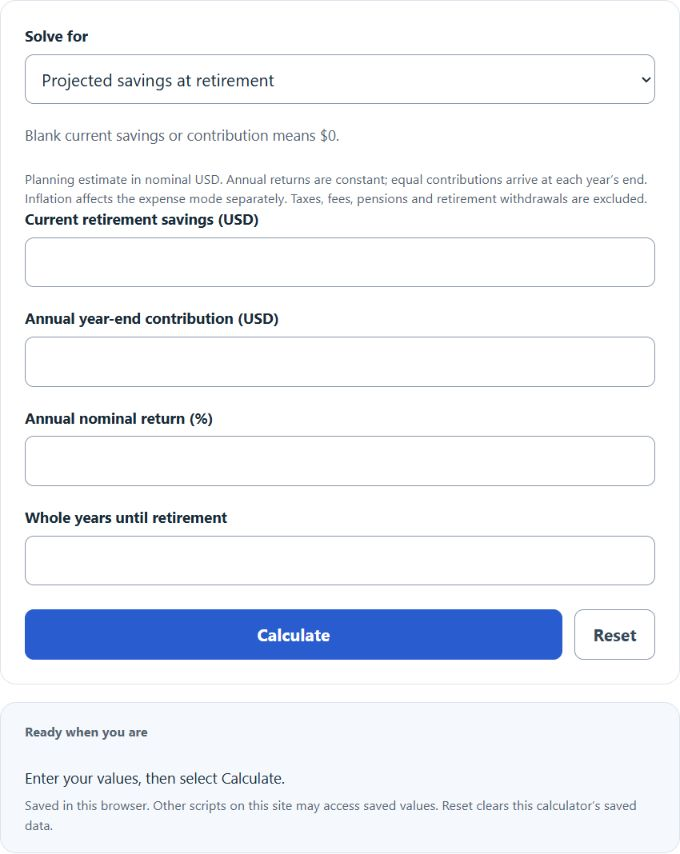
Calculate your projected retirement savings, inflation-adjusted expenses, and the annual contributions needed to reach your goal.
Retirement Savings Formula
This calculator preserves three separate projection modes in nominal dollars. Contributions are equal deposits at each year’s end, returns and inflation are constant annual rates, and years must be whole and nonnegative. Money inputs must be nonnegative, and rates must exceed −100%.
Projected savings at retirement:
FV = P(1 + r)^n + C * [((1 + r)^n - 1) / r]
Inflation-adjusted annual expenses:
E_f = E_0 * (1 + i)^n
Required annual contribution to reach a goal:
C = max(0, (G - P(1 + r)^n) / A), where A = ((1 + r)^n - 1) / r; A = n when r = 0
Where:
- FV is the projected savings balance at retirement.
- P is your current retirement savings.
- C is your annual contribution.
- r is your expected annual rate of return as a decimal.
- n is the number of years until retirement.
- E_f is your annual expenses at retirement after inflation, and E_0 is your current annual expenses.
- i is your expected annual inflation rate as a decimal.
- G is your retirement savings goal.
The first term grows the existing balance and the second sums fixed year-end contributions. At zero return, the contribution factor is n. Inflation is handled separately by the expense mode; savings outputs are not converted to today’s purchasing power. With zero years, current savings and expenses stay unchanged. The contribution mode returns zero if the goal is already met; otherwise, it reports that no deposit time remains. A monthly equivalent is annual contribution divided by 12, not a monthly-deposit projection.
Inflation Impact on Expenses Over Time
The table below shows how a $50,000 annual expense grows under different inflation rates so you can gauge the income you will need at retirement.
| Years | 2% Inflation | 3% Inflation | 4% Inflation |
|---|---|---|---|
| 10 | $60,950 | $67,196 | $74,012 |
| 20 | $74,297 | $90,306 | $109,556 |
| 30 | $90,568 | $121,363 | $162,170 |
Example Problems
Example 1. You have $100,000 saved, contribute $10,000 per year, expect a 6% annual return, and plan to retire in 20 years. Your current balance grows to $100,000 * (1.06)^20 = $320,714. Your contributions grow to $10,000 * [((1.06)^20 – 1) / 0.06] = $367,856. Your projected savings at retirement are about $688,570.
Example 2. Your current annual expenses are $50,000 and you expect 3% inflation over the 20 years until you retire. Your inflation-adjusted expenses are $50,000 * (1.03)^20 = $90,306 per year, so you will need that much income in the first year of retirement to match today’s lifestyle.
FAQ
Why does inflation matter for retirement planning? Inflation steadily raises the cost of living, so the income that supports you today will not cover the same expenses decades from now. Adjusting your target for inflation prevents you from saving too little.
What return and inflation rates should I use? Use assumptions appropriate to your investments, costs and planning horizon, and compare several scenarios. Constant rates are illustrative inputs, not forecasts or guaranteed returns. Enter a nominal return; the expense mode applies inflation separately.
Does this calculator account for taxes and Social Security? No. It projects pre-tax savings growth and inflation-adjusted expenses only. Treat the results as a planning estimate and factor in taxes, pensions, and Social Security separately.