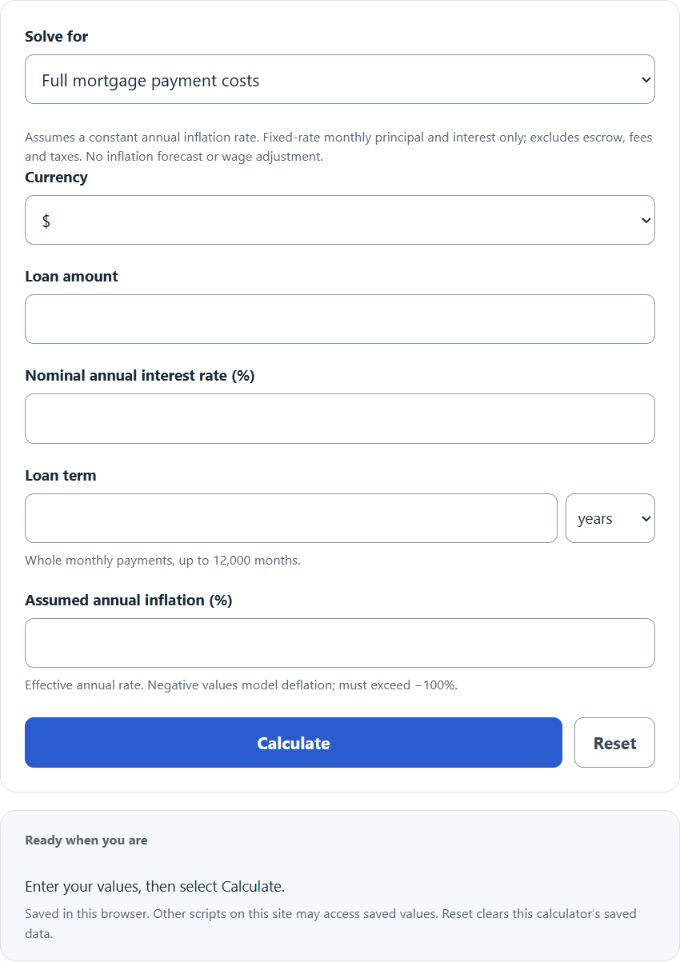
Estimate fixed-rate monthly mortgage payment costs in today’s purchasing power, or the value of one future payment. Enter an assumed constant effective annual inflation rate; this is not a current inflation forecast.
Mortgage Inflation Formula
The following equation is used to calculate the inflation-adjusted value of mortgage payments.
- Where Minfl is the inflation-adjusted mortgage payment ($)
- M is the nominal mortgage payment ($)
- i is the annual inflation rate (as a decimal)
- t is the number of years from the start
To calculate the inflation-adjusted mortgage payment, divide the nominal mortgage payment by (1 + i) raised to the power of the number of years (t).
What is Mortgage Inflation?
Definition:
Mortgage inflation refers to the effect of rising prices over time on the real (inflation-adjusted) value of your mortgage payments. As inflation occurs, each dollar you pay in the future is worth slightly less than it is today, effectively influencing both the perceived burden of payments and the total cost of the loan.
How to Calculate Mortgage Inflation?
Example Problem:
The following example outlines the steps and information needed to calculate mortgage inflation.
First, determine the nominal mortgage payment. In this example, the monthly payment is $1,000.
Next, determine the annual inflation rate. In this case, the inflation rate is 3% (0.03).
Finally, calculate the inflation-adjusted payment for year 5 using the formula above:
Minfl = M / (1 + i)t
Minfl = $1,000 / (1 + 0.03)5
Minfl ≈ $1,000 / 1.15927
Minfl ≈ $862.61 (inflation-adjusted monthly payment in year 5)
FAQ
Why does inflation matter when considering a mortgage?
Inflation reduces the real value of money over time. While this can make future mortgage payments feel less burdensome, it can also affect interest rates and the broader economy, influencing the overall cost of borrowing.
Is it beneficial or harmful to have a mortgage during periods of high inflation?
It depends on factors like the terms of your loan, your personal financial situation, and how wages or investments track with inflation. In some cases, fixed-rate mortgages become more manageable over time as inflation erodes the real value of the payments, but higher inflation can also lead to rising interest rates and other economic pressures.
How can I protect myself against the negative effects of inflation on my mortgage?
Consider locking in a fixed interest rate if you expect inflation to rise, maintain an emergency fund to handle unexpected costs, and regularly review your mortgage and financial goals. Keeping an eye on interest rates and refinancing when favorable can also mitigate some inflation risks.