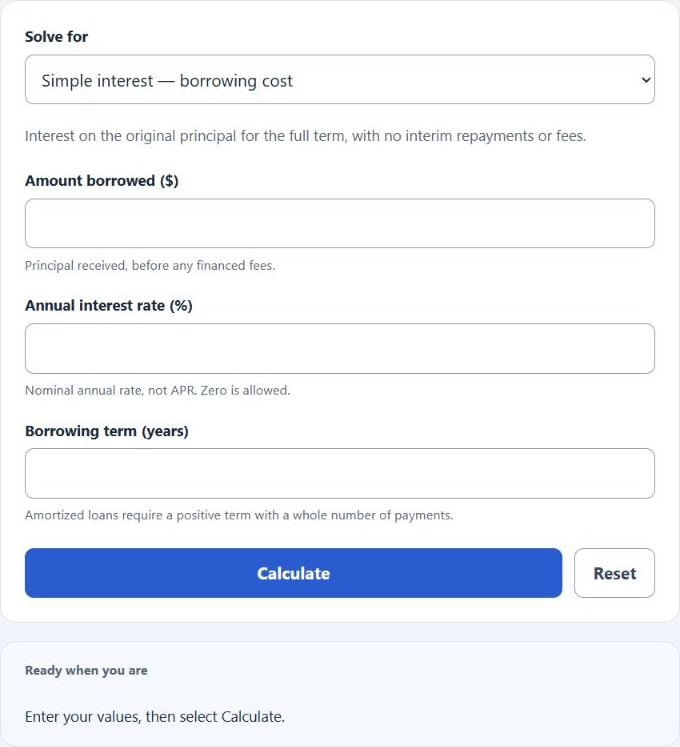
Calculate borrowing costs from loan amount, interest rate, term, fees, and payment frequency for simple, compound, or amortized loans.
Simple-Interest Borrowing Cost Formula
The following formula is used to calculate the borrowing cost (total interest) for a simple-interest loan where interest is calculated on the original principal for the full term.
- Where BC is the borrowing cost (total interest) ($)
- A is the total amount borrowed (principal) ($)
- I is the annual interest rate (%/year)
- T is the length of borrowing (years)
To calculate the simple-interest borrowing cost, multiply the amount borrowed by the annual interest rate (as a percent, so divide by 100), then multiply by the borrowing term length in years. For compound-interest or amortized loans (payments over time), choose the appropriate model in the Solve for menu above. In amortized mode, borrowing cost means interest plus fees; total repayment also includes principal. Enter a nominal annual interest rate, not APR. Payments are estimated without per-payment cent rounding.
How to Calculate Borrowing Cost?
The following example problem outlines how to calculate borrowing cost using the simple-interest formula above.
Example Problem #1
- First, determine the total amount borrowed ($). The total amount borrowed ($) is given as 5000.
- Next, determine the annual interest rate (%/year). The annual interest rate (%/year) is given as 2.
- Next, determine the length of borrowing (years). The length of borrowing (years) is found to be 10.
- Finally, calculate the Borrowing Cost using the formula above:
BC = A * I/100 * T
Inserting the values from above yields:
BC = 5000 * 2/100 * 10 = 1000 ($)
FAQ
What factors influence the total borrowing cost?
The total borrowing cost is influenced by the amount borrowed, the interest rate, and the time over which interest accrues. For many real-world loans, the payment schedule, compounding frequency, and any fees also affect the total cost.
How can one reduce the borrowing cost?
To reduce the borrowing cost, one can consider borrowing a lower amount, securing a lower interest rate, or reducing the length of the borrowing period. For amortized loans and revolving credit where interest accrues on the remaining balance, making extra payments (or paying earlier) can reduce total interest paid, subject to lender rules and any prepayment penalties.
Is it possible to negotiate the terms of borrowing to achieve a lower borrowing cost?
Yes, in many cases, it is possible to negotiate borrowing terms, especially the interest rate, fees, and the length of the loan. This is more common with private lenders and in situations where the borrower has a good credit score or an existing relationship with the lender. Negotiating better terms can lead to savings on the total borrowing cost.