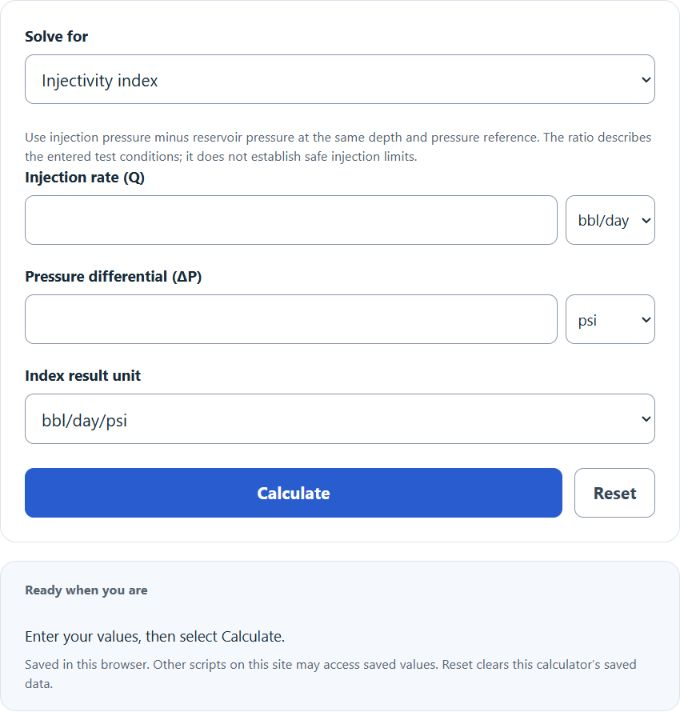
Calculate injection rate, pressure differential, or injectivity index from any two values with unit conversions in bbl/day, psi, bar, kPa, and more.
Related Calculators
- Natural Gas Velocity Calculator
- Parallel Pipe Flow Calculator
- Flow Time Calculator
- Oil Velocity Calculator
- All Physics Calculators
Injectivity Index Formula
The injectivity index measures how readily an injection well or interval accepts fluid. It compares the injection rate to the pressure drop required to move that fluid into the formation. For the same reservoir and fluid system, a higher injectivity index means more rate can be injected for each unit of pressure differential.
If you need to solve for a different variable, use these rearranged forms:
Variable Reference
| Variable | Meaning | Common Units |
|---|---|---|
| II | Injectivity index | bbl/day/psi, m³/day/bar, L/day/kPa |
| Q | Injection rate | bbl/day, m³/day, L/day |
| ΔP | Pressure drop across the injection interval | psi, bar, kPa, Pa |
| Pinj | Injection pressure at the selected reference point | psi, bar, kPa, Pa |
| Pres | Reservoir pressure at the same reference depth | psi, bar, kPa, Pa |
The unit of the injectivity index is always rate divided by pressure. If you input rate in m³/day and pressure in bar, the result should be interpreted as m³/day/bar.
How to Calculate Injectivity Index
- Determine the injection rate, Q, for the well or interval.
- Determine the pressure drop, ΔP, using a consistent pressure reference.
- Divide the injection rate by the pressure drop.
- Interpret the result against prior tests or historical performance for the same well, interval, and fluid conditions.
This simple ratio is most useful when the data is taken under reasonably stable operating conditions. If rate, fluid quality, or pressure response is changing rapidly, the calculated value may reflect transient behavior rather than true steady injectivity.
Example
If the injection rate is 120 bbl/day and the pressure drop across the interval is 50 psi:
The injectivity index is 2.4 bbl/day/psi. In practical terms, that means each additional 1 psi of pressure differential supports about 2.4 bbl/day of injection under those conditions.
How to Interpret the Result
- Higher injectivity index: the formation accepts more fluid for the same pressure increase.
- Lower injectivity index: more pressure is required to inject the same fluid rate.
- Declining injectivity over time: may indicate plugging, scale, fines migration, damage near the wellbore, or poorer fluid compatibility.
- Improving injectivity over time: may occur after stimulation, cleanout, better filtration, or fracture development.
There is no universal “good” injectivity index. A useful value depends on the reservoir, completion, fluid system, interval thickness, and operating objective. The best comparison is usually against earlier tests from the same well or against nearby wells completed in the same zone.
What Affects Injectivity?
- Formation permeability and effective thickness
- Fluid viscosity and temperature
- Completion quality, perforation performance, and skin
- Reservoir pressure and pressure depletion state
- Scale, solids, bacteria, filter cake, or emulsion damage
- Natural fractures or injection-induced fracturing
- Fluid compatibility between injected fluid and formation fluids
Practical Notes for Using the Calculator
- Use the same pressure basis throughout the calculation. Surface pressure and bottomhole pressure should not be mixed without correction.
- Make sure pressure values are referenced consistently. Reversing the pressure difference will produce an incorrect sign.
- If ΔP is zero or extremely small, the calculated injectivity index becomes undefined or unrealistically large.
- If the injectivity index changes significantly with rate, the system may not be behaving linearly and a single ratio may not describe the interval well.
- For fractured injection conditions, the ratio is still operationally useful, but it may represent fracture-assisted injectivity rather than matrix-only injectivity.
Common Questions
Is a higher injectivity index always better?
A higher value generally means the well accepts fluid more easily, but a sudden increase can also signal fracture initiation or extension. Always interpret the number with pressure history and operating limits in mind.
Why did the calculated value drop after a period of injection?
A falling injectivity index often points to increasing flow resistance near the wellbore or inside the formation. Common causes include plugging, scale buildup, solids invasion, or changing fluid properties.
Can this calculator be used to solve for injection rate or pressure drop?
Yes. Choose the variable to solve for and enter the other two positive values. The same relationship is rearranged for the selected result.