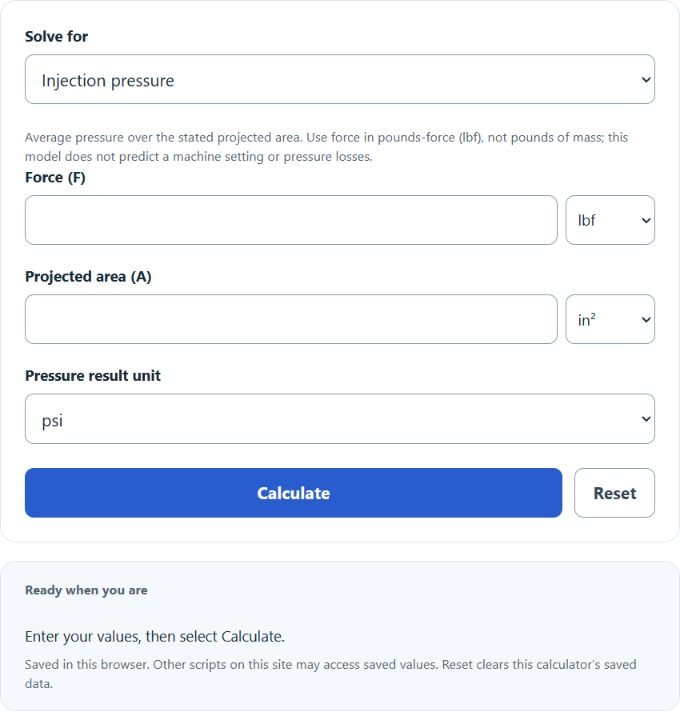
Calculate injection pressure, force, or projected area from any two values using lbf (pounds-force), N, kgf, in², ft², cm², m², psi, bar, kPa, or Pa.
Related Calculators
- PSI to Force Calculator
- Newton to PSI Calculator
- Gauge Pressure Calculator
- Absolute Pressure Calculator
- Pressure Depth Calculator
- Water Pressure Calculator
- All Automotive Calculators
Injection Pressure Formula
The injection pressure calculation is based on the relationship that pressure equals force divided by projected area. The calculator can rearrange the formula to solve for injection pressure, force, or projected area.
- P = injection pressure
- F = force applied to the material
- A = projected area the force acts on
The calculator uses psi, pounds-force, and square inches as the internal base units. If you enter values in N, kgf, ft², cm², m², bar, kPa, or Pa, the values are converted before the formula is applied.
- To calculate injection pressure: enter force and projected area. The calculator uses P = F / A.
- To calculate force: enter injection pressure and projected area. The calculator uses F = P * A.
- To calculate projected area: enter force and injection pressure. The calculator uses A = F / P.
Common Units and Conversion Factors
These are the main unit conversions used by the calculator.
| Quantity | Unit | Conversion to base unit |
|---|---|---|
| Force | N | 1 N = 0.2248089431 lbf |
| Force | kgf | 1 kgf = 2.2046226218 lbf |
| Area | ft² | 1 ft² = 144 in² |
| Area | cm² | 1 cm² = 0.15500031 in² |
| Pressure | bar | 1 bar = 14.5037738 psi |
| Pressure | kPa | 1 kPa = 0.1450377377 psi |
Injection Pressure Result Checks
| Result pattern | What it usually means |
|---|---|
| Pressure increases when force stays the same and area gets smaller | The same force is concentrated over less projected area. |
| Pressure decreases when force stays the same and area gets larger | The force is spread over more projected area. |
| Required force doubles when pressure doubles at fixed area, or area doubles at fixed pressure | Force is directly proportional to pressure and projected area. |
Example Section
Example 1: Calculate injection pressure
You have a force of 12,000 lbf and a projected area of 24 in².
The injection pressure is 500 psi.
Example 2: Calculate required force
You have an injection pressure of 850 psi and a projected area of 18 in².
The required force is 15,300 lbf.
FAQ Section
What is projected area in an injection pressure calculation?
Projected area is the area of the part, cavity, or surface as viewed in the direction of the applied force. For this formula, pressure acts across that projected area. If the projected area is too low, the calculated pressure will be too high.
Is injection pressure the same as force?
No. Force is the total push applied. Injection pressure is that force divided by area. A large force can produce a low pressure if it acts over a large area. A smaller force can produce a high pressure if it acts over a small area.
Which values should I enter?
Choose the variable to solve for, then enter the other two values. The result appears below the calculator. Use nonnegative force and pressure magnitudes and a positive area; solving for area requires positive force and pressure.