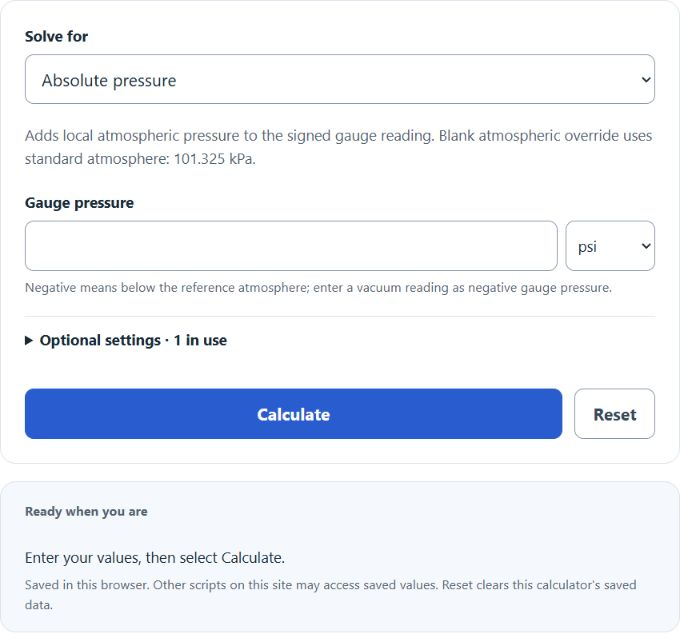
Calculate absolute, gauge, or atmospheric pressure with standard or custom atmospheric pressure and conversions for psi, bar, kPa, MPa, atm, inHg, and Torr.
- All Unit Converters
- All Pressure Calculators
- Pressure Altitude Calculator
- Water Vapor Pressure Calculator
- Stagnation Pressure Calculator
Absolute Pressure Formula
Absolute pressure is the pressure measured against a perfect vacuum. The calculator uses one of three formulas depending on the mode you choose.
Absolute pressure mode:
Gauge pressure mode:
For reference only, the standard-atmosphere troposphere model below estimates pressure from geopotential height h (0–11,000 m). This calculator does not have an altitude estimator:
Atmospheric pressure mode:
- P_abs = absolute pressure (kPa, psia, bar(a), etc.)
- P_gauge = pressure read on a gauge referenced to local atmosphere
- P_atm = local atmospheric (barometric) pressure
- A vacuum magnitude is entered as a negative gauge pressure; there is no separate vacuum mode
- h = geopotential height for the reference model only
Assumptions: gauge pressure is signed relative to the local reference atmosphere. A vacuum magnitude is entered with a minus sign. Blank atmospheric override uses standard atmosphere, exactly 101.325 kPa, regardless of the override unit selection. Enter a measured local absolute pressure when the standard reference is unsuitable.
The three modes solve absolute pressure, gauge pressure, or the reference atmospheric pressure. For a vacuum reading such as 25 inHg below atmosphere, enter −25 inHg as the gauge pressure in Absolute pressure mode. All inputs are converted to pascals before addition or subtraction.
Reference Tables
Standard atmospheric pressure expressed in common units:
| Unit | Standard reference value |
|---|---|
| kPa | 101.325 |
| psi | 14.696 |
| bar | 1.01325 |
| atm | 1.0000 |
| Torr | 760.0 |
| inHg | 29.92 |
Approximate reference-model pressure at geopotential heights (not measured local values or calculator modes):
| Altitude | kPa | psi | inHg |
|---|---|---|---|
| Sea level | 101.3 | 14.70 | 29.92 |
| 1,000 ft | 97.7 | 14.17 | 28.86 |
| 2,500 ft | 92.5 | 13.42 | 27.32 |
| 5,000 ft | 84.3 | 12.23 | 24.90 |
| 7,500 ft | 76.7 | 11.13 | 22.65 |
| 10,000 ft | 69.7 | 10.11 | 20.58 |
| 15,000 ft | 57.2 | 8.29 | 16.89 |
Worked Examples and FAQ
Example 1: Tire pressure. A tire gauge reads 32 psig at sea level. Absolute pressure is 32 + 14.696 = 46.7 psia.
Example 2: Process tank in Denver. Suppose a vessel reads 50 psig and its measured local atmosphere is 12.2 psi. Absolute pressure is 50 + 12.2 = 62.2 psia. Using sea level instead would overstate the absolute value by about 2.5 psi.
Example 3: Vacuum line. A vacuum gauge reads 25 inHg below atmosphere at sea level. Convert: 25 inHg × 3.3864 = 84.66 kPa. Absolute pressure is 101.325 – 84.66 = 16.7 kPa(a).
Why use absolute pressure? Gas law calculations (PV = nRT), compressor ratios, boiling point lookups, and vacuum work all require absolute pressure. Gauge values shift with weather and elevation, so they cannot be used directly in those equations.
Is absolute pressure ever negative? No. Absolute pressure is referenced to a perfect vacuum, so the lowest possible value is zero. If the calculator returns an error about negative absolute pressure, your vacuum reading exceeds the local atmosphere or your gauge sign is wrong.
psig vs psia. psig is gauge pressure, with zero at local atmosphere. psia is absolute, with zero at vacuum. At sea level, psia = psig + 14.696.
Does this calculator estimate pressure from altitude? No. The table is a standard-atmosphere reference model; local weather can change the pressure. Enter a measured local atmospheric override when precision matters. inHg conversions use conventional mercury at 0°C; Torr is defined as 1/760 of a standard atmosphere.