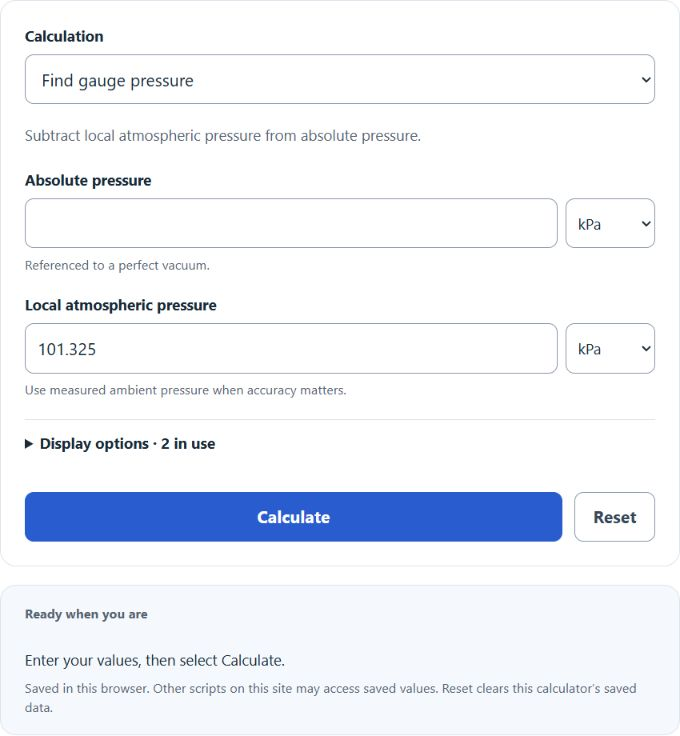
Calculate gauge pressure from absolute pressure or fluid depth, and convert gauge pressure to absolute pressure using atmospheric pressure.
- All Physics Calculators
- Absolute Pressure Calculator
- Pressure Altitude Calculator
- ISA Temperature Calculator
Gauge Pressure Formula
Choose a pressure-reference calculation or fluid depth. The altitude options estimate atmospheric pressure for a standard troposphere from −500 to 11,000 m; they do not account for weather. Altitude is treated as geopotential height; ordinary elevation is an approximation.
Absolute to gauge:
Atmospheric reference: P_atm = P_abs − P_g.
Fluid height (hydrostatic):
Gauge to absolute:
- P_g — gauge pressure (Pa)
- P_abs — absolute pressure (Pa)
- P_atm — local atmospheric pressure (Pa)
- ρ — fluid density (kg/m³)
- g — gravitational acceleration, 9.80665 m/s² standard
- h — fluid column height or depth (m)
Gauge pressure is measured relative to local atmospheric pressure, not the standard sea-level value. A negative gauge reading means vacuum: pressure below ambient. The hydrostatic formula assumes a stationary, incompressible fluid of uniform density. For an open tank, surface gauge pressure is zero. For a pressurized tank, use the optional nonnegative surface gauge pressure; the calculator adds it to ρgh.
Reference Values
Atmospheric pressure drops with elevation. These are approximate standard-atmosphere values, not a local weather report. Use a measured local atmospheric pressure when accuracy matters.
| Elevation | P_atm (kPa) | P_atm (psi) |
|---|---|---|
| Sea level | 101.325 | 14.696 |
| 500 m | 95.46 | 13.85 |
| 1,000 m | 89.87 | 13.04 |
| 1,500 m | 84.56 | 12.26 |
| 2,000 m | 79.50 | 11.53 |
Illustrative fluid densities for the hydrostatic mode are shown below. Actual density depends on the fluid, temperature, and composition; enter a suitable value for the conditions being calculated.
| Fluid | Density (kg/m³) | P_g per meter (kPa/m) |
|---|---|---|
| Fresh water | 1,000 | 9.81 |
| Seawater | 1,025 | 10.05 |
| Typical oil | 850 | 8.34 |
| Gasoline | 740 | 7.26 |
| Mercury | 13,595 | 133.32 |
Example and FAQ
Example: A car tire reads 32 psi on the gauge. Assuming ambient pressure is 14.696 psi (standard sea-level pressure), absolute pressure inside the tire is 32 + 14.696 = 46.7 psi.
Example: Pressure at the bottom of a 5 m fresh water tank open to air. P_g = 1000 × 9.80665 × 5 = 49,033 Pa, or about 49.0 kPa (7.11 psi).
Why does my tire pressure drop in winter? As a rule of thumb, tire pressure may fall about 1 psi for every 10 °F drop in temperature, even without a leak. The change varies with starting pressure and temperature; check tires cold against the vehicle manufacturer’s recommendation.
Can gauge pressure be negative? Yes. Negative gauge pressure is below ambient. For the ordinary gas and vacuum model used here, the lower limit is −P_atm, corresponding to zero absolute pressure (a perfect-vacuum limit).
Does altitude affect a tire gauge reading? Yes. If the absolute pressure inside the tire stays the same, a lower ambient pressure gives a higher gauge reading.
When do I use absolute pressure instead? Use absolute pressure for gas law calculations (PV = nRT), thermodynamic properties, and anything involving vacuum systems. Use gauge pressure for tires, pipe systems, and most field instruments.