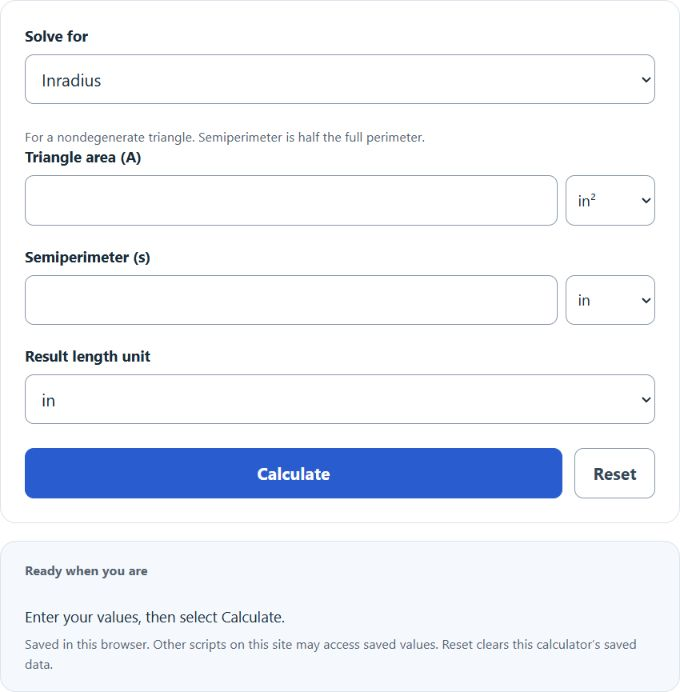
Calculate inradius, area, or semi-perimeter from any two values and convert among in, ft, cm, or m units when one value is missing.
Related Calculators
- Angle Bisector Calculator
- Euclidean Distance Calculator
- Tangent Ratio Calculator
- Hole Area Calculator
- All Math and Numbers Calculators
Inradius Formula
The inradius of a triangle is the radius of its incircle, the unique circle drawn inside the triangle that touches all three sides. For any triangle, the inradius is found from the triangle’s area and semiperimeter.
If the side lengths are known, compute the semiperimeter first and then apply the same relationship.
Variable Definitions
- r = inradius of the triangle
- A = area of the triangle
- s = semiperimeter of the triangle
- a, b, c = side lengths of the triangle
The output unit for the inradius is always a length unit. If the area is entered in square feet and the semiperimeter is entered in feet, the resulting inradius will be in feet.
How to Calculate the Inradius
- Determine the triangle’s area.
- Determine the semiperimeter, which is half of the full perimeter.
- Divide the area by the semiperimeter.
- Use the same base length unit as the triangle’s sides for the final answer.
Rearranged Forms
This calculator can also solve for a missing area or semiperimeter when the other values are known.
| Find | Formula | Use Case |
|---|---|---|
| Inradius | r = (A) / (s) |
When area and semiperimeter are known |
| Area | A = r s |
When inradius and semiperimeter are known |
| Semiperimeter | s = (A) / (r) |
When area and inradius are known |
Example
If a triangle has an area of 36 square units and a semiperimeter of 15 units, the inradius is:
The incircle radius is 2.4 units.
Finding the Inradius from Side Lengths Only
If you only know the three side lengths, first compute the semiperimeter and then use Heron’s formula for the area.
Substituting that area into the inradius relationship gives a side-length-only form:
This is useful when the triangle is fully defined by its sides but the area has not been calculated yet.
Special Triangle Shortcuts
| Triangle Type | Formula | Notes |
|---|---|---|
| Equilateral triangle | r = (a√(3)) / (6) |
Use when all three sides are equal to a |
| Right triangle | r = (x + y - c) / (2) |
Use when x and y are the legs and c is the hypotenuse |
What the Inradius Represents
The center of the incircle is called the incenter. It is the point where the triangle’s three angle bisectors meet. The inradius is the perpendicular distance from that point to any side of the triangle. Because the incircle touches every side, the distance is the same for all three sides.
Why the Formula Works
A triangle can be viewed as three smaller triangles formed by the incenter. Each smaller triangle has height equal to the inradius, and together their bases add up to the full perimeter. That leads to the area identity below, which is equivalent to the calculator’s main formula.
Once the area is written in that form, solving for the radius gives the standard inradius equation.
Common Mistakes
- Using the full perimeter instead of the semiperimeter.
- Selecting units that do not match the entered values. The calculator converts supported mixed units automatically.
- Entering side lengths that do not form a valid triangle.
- Using zero or negative values.
Practical Use Cases
- Geometry homework and proofs involving incircles and incenters
- Triangle design problems in drafting, CAD, and layout work
- Comparing how “compact” different triangles are relative to their perimeter
- Solving constructions where a circle must fit exactly inside a triangle