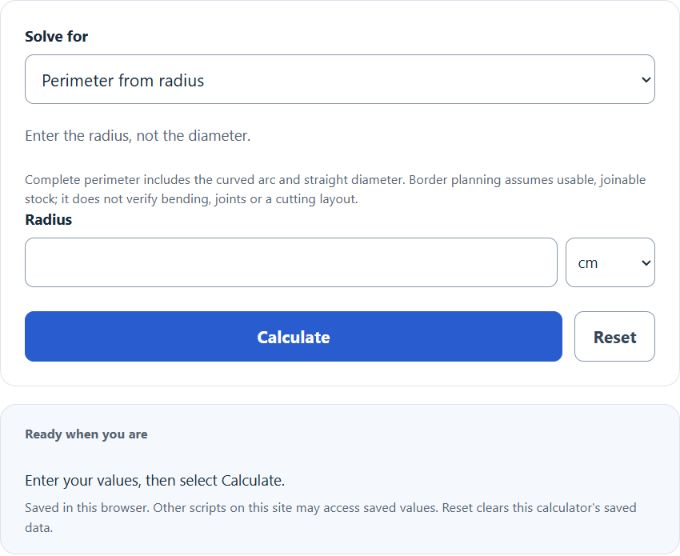
Find complete semicircle perimeter from radius, reverse-solve radius from complete perimeter or half-circle area, and compare arc, diameter and full-circle circumference. Border planning adds an explicit extra-length allowance, rounds up to whole stock pieces and estimates their cost in the selected currency.
- All Math and Numbers Calculators
- Circumference to Diameter Calculator | Find Diameter
- Perimeter Ratio Calculator
- Circle Length Calculator
- Circle Volume Calculator
- Perimeter Calculator – All Shapes & Formulas
Semicircle Perimeter Formula
The following formula is used to calculate the perimeter of a semicircle:
Variables:
- P is the perimeter of the semicircle
- r is the radius of the semicircle
To calculate complete perimeter, multiply radius by π and add twice the radius. The curved arc alone is πr. Reverse formulas are r = P ÷ (π + 2) and r = √(2A/π), where A is half-circle area. Length and square-area units convert independently.
What is a Semicircle Perimeter?
A semicircle perimeter refers to the boundary length of a semicircle (half of a full circle). The perimeter of a semicircle is not the same as the circumference of a full circle, as it includes the diameter of the circle as well. The formula to calculate the perimeter of a semicircle is derived from the formula of a full circle’s circumference, which is 2πr (where r is the radius of the circle). Since a semicircle is half of a circle, the formula becomes πr. However, this only accounts for the curved part of the semicircle. To get the total perimeter, we must add the length of the diameter, which is 2r. Therefore, the formula for the perimeter of a semicircle is πr + 2r.
How to Calculate Semicircle Perimeter?
The following steps outline how to calculate the Semicircle Perimeter.
- First, determine the radius of the semicircle (r).
- Next, calculate the circumference of the full circle using the formula C = 2πr.
- Then, divide the circumference by 2 to get the curved arc length of the semicircle (πr).
- Finally, add the diameter (2r) to the arc length to get the total semicircle perimeter: P = πr + 2r.
- Select the required task, enter its measurements and select Calculate. In Border material and cost, enter stock piece length, extra material percentage (zero for none), price per its own selected length unit and currency. Required length = P × (1 + percentage/100); pieces = ceiling(required length ÷ piece length); estimated cost = whole purchased stock length × price per unit. No currency conversion occurs. This assumes usable offcuts and joints, not a verified cutting or bending plan.
Example Problem:
Use the following variables as an example problem to test your knowledge.
radius (r) = 5 cm. Curved arc = 5π ≈ 15.707963 cm; straight diameter = 10 cm; complete perimeter ≈ 25.707963 cm. Half-circle area ≈ 39.269908 cm². These rounded display values are not intermediate inputs for the calculation.