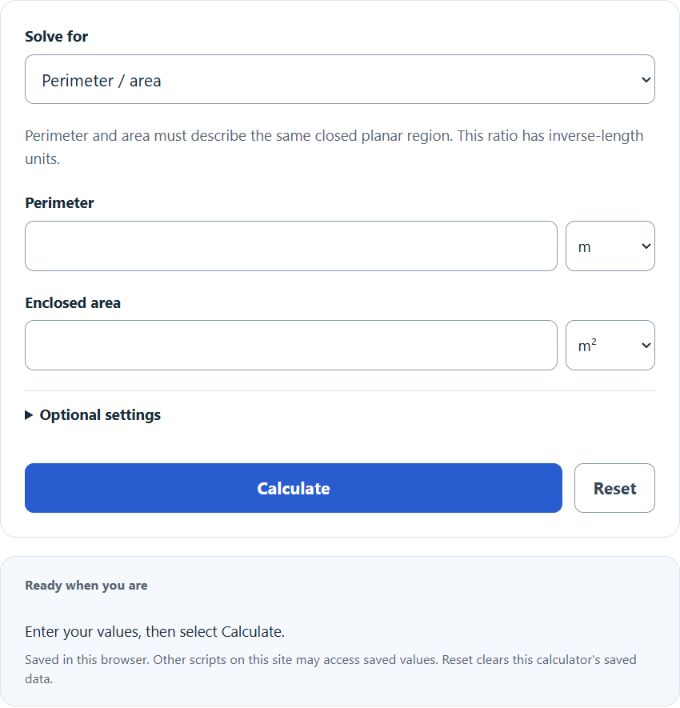
Calculate perimeter divided by area (P/A), area, or perimeter with unit conversions for inches, feet, meters, and centimeters. Separate A:B tasks compare two perimeter lengths or find a missing perimeter from their ratio.
- All Math and Numbers Calculators
- All Ratio Calculators
- Volume Ratio Calculator
- Decimal to Ratio Calculator
- Trigonometric Ratio Calculator
- Maximum Area Calculator
- Perimeter Calculator – All Shapes & Formulas
Perimeter Ratio Formula
Here, perimeter ratio means perimeter divided by enclosed area (P/A), a measure of boundary length per unit area. It has inverse-length units and changes with size, so it is not a dimensionless compactness score. At the same area and in the same units, a lower P/A means less perimeter. The separate A:B calculator tasks compare two perimeter lengths; that ratio, its decimal value, and its percentage are dimensionless.
- PRR = perimeter ratio
- PL = total perimeter length
- TA = total area
Because perimeter is a length and area is a square length, P/A is expressed in inverse-length units. For example, feet divided by square feet gives inverse feet. The calculator converts each selected input unit before calculation and converts the answer to the selected result length basis. The P/A tasks require the perimeter and area of the same closed planar region, whose measurements must satisfy P² ≥ 4πA; passing this necessary check does not identify the shape.
Rearranged Forms
If you know any two values, you can solve for the third:
How to Calculate Perimeter Ratio
- Determine the full perimeter by adding all outer side lengths.
- Calculate or measure the total enclosed area.
- Convert the measurements into compatible units if needed.
- Divide the perimeter by the area.
- Interpret the result as boundary length per unit area.
Example Calculation
If a figure has a perimeter of 100 inches and an area of 600 square inches, the perimeter ratio is:
If another figure has a perimeter of 140 inches and an area of 800 square inches, then:
The second figure has the higher ratio, so it uses more perimeter for each unit of enclosed area.
How to Interpret the Result
- Lower perimeter ratio: less boundary per unit area. At the same area and in the same units, a lower ratio means a smaller perimeter.
- Higher perimeter ratio: more edge relative to area, often caused by narrow dimensions, stretching, or irregular boundaries.
- Best use case: comparing boundary length per area in consistent units; hold area fixed when comparing shape compactness.
Common Shape Relationships
The perimeter ratio depends on geometry as well as size. These common forms show how the ratio changes from one shape to another:
| Shape | Perimeter Ratio | Interpretation |
|---|---|---|
| Square with side length s | PRR = (4s) / (s²) = (4) / (s) |
Larger squares have lower perimeter ratios than smaller similar squares. |
| Rectangle with length l and width w | PRR = (2(l + w)) / (lw) |
At a fixed area, stretching a rectangle away from a square increases the ratio. |
| Circle with radius r | PRR = (2π r) / (π r²) = (2) / (r) |
For a fixed area, the circle gives the smallest possible perimeter ratio. |
Why Scale Matters
Perimeter increases in direct proportion to length, but area increases with the square of length. That means similar shapes become more area-efficient as they get larger. In general, for similar figures, the perimeter ratio follows this pattern:
Here, L represents a characteristic length such as side length, radius, or another linear dimension. As that length increases, the perimeter ratio decreases.
Practical Uses
- Land planning and fencing: compare parcels or enclosures to see which layout surrounds more area with less boundary.
- Packaging and manufacturing: estimate exposed edge relative to panel size, sheet cuts, or component faces.
- Architecture and construction: evaluate compact floor plans, courtyards, facades, and building envelope efficiency.
- Image analysis and biology: compare traced boundary length per area, using consistent units and equal areas for shape compactness comparisons.
Common Mistakes
- Mixing units, such as inches for perimeter and square feet for area, without converting first.
- Using only part of the outline instead of the full outside perimeter.
- Entering an area of zero, which makes the ratio undefined.
- Comparing shapes of very different sizes without recognizing that smaller similar shapes naturally have larger perimeter ratios.
Quick Notes
- A valid perimeter ratio is positive whenever both perimeter and area are positive.
- If two shapes have the same area, the one with the smaller perimeter will also have the smaller perimeter ratio.
- If two shapes have the same perimeter, the one with the larger area will have the smaller perimeter ratio.