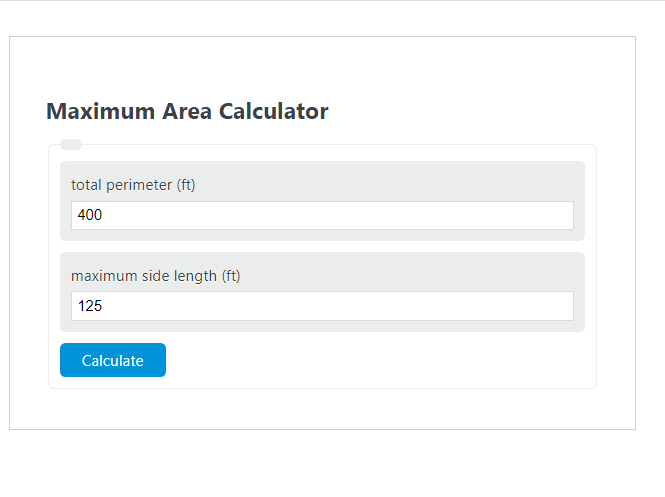
Calculate the maximum area of a rectangle from total perimeter and side length, or find the missing perimeter, side, or area in feet, inches, cm, or m.
- All Area Calculators
- Perimeter Ratio Calculator
- Shaded Area Calculator
- All Math and Numbers Calculators
Maximum Area Formula
This calculator finds the largest possible rectangular area when the total perimeter is fixed and one side is limited by a maximum allowed length. The key idea is simple: for a fixed perimeter, the rectangle with the greatest area is the most balanced shape possible. If the side limit is large enough, that shape is a square. If the side limit is too small, the best rectangle uses the full allowed side length on the constrained side.
- Maximum Area (MA): the largest achievable rectangular area.
- Total Perimeter (P): the full distance around the rectangle.
- Maximum Side Length (SL): the largest permitted value for the constrained side.
Use the same linear unit for perimeter and side length. The output area will be returned in the corresponding square unit.
Why the Formula Has Two Cases
A rectangle with a fixed perimeter must split that perimeter between two side lengths. The area gets larger as those two sides move closer together. That is why a square gives the largest area whenever the side-length cap still allows it.
If no side-length cap is active, the optimal rectangle is a square.
If the allowed side length is smaller than that square threshold, the constraint becomes active. In that case, the constrained side is set equal to the maximum allowed value, and the other side is whatever remains from the fixed perimeter.
How to Use the Calculator
- Enter any two known values: total perimeter, maximum side length, or maximum area.
- Leave the unknown field blank.
- Click calculate to solve for the missing value.
- Interpret the result using the square case or the constrained-side case, depending on whether the side limit is restrictive.
Rearranged Forms
If you want to solve backward by hand, these equivalent forms are useful.
Perimeter from maximum area and side limit
Maximum side length from perimeter and maximum area
Quick Decision Rule
- If the side limit is at least one-quarter of the perimeter, the maximum area comes from a square.
- If the side limit is less than one-quarter of the perimeter, the side limit controls the answer.
- The more equal the two side lengths are, the larger the area becomes.
Practical Checks
The area can never be larger than the square-area limit for the same perimeter.
- If the entered area is larger than this limit, the inputs are not physically consistent.
- If the side limit is very large, it does not affect the result because the square already fits.
- If the side limit is small, it becomes the controlling dimension of the rectangle.
- All entered values should be positive.
Examples
Example 1: the square is allowed
Suppose the total perimeter is 400 feet and the maximum side length is 125 feet. A square would only require 100 feet per side, so the limit does not restrict the shape.
The maximum area is 10,000 square feet.
Example 2: the side limit is binding
Suppose the total perimeter is 500 meters and the maximum side length is 100 meters. A square would require 125 meters per side, so the side cap becomes active.
The maximum area is 15,000 square meters.
Common Questions
Why does a square maximize area for a fixed perimeter?
Because the product of the two side lengths is greatest when the two sides are equal. With no restrictive side cap, the rectangle becomes a square and reaches the largest possible area.
What does the maximum side length represent?
It is the largest permitted value for the constrained side in the optimization. When that cap is below the square threshold, the best rectangle uses the full allowed side length.
When does the side limit stop mattering?
Once the allowed side length is at least one-quarter of the perimeter, the optimal square already fits inside the constraint, so the cap no longer changes the result.
Can the calculator solve for perimeter or side limit too?
Yes. If you enter any two values, the calculator can determine the missing third value using the same maximum-area relationships shown above.