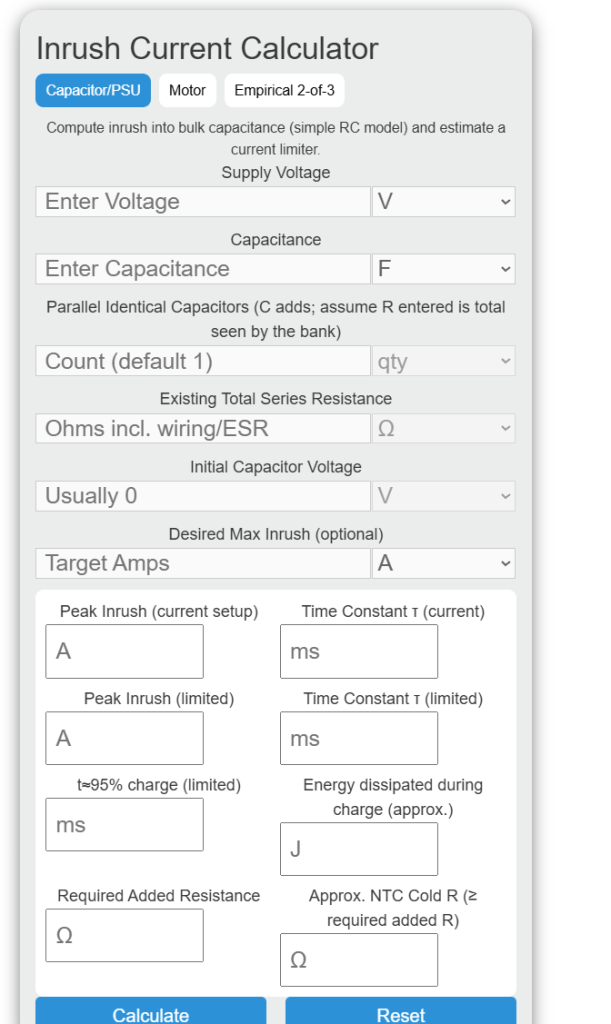
Calculate capacitor or PSU peak inrush current from voltage and total resistance, estimate RC charge timing, or estimate motor starting current from FLA and a multiplier.
Related Calculators
- Inductive Load Calculator
- Impedance to Voltage Calculator
- Capacitor Size Calculator
- Line To Ground Voltage Calculator
- All Physics Calculators
Inrush Current Formula
There is no single universal inrush-current formula that works for all devices. Inrush depends on the load type (capacitor input PSU, motor, transformer, etc.) and the total source/series impedance. The calculator above uses the following common estimation models:
Variables:
- I_{peak} is the peak capacitor-charge inrush current (A)
- V_s is the supply voltage (V), and V_i is the initial capacitor voltage (V)
- R_{total} is the total series resistance limiting inrush (Ω)
- C_{total} is the total capacitance being charged (F), and τ is the RC time constant (s)
- I_{FLA} is the motor full-load (rated) current (A), and M is an estimated starting multiplier (unitless)
For capacitor-input loads, the initial peak is approximately ΔV/R_{total}, and the current then decays with an RC time constant τ. For motors, a common first estimate is that starting current is several times the rated current, depending on the starting method. The “Empirical 2-of-3” tab uses a simple heuristic relationship (not a standard physical law) and should be used only as a rough fit when you have measured/assumed values.
What is Inrush Current?
Inrush current is the maximum (or near-maximum) transient input current drawn by an electrical device immediately after it is energized. Inrush current is typically higher than steady-state current due to effects such as charging input capacitors, establishing magnetic flux in inductive components (motors/transformers), and core saturation. It is a critical design and protection parameter, because excessive inrush can trip circuit breakers or blow fuses if not properly managed.
How to Calculate Inrush Current?
The following steps outline how to calculate the Inrush Current.
- First, choose a model that matches your load (capacitor-input supply, motor, etc.).
- Next, collect the inputs required by that model (for example: V_s, C_{total}, and total series resistance for an RC charge model; or FLA/power, voltage, and starting method for a motor).
- For a capacitor-input load, estimate the peak using I_{peak} ≈ (V_s − V_i)/R_{total} and the time scale using τ = R_{total}C_{total} (with t_{95%} ≈ 3τ as a rough “mostly charged” time).
- For a motor, estimate inrush as I_{inrush} ≈ M × I_{FLA}, using a multiplier M appropriate to the starting method (or a custom multiplier if known).
- Finally, sanity-check the estimate against equipment datasheets, protection curves, and (ideally) measured waveforms.
Example Problem:
Use the following variables as an example problem to test your knowledge.
supply voltage (V_s) = 120 V, capacitance (C) = 470 µF, series resistance (R_{total}) = 5 Ω, initial capacitor voltage (V_i) = 0 V
peak inrush current I_{peak} ≈ (V_s − V_i)/R_{total} = 24 A, and τ = R_{total}C ≈ 2.35 ms (so t_{95%} ≈ 7.0 ms)