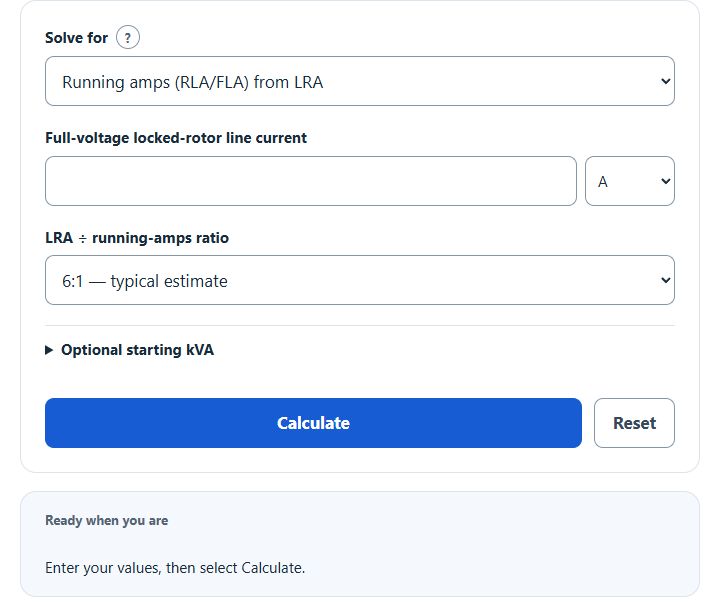
Convert LRA to amps: estimate running amps (RLA/FLA) from locked rotor amps with a typical 6:1 ratio or your motor’s own ratio, plus starting kVA.
Related Calculators
- Single Phase Power Calculator
- Charge to Current Calculator
- Phasor Calculator
- Secondary Voltage Calculator
- All Physics Calculators
Calculator Functions
| Function | What it does | What it requires |
|---|---|---|
| Running amps (RLA/FLA) from LRA | Estimates a motor’s running current from its locked rotor amps | Requires the full-voltage locked-rotor line current and an LRA to running-amps ratio |
| LRA from running amps | Estimates locked rotor amps from the running current | Requires the running line current and an LRA to running-amps ratio |
| LRA ÷ running-amps ratio from two currents | Finds the ratio between a motor’s locked-rotor current and its running current | Requires the full-voltage locked-rotor line current and the running line current |
The ratio is picked from 6:1 (the typical estimate), 5:1, 7:1 or 8:1, or entered from the motor’s own data. Currents can be entered in A or kA. An optional setting adds starting apparent power in kVA, which needs the supply voltage, the phase and a starting method: full voltage, wye-delta, or a soft starter or custom percentage of LRA.
LRA to Amps Formulas
| A | Estimated running current (A) |
| LRA | Locked rotor amps at full voltage (A) |
| k | Ratio of locked-rotor current to running current |
LRA is already a current in amps. It is the current a motor draws at the moment of starting, and the current stays near that value until the motor approaches its operating speed [1]. Turning it into running amps therefore needs the ratio between the two for that motor. A ratio of 6 is the usual rule of thumb for induction motors, and the nameplate code letter fixes the real figure by setting the locked-rotor kVA per horsepower [1].
Running amps (RLA/FLA) from LRA
The locked rotor amps are divided by the ratio. A compressor marked 50 LRA is estimated at 50 ÷ 6 = 8.33 A running at the 6:1 ratio, 10 A at 5:1 and 6.25 A at 8:1. The nameplate RLA or FLA, when it is legible, replaces the estimate.
LRA from running amps
A motor that runs at 10 A is estimated to draw 10 × 6 = 60 A with the rotor locked. The running current entered should be the nameplate full-load value. A reading taken on a lightly loaded motor is lower and gives an LRA that is too low.
LRA ÷ running-amps ratio from two currents
A nameplate showing 72 LRA and 12 RLA has a ratio of 72 ÷ 12 = 6:1. Both currents must be line currents in the same unit.
Starting kVA
1,000 [1]
V is the line-to-line supply voltage of a balanced three-phase motor. A single-phase motor uses V × LRA ÷ 1,000 with no √3. A three-phase 460 V motor with 100 LRA draws 1.732 × 460 × 100 ÷ 1,000 = 79.67 kVA at full voltage. This is apparent power, not kW.
With the wye-delta method the supply sees one third of the full-voltage current and kVA, because connecting the windings in wye for the start triples the impedance the power system sees [2]. Starting torque falls by about the same share. A soft starter has no fixed figure, so the percentage of LRA it is set to deliver has to be entered.
LRA to Horsepower or Tons
LRA alone does not give horsepower. It also takes the voltage, the phase and the nameplate code letter, which states the locked-rotor kVA per horsepower: code G is 5.6 to 6.3 kVA per hp, for example [1]. Horsepower is then about the locked-rotor kVA divided by that figure. The Locked Rotor Amps Calculator does this under Motor hp from LRA and NEMA code.
There is no general conversion from LRA to tons of cooling. Compressor horsepower is not refrigeration capacity, which depends on the refrigerant and the operating conditions and comes from the compressor maker’s performance data.
Limits of This Estimate
- The 5:1 to 8:1 ratios are rules of thumb and not ratings. The ratio for a given motor depends on its design and code letter. These estimates are based on the best available data and estimations.
- LRA is not the peak inrush. For the first half cycle after the contacts close, the current can reach as much as 2.8 times the locked-rotor value [1].
- Nameplate full-load current, the current measured on a running motor and locked-rotor current are three different quantities. None of these results sizes wire, fuses, breakers or overloads, which follow the electrical code and the manufacturer’s instructions.
- The wye-delta figure is the ideal one third for a motor built for that starter. One motor maker puts the real starting current at approximately 30% of normal [2], and the switch from wye to delta causes a second surge that is not modeled.
Sources
- U.S. Department of Energy, Motor Systems Tip Sheet #6, Avoid Nuisance Tripping with Premium Efficiency Motors: locked rotor current during starting, NEMA code letters in kVA per horsepower, the three-phase current formula and peak inrush
- Nidec Motor Corporation, U.S. Motors Product Facts, Wye Start Delta Run: starting current and torque with wye-delta starting