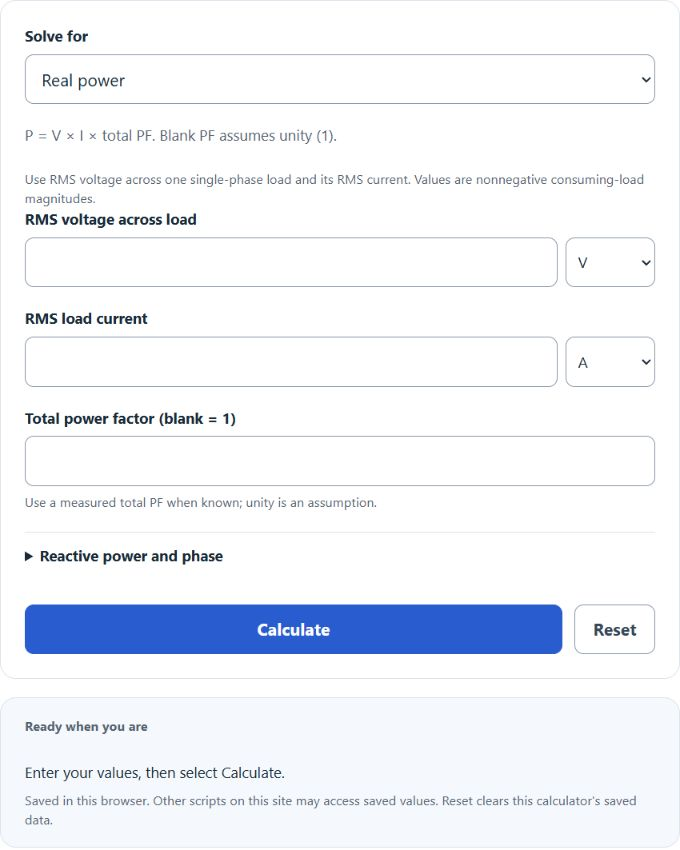
Choose real power, RMS voltage, RMS current, or total power factor as the solve target, then enter the remaining values for one single-phase load. A blank power-factor input assumes unity (1); enter a measured total PF when known.
- All Physics Calculators
- All Electrical Calculators
- Three Phase Power Calculator
- 3 Phase Current Calculator
- Output Power Calculator
- Current Per Phase Calculator
Single Phase Power Formula
The following formula is used to calculate the Single Phase Power.
- P is the consumed single-phase real power (watts)
- V is the RMS voltage across the load terminals (volts), whether line-to-neutral or line-to-line
- I is the RMS current through that load (amps)
- PF is total real-to-apparent power factor, from 0 to 1 for the nonnegative consuming-load values modeled here
Real power is RMS voltage × RMS current × total PF, and apparent power is S = V × I in VA. Total PF includes waveform distortion and is not generally the cosine of a single phase angle. In Reactive power and phase, selecting sinusoidal voltage and current enables |Q| = √(S² − P²) and |phase| = acos(PF); those magnitudes do not identify leading or lagging direction. Inverse solutions require a nonzero divisor; zero apparent power leaves actual PF undefined.
How to Calculate Single Phase Power?
The following example problems outline how to calculate Single Phase Power.
Example Problem #1
- First, determine the input voltage (volts). In this example, the input voltage (volts) is determined to be 16.
- Next, determine the current (amps). For this problem, the current (amps) is measured to be 75.
- Next, determine the total power factor. In this example, PF is 0.4.
- Finally, calculate the Single Phase Power using the formula above:
P = V × I × PF
Inserting the values from above and solving yields:
P = 16 × 75 × 0.4 = 480 W
Example Problem #2
Using the same method as above, determine the variables required by the formula. For this example problem, these are:
input voltage (volts) = 98
current (amps) = 73
total power factor = 0.5
Entering these given values into the calculator or the formula above yields:
P = 98 × 73 × 0.5 = 3,577 W