Calculate balanced three-phase power, voltage, current, or power factor from known RMS line values using volts, amps, and watts, kW, or MW units.
- All Physics Calculators
- All Electrical Calculators
- 3 Phase Current Calculator
- Total Power Calculator
- Current Per Phase Calculator
Three-Phase Power Formula
In a balanced three-phase system with sinusoidal voltage and current, use RMS line-to-line voltage, RMS line current, and power factor. The real power in watts is the product of those three values and the square root of 3:
P = sqrt(3) * V * I * PF
Apparent power uses the same terms but drops the power factor, because it is the total power the system carries whether or not it does useful work:
S = sqrt(3) * V * I
Reactive power is the part that flows back and forth without doing work. It uses the sine of the phase angle, and the angle comes from the power factor:
Q = sqrt(3) * V * I * sin(arccos(PF))
Rearrange the real power formula to solve for the line current from a known power, or to find the power factor from a known power, voltage, and current:
I = P / (sqrt(3) * V * PF)
PF = P / (sqrt(3) * V * I)
Variables:
- P is the real (active) power in watts (W), often given in kilowatts (kW)
- S is the apparent power in volt-amperes (VA), often given in kilovolt-amperes (kVA)
- Q is the reactive power in volt-amperes reactive (VAR), often given in kVAR
- V is the line-to-line voltage in volts (V)
- I is the line current in amperes (A)
- PF is the power factor, a value from 0 to 1; for sinusoidal voltage and current it equals the cosine of the phase angle
- sqrt(3) is about 1.732, the factor that links line values to the three-phase result
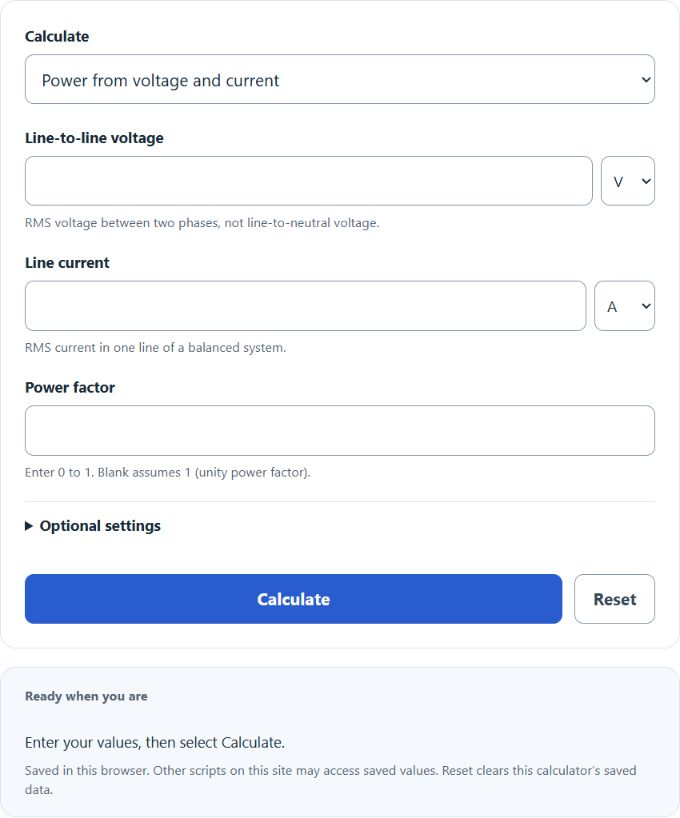
Pick what you want to solve for at the top of the calculator. The default mode takes voltage, current, and power factor and returns real power in kW, apparent power in kVA, and reactive power in kVAR. Switch to the current mode when you know the power and voltage and need the amps, to the voltage mode when you know the power and current, or to the power factor mode when you have the real power, voltage, and current. Choose real or apparent power in the current and voltage modes; apparent power needs no power factor. Blank power factor assumes 1. HP is an equivalent unit of electrical input power; a motor shaft rating requires efficiency. Always enter line-to-line voltage rather than line-to-neutral voltage.
Typical Power Factors and Line Current at Common Voltages
Power factor is the value people most often have to estimate. Use the first table to pick a starting point for a load type, then replace it with a measured figure when you have one. The second table lists common three-phase line voltages and the line current that a 100 kVA load draws at each, so you can sanity check the amps the calculator returns.
| Load type | Typical power factor |
|---|---|
| Resistive heaters | 1.0 |
| Incandescent lighting, direct supply | Approximately 1.0 |
| LED lighting | Varies with driver; use manufacturer specifications |
| Induction motors at full load | 0.85 to 0.90 |
| Induction motors at light load | 0.50 to 0.70 |
| Arc welders | 0.50 to 0.70 |
| Mixed industrial load | 0.85 to 0.95 |
These are approximate. A lightly loaded induction motor generally has a lower power factor: its real-power demand decreases while its magnetizing reactive current remains approximately constant.
| Line-to-line voltage | Line current for a 100 kVA load |
|---|---|
| 208 V | 277.6 A |
| 230 V | 251.0 A |
| 400 V | 144.3 A |
| 415 V | 139.1 A |
| 480 V | 120.3 A |
| 600 V | 96.2 A |
Example Problems
Example 1: Find the power from voltage and current.
A balanced load runs at 400 V line-to-line, draws 100 A per line, and has a power factor of 0.87. Work out each type of power:
P = sqrt(3) * 400 * 100 * 0.87 ≈ 60,275 W, or about 60.3 kW.
S = sqrt(3) * 400 * 100 ≈ 69,282 VA, or about 69.3 kVA.
Q = sqrt(3) * 400 * 100 * sqrt(1 – 0.87²) ≈ 34,160 VAR, or about 34.2 kVAR in magnitude.
Example 2: Find the line current from the power.
A three-phase motor draws 50 kW at 480 V with a power factor of 0.9. First find the apparent power, then divide by the square root of 3 times the voltage:
S = 50 / 0.9 ≈ 55.56 kVA. I = (50,000 / 0.9) / (sqrt(3) * 480) ≈ 66.8 A.
Frequently Asked Questions
Do you use line voltage or phase voltage in the three-phase power formula?
Use the line-to-line voltage, which is the voltage measured between any two of the three phase conductors. The square root of 3 in the formula already converts between line and phase quantities, so if you enter the line-to-neutral (phase) voltage by mistake the result comes out too low. On a 400 V system the line-to-line voltage is 400 V and the line-to-neutral voltage is about 231 V, so mixing them up changes the answer by a factor of 1.732.
Is the formula the same for wye and delta connections?
Yes. When you work in line values, P = sqrt(3) * V * I * PF holds for both wye (star) and delta systems. The connection only changes how the line values relate to the per-phase values. In a wye connection the line voltage is sqrt(3) times the phase voltage and the line current equals the phase current. In a delta connection the line voltage equals the phase voltage and the line current is sqrt(3) times the phase current. Because the total power comes out the same either way, you can use the line-to-line voltage and line current without knowing the connection type.
Why is there a square root of 3 in three-phase power?
Total real power is the sum of the three phase powers. For a balanced sinusoidal load it is 3 times the per-phase power. The 120-degree phase relationship makes wye line-to-line voltage sqrt(3) times phase voltage, or delta line current sqrt(3) times phase current. Expressing the total in RMS line values therefore gives P = sqrt(3) * V * I * PF.