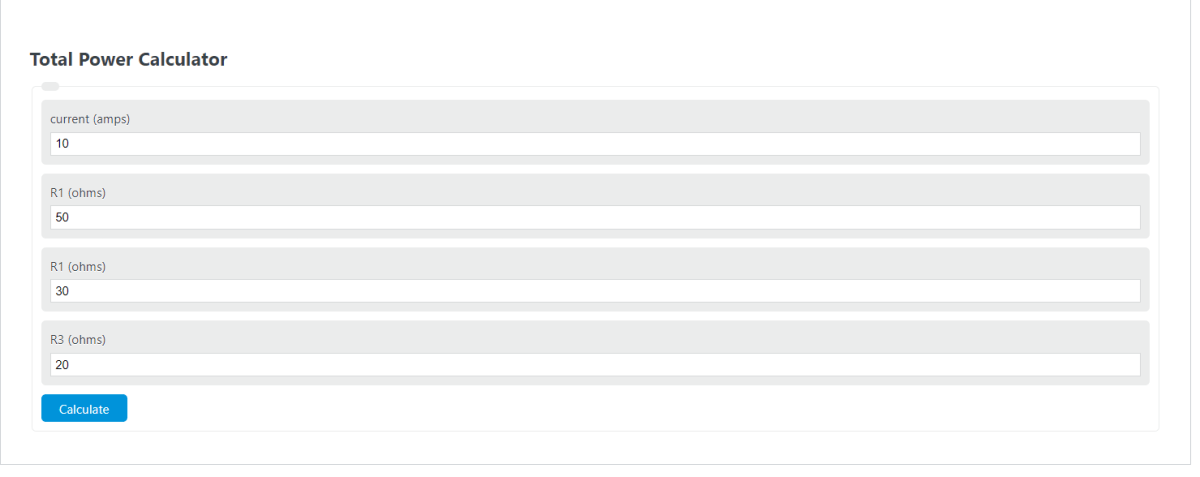
Calculate total power or a missing current or resistance in a circuit from current, R1, R2, R3, with selectable A, Ω, and W units.
- All Physics Calculators
- All Electrical Calculators
- Series Current Calculator
- Series Voltage Calculator
- Total Current Calculator
- Total Voltage Calculator
Understanding Total Power
This calculator finds the total power dissipated by up to three resistances when the same current flows through each one. That makes it especially useful for series circuits and other same-current resistive paths.
Total Power Formula
Pₜ = I²R₁ + I²R₂ + I²R₃
If you first combine the resistances, the equation becomes even simpler:
Rₜ = R₁ + R₂ + R₃
Pₜ = I²Rₜ
| Symbol | Meaning | Typical Unit |
|---|---|---|
| Pt | Total power dissipated by all resistances combined | W |
| I | Circuit current through each resistance | A |
| R1, R2, R3 | Individual resistance values | Ω |
| Rt | Total resistance | Ω |
| V | Total voltage across the circuit | V |
How to Calculate Total Power
- Add the resistance values to get the total resistance.
- Square the current value.
- Multiply the squared current by the total resistance.
- The result is the total power in watts.
Examples
If the current is 10 A and the three resistances are 50 Ω, 30 Ω, and 20 Ω:
Pₜ = 10²(50 + 30 + 20) = 10000 W
If the current is 4 A and only two resistances are used, 5 Ω and 7 Ω, the unused resistance contributes 0:
Pₜ = 4²(5 + 7 + 0) = 192 W
Quick Reference
| Change | Effect on Total Power |
|---|---|
| Current doubles | Total power becomes 4 times larger |
| Current is cut in half | Total power becomes 1/4 as large |
| All resistances double | Total power doubles |
| Another series resistance is added | Total power increases with the total resistance |
If You Know Voltage Instead of Current
When total voltage is known, find current from the total resistance first, or compute power directly from voltage and total resistance:
I = (V) / (Rₜ)
Pₜ = (V²) / (Rₜ)
Common Input Errors
- Using this same-current formula for a parallel circuit without first finding branch power correctly.
- Mixing units such as mA, A, kA, Ω, and kΩ without converting them consistently.
- Forgetting that current is squared, which makes power rise very quickly as current increases.
- Adding resistance values incorrectly before calculating total power.