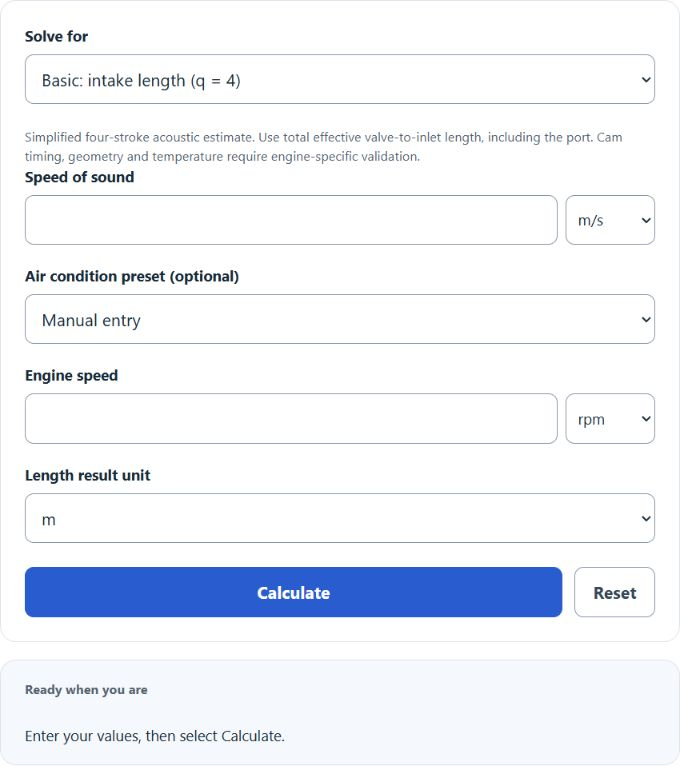
Select intake length, engine speed or sound speed and enter the two known values. Pulse mode estimates length from target RPM using fixed sound speed and a selected frequency ratio.
Intake Length Formula
The following simplified quarter-wave relationship estimates effective intake length for a four-stroke engine using a pipe-frequency to intake-event-frequency ratio:
Variables:
- L is the estimated tuned intake runner length (meters)
- c is the speed of sound in the intake air (meters per second)
- N is the engine speed (revolutions per minute)
- H is the pipe-frequency to intake-event-frequency ratio (dimensionless, 3, 4 or 5); the widget labels this ratio q
For a 4-stroke engine, each cylinder has one intake event every two crank revolutions, so the intake-event frequency is N/120 in events per second. This model uses ratios of 3, 4 or 5. The Basic modes use H = q = 4, giving L = 7.5c/N with N in RPM. Pulse mode fixes sound speed at 1100 ft/s (335.28 m/s): legacy options 2, 3 and 4 correspond to ratios 3, 4 and 5 and coefficients 132000, 99000 and 79200 in·rpm. Its displayed RPM intervals are illustrative offsets, not predicted torque bands.
What is Intake Length?
In this context, intake length (often called intake runner length) is the effective distance from the intake valve/port to the runner inlet (plenum entry, bellmouth, or open end) used for pressure-wave tuning. Changing runner length alters when reflected pressure waves arrive back at the intake valve, which can improve cylinder filling over a chosen RPM range. The actual effective length can differ from the physical length because of geometry and “end correction” effects.
How to Calculate Intake Length?
The following steps outline how to estimate a tuned Intake Length.
- Determine the speed of sound (c) in the intake air (m/s). (It depends mainly on air temperature.)
- Determine the engine speed (N) in RPM.
- Use the fixed ratio H = q = 4 in Basic modes, or choose a frequency-ratio option in Pulse mode. Higher ratios shorten the effective length at a fixed RPM and sound speed.
- Use the formula L = 30c/(NH) to estimate the runner length (L) in meters.
- Check your result with the selected Basic solve (fixed H = q = 4). Validate physical runner design against valve timing, geometry and engine testing; effective acoustic length includes the port and end effects.
Example Problem:
Use the following variables as an example problem to test your knowledge.
Speed of sound (c) = 343 meters per second
Engine RPM (N) = 3000 RPM (using H = 4, L ≈ 0.8575 m)