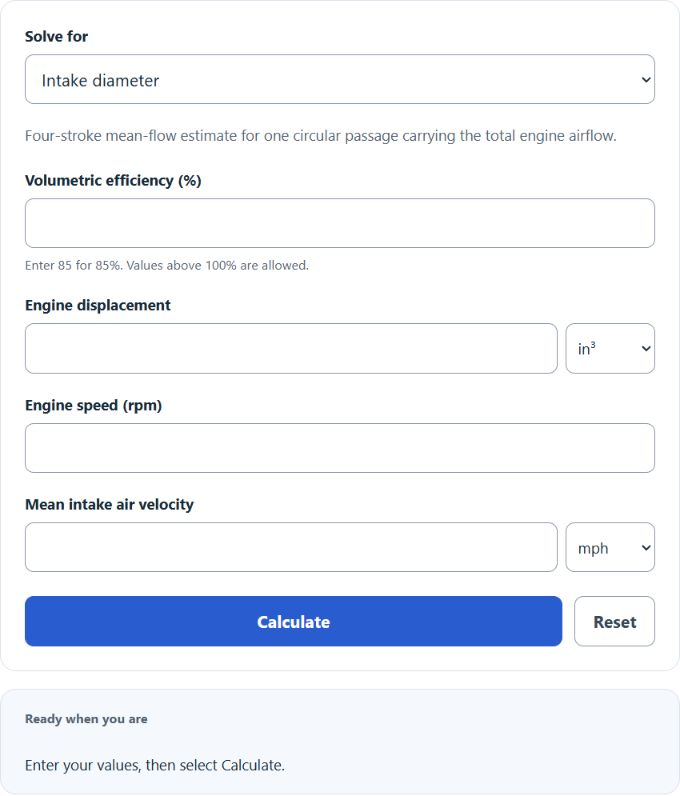
Choose intake diameter, VE, displacement, RPM, or mean air velocity, then enter the other four inputs. This is a four-stroke, steady-flow estimate for one circular passage carrying total engine airflow.
- All Automotive Calculators
- Exhaust Diameter Calculator
- Supercharger RPM Calculator
- Boost to HP Calculator
- Piston Speed Calculator (mean)
- CID Calculator
- Engine Hours to Miles
Engine Intake Diameter Formula
The calculator uses engine displacement, volumetric efficiency, engine speed, and target intake air velocity to solve for the missing value. The base units are cubic inches for displacement, RPM for engine speed, MPH for intake air velocity, and inches for intake diameter.
- D = engine intake diameter, in inches
- VE = volumetric efficiency, entered as a percent
- CID = engine displacement, in cubic inches
- RPM = engine speed, in revolutions per minute
- S = intake air velocity, in miles per hour
- pi = 3.14159…
When you select intake diameter, the calculator uses the formula above. The other functions are rearrangements of the same relationship:
- Calculate diameter: enter VE, CID, RPM, and intake air velocity, then select the corresponding solve mode.
- Calculate intake air velocity: enter VE, CID, RPM, and diameter, then select the corresponding solve mode.
- Calculate VE: enter CID, RPM, intake air velocity, and diameter, then select the corresponding solve mode.
- Calculate CID: enter VE, RPM, intake air velocity, and diameter, then select the corresponding solve mode.
- Calculate RPM: enter VE, CID, intake air velocity, and diameter, then select the corresponding solve mode.
Typical VE and Unit Reference Values
These VE values are illustrative assumptions, not validated ranges for every engine. Use measured or documented VE at the operating RPM. Boosted or pulsating flow requires additional pressure, density, and timing information outside this calculator’s constant-density model.
| Engine type or condition | Illustrative VE assumption | Notes |
|---|---|---|
| Stock naturally aspirated street engine | 75% to 90% | An assumed example; confirm VE for the engine and RPM. |
| Well-tuned naturally aspirated performance engine | 90% to 105% | The calculator allows VE above 100%; verify its definition and reference density. |
| Forced induction engine | 100%+ | Boosted engines need extra context because pressure ratio changes the air mass calculation. |
| Quantity | Conversion used |
|---|---|
| Displacement | 1 liter = approximately 61.0237441 cubic inches |
| Velocity | 1 km/h = 1 / 1.609344 mph |
| Diameter | 1 inch = 25.4 mm = 2.54 cm |
Example Problems
Example 1: Calculate engine intake diameter
You have a 350 CID engine, 85% VE, 6000 RPM, and a target intake air velocity of 250 mph.
The result is approximately 2.0747 inches.
Example 2: Calculate intake air velocity
You have a 5.7 L engine, 90% VE, 5500 RPM, and a 75 mm intake diameter. First, the calculator converts 5.7 L to 347.8351 CID and 75 mm to 2.9528 inches.
The result is approximately 119.05 mph.
FAQ
What does VE mean in this calculator?
VE means volumetric efficiency. It describes how effectively the engine fills its cylinders compared with its theoretical displacement. Enter VE as a percent, such as 85 for 85%, not 0.85.
Should the intake diameter be for one runner or the main intake tube?
Use the circular passage carrying the total engine airflow, such as a single main intake tube. This mean-flow model does not size an individual runner: runner flow is intermittent and needs a separate cylinder-flow and valve-timing model.
Why does a higher target air velocity give a smaller diameter?
For the same engine displacement, RPM, and VE, a smaller opening makes air move faster. A larger opening lowers velocity. This calculator uses that area and velocity relationship to solve for the missing value.