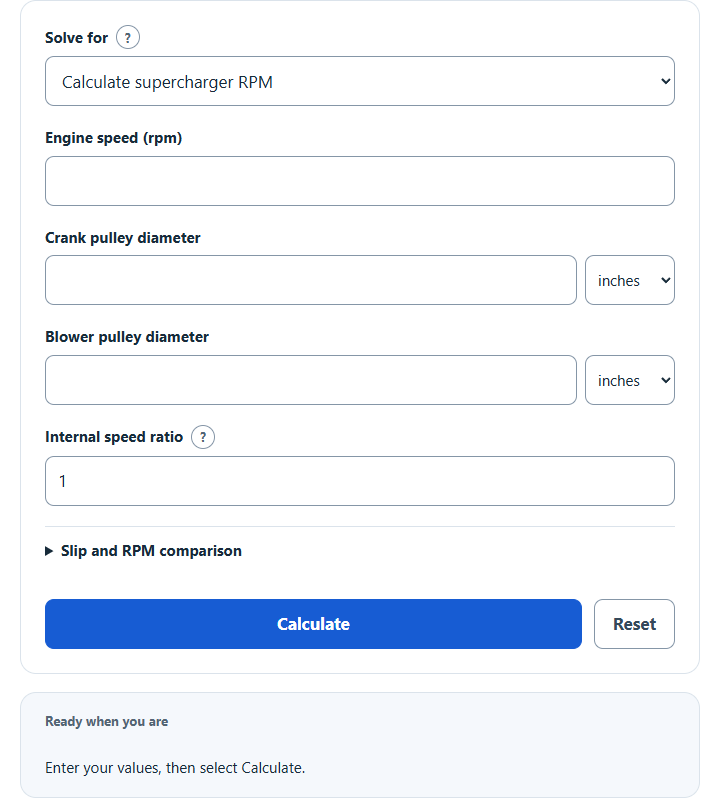
Calculate supercharger RPM from engine RPM and crank and blower pulley sizes, or solve the pulley size or engine RPM for a target blower speed.
- All Automotive Calculators
- Boost to HP Calculator
- Final Drive Ratio Calculator
- Wheel Speed Calculator
- Exhaust Diameter Calculator
- RPM to Horsepower Calculator
Supercharger RPM Formula
The component-speed model combines engine RPM, the external pulley ratio, the internal speed ratio I, and estimated external belt slip s in percent. Setting I = 1 reports pulley/input-shaft speed; use the exact manufacturer ratio to model an impeller or rotor.
- Ncomponent is the modeled speed of the component represented by I; s is estimated external belt slip in percent
- CD is the crank drive-pulley diameter, measured using the manufacturer’s diameter convention
- SCD is the driven supercharger pulley diameter, converted to the same unit as CD
- ERPM is the engine RPM
Let k = CD/SCD and f = 1 − s/100. The operating estimate is ERPM × k × I × f. Blower diameter = ERPM × CD × I × f / target RPM; crank diameter = target RPM × SCD / (ERPM × I × f). The engine threshold at an entered component-speed limit uses zero slip: limit / (k × I). A separate slip-modeled threshold is an operating estimate and must not be treated as a safe ceiling.
What is a Supercharger RPM?
Definition:
Specify which rotating component the RPM describes. Input-shaft speed differs from impeller or rotor speed when internal multiplication is present. Verify the exact model’s ratio and maximum speed, and use the same speed reference for the comparison. Assumed slip can decrease or disappear; the no-slip threshold does not certify safe operation or compatible hardware. This model covers one direct belt stage, not a jackshaft, cog drive, boost prediction, or multistage system. See the Rotrex Technical Handbook, Vortech belt-slip and pulley guidance, and Vortech configuration-specific speed calculators.
What internal speed ratio should I enter for a ProCharger?
Use the step-up ratio for your exact head unit. ProCharger lists 4.10:1 for the P-1SC-1, P-1X, D-1SC and D-1X, 4.44:1 for the D-1, and 5.40:1 for the F-1, F-1A and F-1X. Enter the first number in Internal speed ratio to calculate impeller RPM. Check the specifications for your model and drive configuration before comparing that result with the impeller speed limit.
Can pulley size tell me how much boost I will make?
A smaller driven pulley increases the modeled supercharger speed at the same engine RPM, but there is no fixed PSI gain per pulley size. The same pulley ratio can produce different manifold pressure on different setups. Boost depends on the supercharger’s airflow at that speed, how much air the engine draws, and losses through the intake and intercooler. This calculator compares speeds. Use measured manifold pressure or compressor data for the specific engine and supercharger setup to assess boost.
How to Calculate Supercharger RPM?
Example Problem:
This example calculates pulley/input-shaft speed with internal ratio I = 1 and belt slip s = 0%. It does not specify an impeller ratio or certify a safe speed for a particular head unit.
First, determine the crank diameter. For this example, the crank diameter is measured to be 4.5 inches.
Next, determine the supercharger diameter. The supercharger diameter for this problem is measured to be 3.5 inches.
For this example, use an engine speed of 5,000 rpm. This is an illustrative input, not a manufacturer operating limit.
Finally, calculate the no-slip input-shaft speed using the external pulley ratio:
Ninput = ERPM × CD / SCD
Ninput = 5,000 × 4.5 / 3.5
Ninput ≈ 6,428.57 rpm. For an impeller/rotor estimate, multiply by its specified internal ratio and the entered belt-delivery fraction.