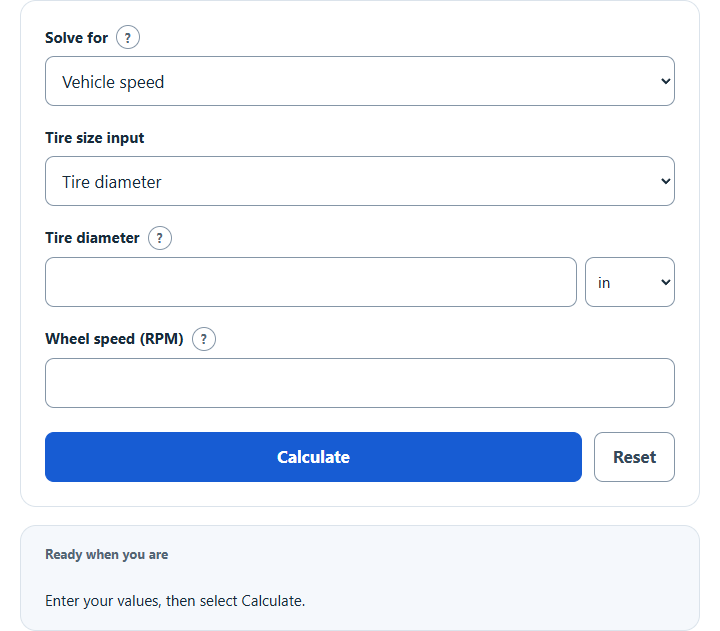
Calculate vehicle speed in mph or km/h from wheel RPM and tire diameter or tire size code, or find wheel RPM from speed or the rolling diameter.
- All Automotive Calculators
- Rev Per Mile Calculator
- Wheel Horsepower Calculator
- Wheel Rate Calculator
- RPM Tire Size Calculator (Vehicle Speed from Engine RPM)
Calculator Functions
| Function | What it does | What it requires |
|---|---|---|
| Vehicle speed | Finds road speed in mph, km/h and m/s from how fast the wheel turns | Requires wheel RPM and the tire diameter or tire code |
| Wheel RPM | Finds how many times per minute the wheel turns at a given road speed | Requires vehicle speed and the tire diameter or tire code |
| Tire diameter | Finds the rolling diameter that matches a measured speed and wheel RPM | Requires vehicle speed and wheel RPM |
Tire size goes in as a diameter in in, mm, cm, m or ft, or as the three numbers of a metric tire code such as 225/45R17. Speed goes in as mph, km/h, m/s or ft/s. Every result also lists the tire circumference and the revolutions per mile and per kilometer. The RPM is the wheel’s, so an engine RPM has to be divided by the overall drive ratio first.
Wheel Speed Formulas
| v | Vehicle speed (m/s) |
| D | Rolling diameter of the tire (m) |
| N | Wheel speed (revolutions per minute) |
| 60 | Seconds in a minute, which turns revolutions per minute into revolutions per second |
A wheel that rolls without slipping moves forward one circumference, π × D, for every turn, so its road speed equals its radius times its angular speed [1]. The calculator works in meters and seconds, then converts with 1 in = 0.0254 m and 1 mph = 0.44704 m/s [2].
Vehicle speed
With the diameter in inches, the unit conversions collapse into the single constant 336.13, which is 63,360 inches per mile divided by 60π. A 26 in tire at 800 RPM gives 26 × 800 ÷ 336.13 = 61.88 mph, or 99.59 km/h.
Wheel RPM
In mph and inches this is N = 336.13 × mph ÷ Din. A 26 in tire at 60 mph turns 336.13 × 60 ÷ 26 = 775.7 RPM. At exactly 60 mph the wheel RPM equals the revolutions per mile, because the vehicle covers one mile each minute.
Tire diameter
This returns the effective rolling diameter, the size the tire acts like on the road. A vehicle at 60 mph with its wheels at 800 RPM has a rolling diameter of 336.13 × 60 ÷ 800 = 25.21 in. Zero speed with zero RPM fits any diameter, so the calculator reports that instead of a number.
Diameter from a metric tire code
2 × W × A ÷ 100 [3]
W is the section width in millimeters, A is the aspect ratio and R is the rim diameter in inches. The aspect ratio is the sidewall height as a percentage of the width, and the tire has a sidewall above and below the rim [3]. A 225/45R17 tire works out to 25.4 × 17 + 2 × 225 × 45 ÷ 100 = 634.3 mm, or 24.97 in. At 65 mph that tire turns 874.9 RPM.
How to Calculate RPM from Speed
Multiply the speed in mph by 336.13 and divide by the tire diameter in inches. For metric units, divide the speed in km/h by 3.6 to get m/s, multiply by 60, then divide by π times the diameter in meters. The answer is wheel RPM. Engine RPM is higher by the overall drive ratio, which is the transmission gear ratio times the axle ratio.
Limits of This Estimate
- The formulas assume rolling without slip. A spinning drive wheel turns faster than its road speed suggests, and a locked, skidding wheel turns slower [1].
- A tire code gives the nominal diameter of an unloaded tire. Load, inflation pressure and tread wear make the real rolling diameter a little smaller, so a measured diameter is more accurate.
- A larger tire raises road speed only at the same wheel RPM. The result says nothing about engine torque, gearing or whether a tire size fits the vehicle.
Sources
- MIT OpenCourseWare, Classical Mechanics, Chapter 20, Section 20.2: rolling without slipping, where speed equals radius times angular speed, and the skidding and slipping cases
- NIST, Guide for the Use of the International System of Units (SP 811), Appendix B.8: inch, foot, mile and mile per hour in SI units
- NHTSA, Tires, tire labeling: width in millimeters, aspect ratio as height to width, and rim diameter in inches