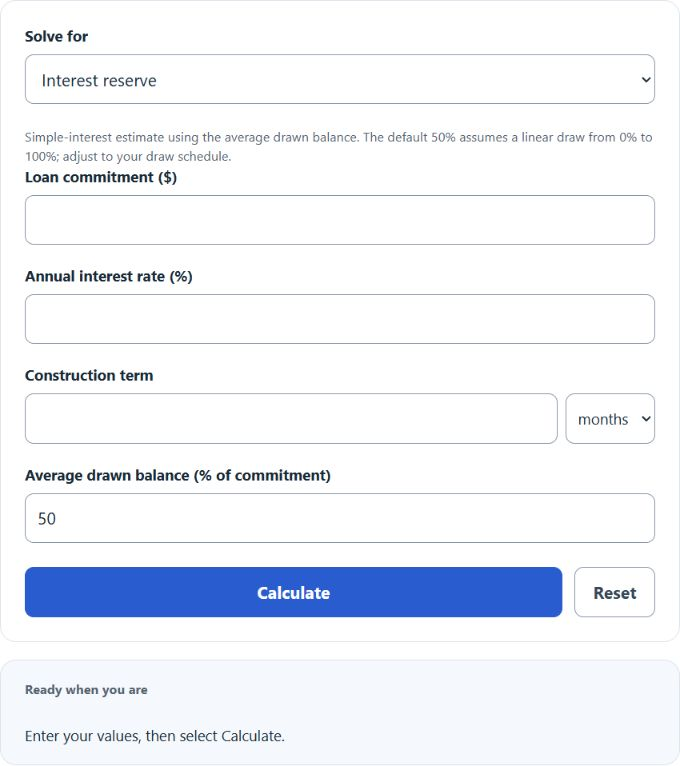
Calculate the interest reserve for a construction loan from the loan amount, interest rate, term, and average outstanding balance, or solve for any one of those inputs.
- All Construction Calculators
- Shift Differential Overtime Calculator
- Profit Interest Units Calculator
Interest Reserve Formula
Interest Reserve = Loan Amount × (Average Balance % ÷ 100) × (Annual Rate % ÷ 100) × (Months ÷ 12)
Where:
Loan Amount is the total committed construction loan. The full amount is rarely outstanding the whole time because funds are drawn as work is completed.
Average Balance % is the share of the loan that is outstanding on average over the construction period. Because draws build up gradually, a steady draw schedule averages near 50%. Use a higher percent when draws are front loaded and a lower percent when they are back loaded.
Annual Rate is the yearly interest rate on the loan, entered as a percent.
Months is the length of the construction term, after which the loan is expected to be fully drawn or refinanced.
Multiplying the loan by the average balance percent gives the average outstanding balance. Multiplying that by the annual rate gives the yearly interest, and the months over twelve scales it to the construction term. To solve for the loan amount, rate, or term instead, the calculator rearranges the same formula.
Average Balance and Reserve Reference
The table below shows how the average balance assumption changes the reserve on a $1,000,000 loan at 8% interest over 12 months.
| Draw Pattern | Average Balance % | Interest Reserve |
|---|---|---|
| Back loaded draws | 40% | $32,000 |
| Steady draws | 50% | $40,000 |
| Front loaded draws | 60% | $48,000 |
| Fully funded at close | 100% | $80,000 |
A fully funded loan uses 100% if the entire balance accrues interest throughout the term. The 40%, 50% and 60% values above are illustrative assumptions, not a universal range; estimate the time-weighted average from your draw schedule.
Example
You are sizing the interest reserve on a $2,000,000 construction loan. The annual rate is 9%, the construction term is 18 months, and draws are expected to be steady, so you use a 50% average balance.
Average outstanding balance is $2,000,000 × 50% = $1,000,000. Annual interest on that balance is $1,000,000 × 9% = $90,000. Scaling to 18 months gives $90,000 × (18 ÷ 12) = $135,000. Enter the four inputs and the calculator returns an interest reserve of $135,000.
FAQ
What is an interest reserve? An interest reserve is a portion of a construction loan set aside to pay the interest that accrues while the property is being built and is not yet producing income. The lender draws from this reserve to cover interest payments during the term.
Why use an average balance instead of the full loan amount? Draws change the outstanding balance during construction. Using the time-weighted average estimates simple interest at a constant rate. A 100% assumption overstates this model only when less than the full balance is outstanding on average. Actual lender calculations may include financed interest, fees and different day-count conventions.
What average balance percent should you use? A linear draw from 0% to 100% averages 50%. Front-loaded draws can produce a higher average and back-loaded draws a lower one. Use the actual planned balances and time intervals rather than treating 40% or 60% as prescribed values.