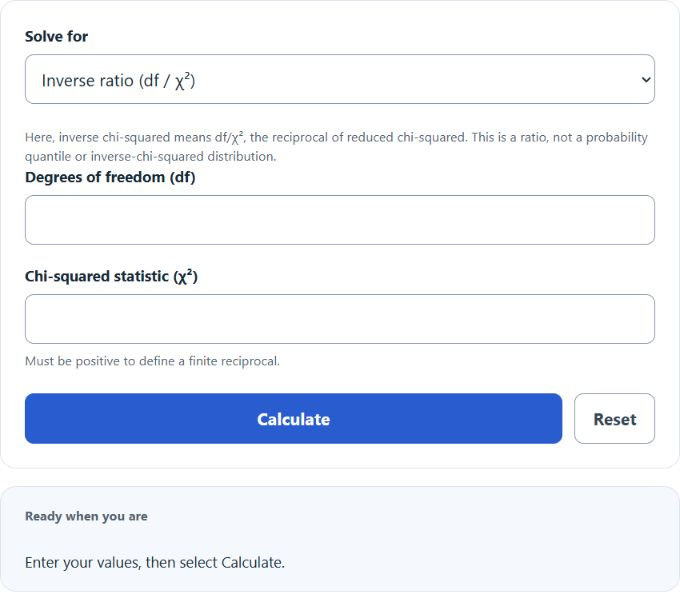
Calculate the inverse chi-squared ratio by entering degrees of freedom and chi-squared value to find the missing df, χ², or df/χ².
Related Calculators
- Inverse Z Score Calculator
- Bayes’ Theorem Calculator
- Cramer’s V Calculator
- Compound Probability Calculator
- 40th Percentile Calculator
- All Statistics Calculators
Inverse (df/χ²) Formula
The following formula is used to calculate df/χ² (the inverse of the reduced chi-squared, χ²/df) for a given number of degrees of freedom and chi-squared statistic.
Variables:
- I is the inverse ratio (df/χ²), i.e., the reciprocal of the reduced chi-squared (χ²/df)
- df is the degrees of freedom
- χ² is the chi-squared statistic
To calculate df/χ², divide the degrees of freedom by the chi-squared value.
What is df/χ²?
On this page, “inverse chi-squared” refers to the simple ratio df/χ², which is the reciprocal of the reduced chi-squared statistic (χ²/df). It is a unitless summary sometimes used when assessing goodness of fit: values near 1 indicate χ² is close to df; values greater than 1 occur when χ² < df; and values less than 1 occur when χ² > df (often interpreted alongside measurement uncertainties and model assumptions). This is different from the inverse-chi-squared (or scaled inverse-chi-squared) probability distribution used in Bayesian statistics, and also different from the inverse chi-squared CDF (the chi-squared quantile function).
How to Calculate df/χ²?
The following steps outline how to calculate df/χ².
- First, determine the degrees of freedom (df).
- Next, determine the chi-squared value (χ²).
- Finally, calculate the inverse ratio using the formula I = df / χ².
- After inserting the values and calculating the result, check your answer with the calculator above.
Example Problem :
Use the following variables as an example problem to test your knowledge.
Degrees of freedom (df) = 10
Chi-squared value (χ²) = 5
Inverse (df/χ²) = 10 / 5 = 2