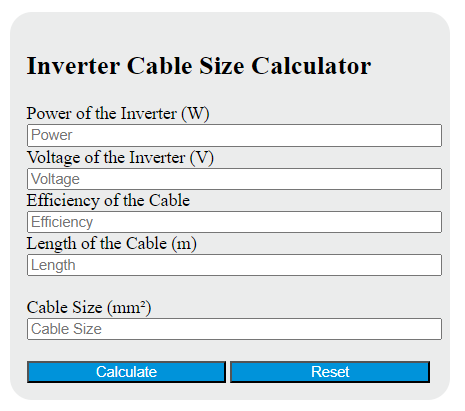
Solve cable area, drop, length, power, voltage, or efficiency, then require explicit ampacity, installation, derating, and surge safety gates.
Related Calculators
- Inverter Size Calculator
- Current Capacity Calculator
- Amps Draw Calculator
- Watts to Amps Calculator
- AWG to mm² Calculator
- Ground Resistance Calculator
- All Construction Calculators
Inverter Cable Size Formula
This calculator estimates the minimum DC cable cross-sectional area needed between a battery bank and an inverter so the cable run stays within an allowable voltage-drop limit. It is especially useful for 12 V, 24 V, and 48 V systems, where current can be high and undersized cable can cause heat, efficiency loss, inverter low-voltage alarms, and poor startup performance.
For inverter input current, the calculator uses the DC-side power relationship:
If allowable voltage drop is entered as a percentage of system voltage, then:
Combining those relationships gives a compact form that shows how cable size changes with power, voltage, efficiency, and distance:
That final form is useful because it shows an important design rule: for the same power, length, efficiency, and allowable percentage drop, higher system voltage dramatically reduces the required cable size.
Variable Definitions
| Variable | Description | Typical Unit |
|---|---|---|
S |
Required cable cross-sectional area | mm² |
ρ |
Conductor resistivity; this calculator assumes copper at approximately 0.0175 Ω·mm²/m | Ω·mm²/m |
L |
One-way cable length from the DC source to the inverter | m |
I |
Estimated DC input current | A |
ΔV |
Permissible voltage drop across the cable run | V |
P |
Inverter power or load | W |
V |
DC input voltage | V |
η |
Inverter efficiency written as a decimal | decimal |
d |
Allowed voltage-drop fraction, such as 0.03 for 3% | decimal |
How to Calculate Inverter Cable Size
- Enter the inverter power in watts.
- Enter the DC input voltage of the battery bank or DC source.
- Enter inverter efficiency as a percentage, then convert it to decimal form for the formula.
- Enter the one-way cable length.
- Estimate the DC input current from power, voltage, and efficiency.
- Set the allowable voltage drop. A tighter limit gives better performance but requires a larger cable.
- Calculate the minimum cross-sectional area, then round up to the next standard cable size.
Important: the length entered is one-way distance only. The formula already accounts for the outgoing and return conductors by multiplying by 2.
Example
Suppose an inverter draws 1000 W from a 12 V system, has 90% efficiency, and the one-way cable length is 3 m. If the allowed voltage drop is 3%, the required cable size is found in three steps.
First, estimate DC input current:
Next, calculate the allowable voltage drop:
Now solve for the minimum conductor area:
The calculated minimum is about 27.01 mm², so in practice you would normally select the next larger standard cable size, which is typically 35 mm².
How Each Input Changes the Result
| Input Change | Effect on Required Cable Size | Reason |
|---|---|---|
| Higher inverter power | Larger cable | More power means more current on the DC side. |
| Longer cable run | Larger cable | Resistance increases with conductor length. |
| Lower system voltage | Much larger cable | Lower voltage requires higher current for the same power. |
| Lower inverter efficiency | Larger cable | More input current is needed to deliver the same output power. |
| Smaller allowable voltage drop | Larger cable | Tighter performance limits require lower resistance. |
| Higher conductor temperature | Usually larger cable | Resistance rises as conductor temperature increases. |
Practical Cable Selection Notes
- Round up, not down: the formula gives a minimum theoretical area. Real installations should use the next standard size above the result.
- Check ampacity separately: voltage-drop sizing is only one requirement. The final cable must also safely carry the expected continuous current.
- Keep DC runs short: battery-to-inverter cables should usually be as short and direct as practical to reduce losses and improve inverter performance.
- Confirm terminals and lugs: a large cable is only useful if the inverter terminals, fuse block, lugs, and disconnects are also rated for that conductor size and current.
- Consider surge demand: many inverters draw short-duration startup or surge currents well above their steady-state level. Make sure the complete DC path can tolerate those peaks.
- Copper assumption: this calculator is based on copper conductors. If you are using a different conductor material, a larger cross-section may be required for the same voltage-drop target.
Common standard metric cable sizes often include 10, 16, 25, 35, 50, 70, 95, and 120 mm². If your result falls between sizes, choose the next larger one.
Inverter Cable Size FAQs
Do I enter one-way length or total loop length?
Enter the one-way length only. The equation already includes the return path by doubling the distance internally.
Why do 12 V inverter systems need such heavy cable?
At low voltage, current rises quickly for a given power level. High current increases voltage drop and heating, so the cable must be much larger than it would be on a 24 V or 48 V system.
Is the calculator result the final cable size I must install?
It is the minimum size based on voltage drop under the calculator assumptions. The final selected cable should also satisfy current capacity, insulation rating, equipment terminal limits, overcurrent protection, and any applicable installation rules.
What happens if the cable is undersized?
Undersized inverter cables can cause excessive voltage drop, reduced inverter efficiency, hot conductors, nuisance low-voltage shutdowns, dimming during load changes, and poor performance during surge events.