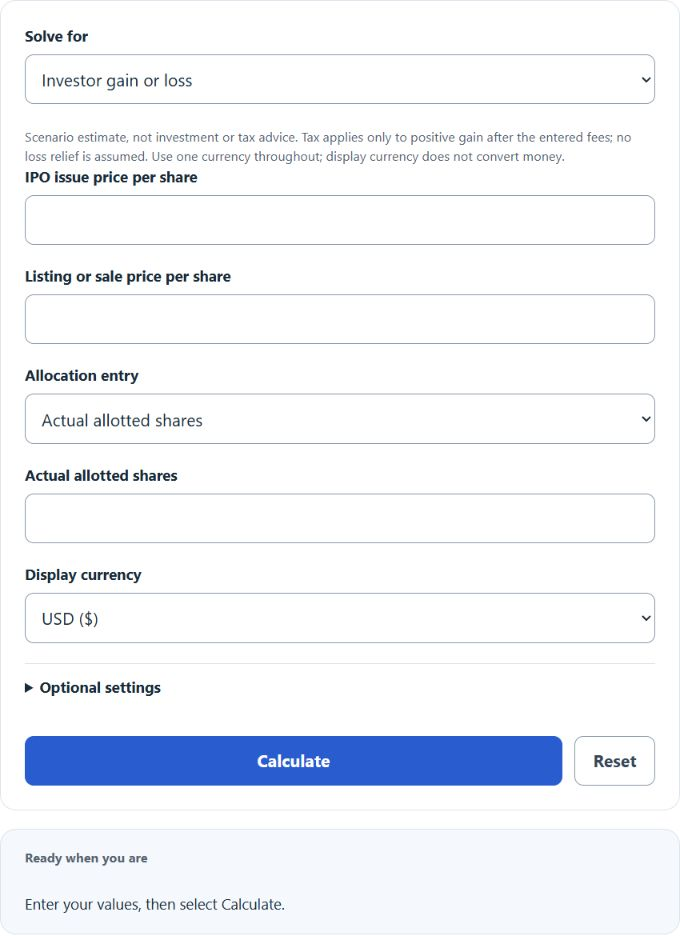
Calculate IPO investor gain from actual allotted shares and fees, find break-even listing price, or keep issuer proceeds and dilution in a separate audited mode.
IPO Formula
The calculator above is most useful for evaluating how an IPO allocation changes in value when the stock begins trading. In practice, users usually compare the offering price to the initial trading price across a chosen number of shares.
Core IPO Calculations
- Vo = value of the shares at the IPO offering price
- Vi = value of the shares at the initial trading price
- G = gross dollar gain or loss
- PC = percentage change from the offer price
- Po = offering price per share
- Pi = initial trading price per share
- S = number of shares analyzed
These equations answer four common IPO questions:
- How much capital was committed at the offer price?
- What is that position worth once trading starts?
- What is the gross dollar gain or loss?
- What percentage did the stock move relative to the IPO price?
How to Use the IPO Calculator
- Enter the Offering Price, which is the price at which the shares were sold in the IPO.
- Enter the Initial Price, which is the first post-listing market price you want to compare against.
- Enter the Shares, using either your allocation or any share count you want to evaluate.
- Investor mode shows gross price change and net gain after your assumed fees and tax. Enter actual allotted shares directly or as lots; application amount is an optional allocation-rate reference. Break-even mode finds the minimum sale price that recovers fees.
If the initial trading price is above the offering price, the result is positive. If it is below the offering price, the result is negative. If both prices are equal, gross price gain is zero; entered fees can still produce a net loss.
Example IPO Calculations
Example 1: Initial Trading Price Above the Offer Price
Suppose a company prices its IPO at $18 per share and the stock begins trading at $24. You receive 500 shares.
In this case, the position shows a gross gain of $3,000, and the stock is trading 33.33% above its offer price.
Example 2: Initial Trading Price Below the Offer Price
Now assume the IPO price is $25, the stock initially trades at $22, and you analyze 200 shares.
That result means the position is down $600, or 12%, relative to the IPO offer price.
What Each Input Means
- Initial Price: the first market reference price after listing. Some investors use the opening trade, while others compare against the first close.
- Offering Price: the official IPO issue price set for the offering.
- Shares: the number of shares awarded, purchased, or evaluated.
Using the correct share count matters. If you requested more shares than you actually received, use the number that was truly allocated to you.
Related IPO Metrics
IPO analysis often goes beyond immediate price change. Two additional measures are gross proceeds raised by the company and market capitalization after the stock begins trading.
- R = gross proceeds raised in the offering
- So = new primary shares sold by the issuer; exclude selling-shareholder shares from company proceeds
- MC = market capitalization at the selected trading price
- SO = total shares outstanding after the offering
- Ownership = percentage ownership represented by your shares
This distinction is important: investor gain depends on the difference between the initial trading price and the offer price, while issuer proceeds depend on the offer price and the new primary shares sold by the company. Proceeds from existing shareholders’ sales belong to those shareholders.
Interpretation Tips
- Positive result: the stock is trading above the issue price, often described as an IPO pop.
- Negative result: the stock is trading below the issue price, meaning the market marked the shares down after listing.
- Larger share counts: increase both gains and losses in a straight-line way.
- Percentage change: helps compare IPO performance across companies with very different offer prices.
Important Notes
- The article price-change formulas are gross. Investor mode additionally subtracts entered fees and a hypothetical tax on positive post-fee gain; actual tax treatment may differ. Issuer mode separately deducts entered proportional offering costs.
- A gain shown at the initial trading price is a paper gain unless the shares are actually sold. Tax estimates assume a sale and apply the entered rate only to positive gain after the entered fees, with no loss relief. The minimum break-even price is issue price + fees / allotted shares; at a hypothetical 100% tax rate, all higher prices also leave zero net gain.
- The term initial price should be used consistently. Mixing the opening trade for one IPO and the first-day close for another can make comparisons less meaningful.
- If you want to measure the company’s total raise, use the proceeds formula rather than the investor gain formula.
Common Questions
Why is the initial trading price different from the IPO price?
The offering price is set before public trading begins. Once the stock lists, supply and demand in the market determine the trading price, which can move above or below the issue price immediately.
Does a higher opening price mean the company raised more money?
Not by itself. The company’s gross raise is tied to the offering price and the number of shares sold in the deal. A higher market price mainly affects aftermarket valuation and investor position value.
Can this calculator be used for partial allocations?
Yes. If you only received part of the shares you requested, enter the actual allocated share count to estimate the correct cost, value, and gain or loss.