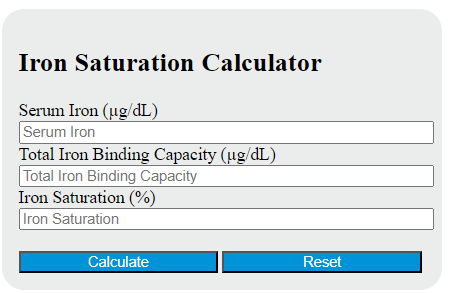
Calculate iron saturation, serum iron, or TIBC by entering any 2 values and find the missing result easily in ug/dL, umol/L, or mg/L.
Note: This calculator is for educational use only and is not medical advice or a diagnosis. Iron tests (including serum iron, TIBC, and transferrin/iron saturation) may help evaluate iron status when interpreted with other labs (such as ferritin and a CBC), your symptoms, and your clinician’s assessment; reference ranges vary by lab. Do not start/stop iron supplements based on this tool alone. Seek urgent care for severe symptoms (e.g., chest pain, fainting, black/tarry stools).
Related Calculators
- HCT Calculator
- Absolute Lymphocyte Count Calculator
- Caffeine Calculator (Total mg caffeine)
- Cycle Phase Calculator
- All Health and Medical Calculators
Iron Saturation Formula
The following formula is used to calculate Iron Saturation.
Variables:
- IS is the Iron Saturation (%)
- SI is the Serum Iron (commonly reported in ug/dL or umol/L)
- TIBC is the Total Iron Binding Capacity (commonly reported in ug/dL or umol/L)
To calculate Iron Saturation, divide the Serum Iron by the Total Iron Binding Capacity, then multiply the result by 100 to get the percentage. If SI and TIBC use the same units, the units cancel. An alternative formula uses transferrin concentration directly: TSAT = (Fe / TF) x 70.9, where TF is the transferrin protein concentration in mg/dL. Research has shown these two methods can produce different estimates; a study of 46 hemodialysis patients found mean TSAT of 28.8% using TIBC versus 24.1% using transferrin concentration.
What is Iron Saturation?
Iron saturation, clinically called transferrin saturation (TSAT), is a blood test that measures the percentage of iron-binding sites on transferrin that are occupied by iron. Transferrin is a glycoprotein synthesized primarily in the liver, and each molecule carries up to two ferric (Fe3+) ions. At any given time, only about one-third of circulating transferrin is loaded with iron, leaving a reserve binding capacity of roughly 67% (the unsaturated iron-binding capacity, or UIBC). The TIBC represents the sum of the iron already bound plus this reserve: TIBC = Serum Iron + UIBC.
TSAT is considered a more sensitive marker for real-time iron availability than serum iron or TIBC measured individually because it captures the ratio between supply and transport capacity. While ferritin reflects stored iron, TSAT reflects circulating iron available for erythropoiesis and enzymatic function at that moment.
Reference Ranges by Sex and Age
Reference ranges depend on age, sex, race, and the specific laboratory assay used. General adult ranges reported across major reference laboratories are as follows.
For adult males, the typical normal range is 20% to 50%. For adult females, the typical normal range is 15% to 50%, though some laboratories set the upper limit at 30% for premenopausal women. Between ages 20 and 70, males tend to have TSAT levels 15 to 20 percentage points higher than females, a gap driven largely by menstrual iron loss and differences in erythropoietic drive. After menopause, female TSAT values tend to rise toward male ranges. In pediatric populations, TSAT below 16% is used as a diagnostic threshold for iron deficiency anemia when anemia is already present.
Clinical Interpretation
A TSAT below 20% generally indicates iron deficiency. Values below 15% are more specific and strongly suggest iron-deficiency anemia. When TSAT drops this low, marrow iron delivery is insufficient for normal red blood cell production, and reticulocyte hemoglobin content falls in parallel.
A TSAT above 50% raises concern for iron overload. At this threshold, the transferrin molecule approaches full saturation, and non-transferrin-bound iron (NTBI) begins to appear in plasma. NTBI is chemically labile and enters cells through unregulated pathways, bypassing the normal transferrin receptor mechanism. Once inside hepatocytes, cardiomyocytes, or endocrine cells, excess iron catalyzes Fenton reactions that generate hydroxyl radicals, damaging lipid membranes, DNA, and proteins. This oxidative injury is the primary mechanism behind organ damage in iron overload conditions: liver fibrosis and cirrhosis, cardiomyopathy, diabetes from pancreatic beta-cell destruction, hypogonadism, and hypothyroidism.
A TSAT between 20% and 50% is considered normal in most clinical contexts, indicating adequate iron availability without overload risk.
Iron Panel Patterns by Condition
Iron saturation is most useful when interpreted alongside the full iron panel. The pattern of results across serum iron, TIBC, TSAT, and ferritin helps differentiate conditions that may appear similar based on a single marker alone.
In iron deficiency anemia, serum iron is low, TIBC is elevated (the body upregulates transferrin production to capture more iron), TSAT is low (typically under 20%), and ferritin is low. In anemia of chronic disease (also called anemia of inflammation), serum iron is low, but TIBC is also low or normal because inflammation suppresses transferrin synthesis via hepcidin upregulation. TSAT may be low or borderline normal, and ferritin is often normal or elevated because it acts as an acute-phase reactant. In iron overload or hereditary hemochromatosis, serum iron is high, TIBC is low to normal, TSAT is elevated (often above 45 to 60%), and ferritin is elevated. In sideroblastic anemia, serum iron is normal to high, TIBC is normal to low, TSAT is elevated, and ferritin is elevated due to ineffective erythropoiesis trapping iron in mitochondrial ring sideroblasts. In acute liver disease, serum iron can spike dramatically as damaged hepatocytes release stored ferritin and iron, TIBC may rise, and TSAT can temporarily exceed normal ranges.
Hemochromatosis Screening Thresholds
Hereditary hemochromatosis (HH) is the most common inherited disorder among people of northern European ancestry. About 80% of cases are caused by homozygosity for the C282Y variant in the HFE gene, with prevalence ranging from approximately 1 in 83 in Ireland to less than 1 in 2,500 in southern Europe. The AASLD recommends a TSAT cutoff of 45% as an initial screening threshold, which identifies 97.9 to 100% of C282Y homozygotes. More specific thresholds are TSAT above 60% in males and above 50% in females, which identify iron metabolism abnormalities with roughly 95% accuracy.
Provisional iron overload criteria for confirmed C282Y homozygotes combine TSAT with ferritin: TSAT above 45% with ferritin above 200 ug/L in premenopausal females, or TSAT above 50% with ferritin above 300 ug/L in males and postmenopausal women. Despite high biochemical penetrance (about 80% of male homozygotes develop elevated ferritin), clinical penetrance, meaning actual organ damage, is much lower and variable. This is why TSAT serves as a gatekeeper test: elevated TSAT prompts HFE genotyping and ferritin monitoring, not immediate treatment.
Factors That Affect TSAT Results
Serum iron (and therefore TSAT) is one of the more volatile routine lab values. Multiple factors introduce variability that clinicians must account for when interpreting a single result.
Diurnal variation is significant. Serum iron follows a circadian rhythm with levels highest between approximately 8:00 AM and 3:00 PM, peaking around 11:00 AM in men and noon in women. Evening and overnight values can be substantially lower. This rhythm persists even in constant darkness, indicating it is driven by endogenous circadian clock genes rather than light exposure alone. Fluctuations of up to 17% from peak to trough have been documented.
Fasting status also plays a role. Blood collection after 5 to 9 hours of fasting provides a representative estimate, but overnight fasting of 12 or more hours can paradoxically elevate serum iron beyond usual levels. There is no consensus on whether fasting samples are superior to random samples for TSAT measurement, and practice varies between laboratories and clinical guidelines.
Inflammation is a major confounder. Hepcidin, the master regulator of iron metabolism, is upregulated by inflammatory cytokines (especially IL-6). Elevated hepcidin blocks iron release from macrophages and enterocytes, lowering serum iron and TSAT even when total body iron stores are adequate or elevated. This makes TSAT more reliable than ferritin in inflammatory states for detecting functional iron deficiency, since ferritin rises as an acute-phase protein while TSAT more accurately reflects true iron availability.
Other factors that can shift TSAT include recent oral iron intake (can transiently spike serum iron), pregnancy (expanded plasma volume dilutes transferrin saturation), oral contraceptive use (increases transferrin production, raising TIBC and lowering TSAT), liver disease (affects transferrin synthesis), and nephrotic syndrome (urinary protein loss includes transferrin).
TSAT in Chronic Kidney Disease and Heart Failure
TSAT has particular clinical importance in chronic kidney disease (CKD) and heart failure (HF), where iron deficiency is common but harder to diagnose because of chronic inflammation. Current guidelines for both conditions rely on the combination of TSAT and ferritin to define iron deficiency and guide intravenous iron therapy. In CKD patients on dialysis, a TSAT below 20% combined with ferritin below 200 ug/L is the standard threshold for iron supplementation. In heart failure, the threshold is TSAT below 20% or ferritin below 100 ug/L (or ferritin 100 to 299 ug/L with TSAT below 20%). These cutoffs are higher than those used in the general population because inflammation artificially raises ferritin, making it an unreliable sole marker in these conditions.