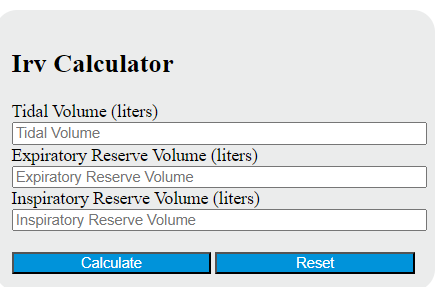
Calculate inspiratory reserve volume or solve a related lung-volume identity using measurements in liters or milliliters. Use values from the same test and review the complete report for interpretation.
IRV and Lung-Volume Formulas
Inspiratory reserve volume belongs to a family of static lung-volume identities. Vital capacity equals the three volumes that can move between a maximal inspiration and maximal expiration:
The same identity can solve VT = VC − IRV − ERV or ERV = VC − IRV − VT. Related capacities use:
IRV is inspiratory reserve volume, VT is tidal volume, ERV is expiratory reserve volume, RV is residual volume, VC is vital capacity, IC is inspiratory capacity, FRC is functional residual capacity, and TLC is total lung capacity. This calculator converts every input to liters internally; 1 L equals 1,000 mL.
What Inspiratory Reserve Volume Means
IRV is the additional volume that can be inspired after the end of a normal tidal inspiration. It is a volume, not a capacity. Inspiratory capacity combines tidal volume and IRV, while vital capacity also includes ERV. IRV should also be distinguished from forced inspiratory measurements, which depend on a maneuver and may be reported with different definitions.
The equations on this page are accounting identities. They can check the arithmetic relationship among compatible measurements, but they do not transform estimated or mismatched inputs into a validated pulmonary function test. The source, testing session, method, posture, and quality of each value remain important.
How to Use the Four-Value Solver
- Select the IRV / VT / ERV / VC solver.
- Enter exactly three of the four values. Leave the value to solve empty.
- Select L or mL separately for every entered value and the desired result.
- Calculate. The tool normalizes units and applies VC = IRV + VT + ERV.
- If solving a component, confirm that VC is greater than the sum of the other two components. An equal or smaller VC is inconsistent because it would leave a zero or negative volume.
The capacity mode requires positive IRV, VT, ERV, and RV values from compatible data. The RV/TLC mode requires both positive volumes and rejects RV equal to or larger than TLC. Those checks enforce the identities; they do not decide whether a valid percentage is clinically expected.
Lung Volumes vs Lung Capacities
| Quantity | Type | Identity used here |
|---|---|---|
| VT, IRV, ERV, RV | Four nonoverlapping volumes | TLC = IRV + VT + ERV + RV |
| IC | Capacity | VT + IRV |
| FRC | Capacity | ERV + RV |
| VC | Capacity | IRV + VT + ERV |
| TLC | Capacity | VC + RV |
A capacity combines two or more volumes; it is not another nonoverlapping compartment. Adding a capacity to its component volumes would double count them. For example, TLC equals VC plus RV, not VC plus IRV plus VT plus ERV plus RV, because VC already contains IRV, VT, and ERV.
Worked Example: Solve IRV
Assume VC is 4.5 L, VT is 0.5 L, and ERV is 1.0 L. Then:
The 3.0 L result is an arithmetic example, not a predicted value or reference limit. Clinical interpretation would require appropriate reference equations, test quality, and individual context.
Worked Example: Mixed Units
Suppose VC is 4,500 mL, VT is 0.5 L, and ERV is 1,000 mL. Convert before subtracting: 4,500 mL = 4.5 L and 1,000 mL = 1.0 L. The same equation gives 3.0 L, which equals 3,000 mL. Subtracting 0.5 directly from 4,500 without unit conversion would be meaningless.
Worked Example: Lung Capacities
For IRV 3.0 L, VT 0.5 L, ERV 1.0 L, and RV 1.2 L, the calculator returns VC 4.5 L, IC 3.5 L, FRC 2.2 L, and TLC 5.7 L. Using the same RV and TLC gives RV/TLC = 100 × 1.2 ÷ 5.7 = 21.0526%. The percentage describes the entered measurements only.
How Lung Volumes Are Measured
Routine spirometry measures air that moves through the mouth, but residual volume remains in the lungs after maximal expiration and cannot be exhaled into a spirometer. Because FRC and TLC include RV, they also require more than ordinary simple spirometry. Complete lung-volume testing may use body plethysmography or gas dilution or washout techniques, each with method-specific procedures and limitations.
Laboratory standards address calibration, acceptability, repeatability, linked spirometry maneuvers, and quality grading. Values combined in one identity should come from a compatible measurement framework, preferably the same session and method when required. A calculator cannot detect a leak, incomplete maneuver, poor panting technique, gas trapping missed by a dilution method, or a value copied from an unrelated report.
Interpreting IRV and RV/TLC Safely
There is no single absolute IRV or RV/TLC number that is normal for everyone. Interpretation uses validated reference equations and appropriate limits, often expressed with z-scores, while considering age, height, sex-related reference inputs, ancestry or reference-population applicability, posture, testing method, and biological variability. The 2022 ERS/ATS interpretive standard also emphasizes uncertainty, test quality, and clinical expertise.
A mathematically consistent identity does not establish restriction, obstruction, air trapping, or hyperinflation. For example, TLC and RV/TLC may contribute to those assessments, but their meaning depends on measured values, reference limits, test quality, other pulmonary function results, symptoms, imaging, and the clinical question. This calculator intentionally does not attach diagnostic labels or severity categories.
Common Input Errors
- Mixing liters and milliliters without selecting the correct unit for each field.
- Using forced vital capacity in place of a reported VC without considering the testing context.
- Combining RV with VC or other volumes from a different session or incompatible method.
- Accepting RV equal to or greater than TLC, which conflicts with the component identity.
- Treating a value derived by subtraction as though it were independently measured.
- Comparing an absolute result with an unadjusted “normal” table instead of an applicable reference equation.
Frequently Asked Questions
Can spirometry measure RV or RV/TLC?
Not by routine simple spirometry alone, because RV cannot be exhaled. Complete lung-volume methods are needed to obtain RV and capacities that contain it.
What is the difference between IRV and IC?
IRV is the extra volume inspired after a normal inspiration. IC is a capacity that includes both the preceding tidal volume and IRV: IC = VT + IRV.
Why can lung-volume values vary?
Biological variability, posture, effort, test technique, equipment, method, and data quality can all contribute. Comparisons are strongest when methods and conditions are documented and compatible.
Is calculated IRV the same as a laboratory measurement?
It is the value implied by the entered identity. Its reliability cannot exceed the reliability and compatibility of VC, VT, and ERV used in the subtraction.
Does one absolute range define normal IRV?
No. Use appropriate reference equations, quality information, and clinical context rather than a universal absolute interval.
Medical note: This calculator performs educational lung-volume arithmetic. It does not replace an accredited pulmonary function report or clinician interpretation.
Primary and current sources: 2023 ERS/ATS lung-volume measurement standard and its published correction; 2022 ERS/ATS interpretive standard; 2019 ATS/ERS spirometry standard; and GLI static lung-volume reference values.