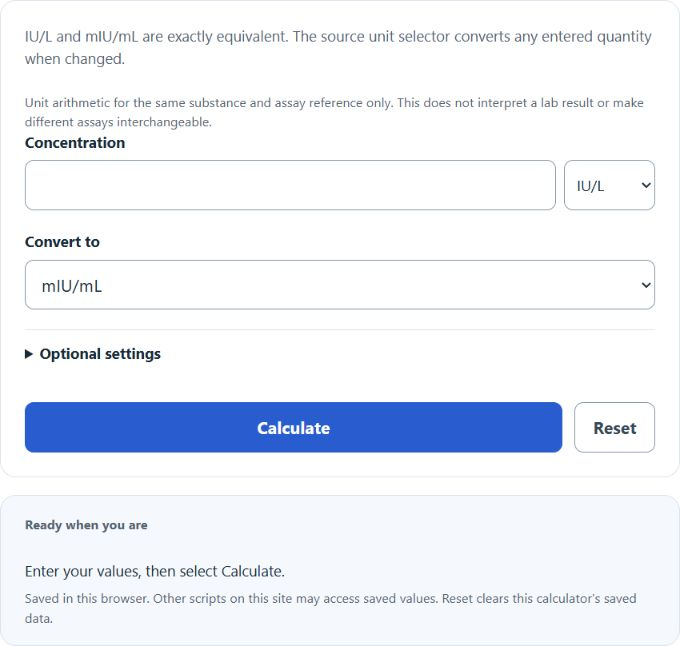
Convert IU/L to mIU/mL without changing the number, or convert related international-unit concentration scales for the same substance and assay reference.
Quick Overview
When labs report hormones or similar assays in IU/L, the same result can be written as mIU/mL without changing the number.
- 1 IU = 1000 mIU
- 1 L = 1000 mL
- 1 IU/L = 1 mIU/mL
- 5 IU/L = 5 mIU/mL
- 10 IU/L = 10 mIU/mL
This identity is commonly used for tests such as TSH, hCG, LH, FSH, prolactin, insulin, and erythropoietin.
- vitamin D IU to mcg Converter
- creatinine mmol/l to mg/dl Converter
- Micromolar To ppm Calculator
- NaOH to molarity Converter
- All Unit Converters
IU/L to mIU/mL Formula
Converting IU/L to mIU/mL does not change the number. Both units describe the same concentration, so the value you put in is the value you get back:
mIU/mL = IU/L
This holds because the top and bottom of the ratio each scale by 1000. One international unit contains 1000 milli-international units, and one liter contains 1000 milliliters, so the two factors of 1000 cancel:
1 IU/L = (1 IU x 1000) / (1 L x 1000) = 1000 mIU / 1000 mL = 1 mIU/mL
For the other units in the calculator, multiply the value in IU/L by a fixed factor:
Value(target) = Value(IU/L) x Factor
Variables:
- IU/L is the concentration in international units per liter
- mIU/mL is the concentration in milli-international units per milliliter, which is equal to IU/L
- Factor is the multiplier for the unit you want: 1 for mIU/mL, 0.001 for IU/mL, and 1000 for mIU/L or uIU/mL
Enter the concentration, choose its source unit and the target unit, then select Calculate. The defaults convert IU/L to mIU/mL. All five unit equivalents appear in Calculation details. This changes units only; compare reference ranges only for the same substance and compatible assay, and obtain clinical interpretation from a qualified clinician.
Unit Equivalents for Hormone Lab Values
The first table shows how one value in IU/L is written in the other units. Read across any row to find the matching number.
| IU/L | mIU/mL | IU/mL | mIU/L (= uIU/mL) |
|---|---|---|---|
| 1 | 1 | 0.001 | 1,000 |
| 2.5 | 2.5 | 0.0025 | 2,500 |
| 5 | 5 | 0.005 | 5,000 |
| 10 | 10 | 0.01 | 10,000 |
| 25 | 25 | 0.025 | 25,000 |
| 100 | 100 | 0.1 | 100,000 |
The second table lists the units that common blood tests are usually reported in, so you can see when the IU/L and mIU/mL identity applies.
| Test | Usual unit | Same value as |
|---|---|---|
| FSH (follicle stimulating hormone) | mIU/mL | IU/L |
| LH (luteinizing hormone) | mIU/mL | IU/L |
| hCG (pregnancy) | mIU/mL | IU/L |
| TSH (thyroid) | uIU/mL | mIU/L |
| Insulin | uIU/mL | mIU/L |
Example Problems
Example 1: Convert IU/L to mIU/mL.
An FSH result reads 5 IU/L and the chart you are using is in mIU/mL. Because the units are equal, no math is needed:
5 IU/L = 5 mIU/mL.
Example 2: Convert IU/L to uIU/mL.
A result of 25 IU/L needs to be written in uIU/mL. Multiply by 1000:
25 x 1000 = 25,000 uIU/mL. The same value in IU/mL is 25 / 1000 = 0.025 IU/mL.
Frequently Asked Questions
Is IU/L the same as mIU/mL?
Yes. A value in IU/L and the same value in mIU/mL are identical. Changing IU to mIU multiplies by 1000, and changing L to mL divides by 1000, so the two changes cancel. A result of 12.4 IU/L is 12.4 mIU/mL, with no rounding or adjustment.
How do you convert mIU/mL back to IU/L?
Use the same number. Since the units are equal, going from mIU/mL to IU/L also leaves the value unchanged, so 8 mIU/mL is 8 IU/L. This unit identity does not make reference ranges from different substances or assay methods interchangeable.
What about uIU/mL and mIU/L?
These two units are equal to each other, and both are 1000 times smaller than IU/L. One IU/L equals 1000 uIU/mL, so to go from IU/L to uIU/mL you multiply by 1000, and to go back you divide by 1000. TSH and insulin are the tests most often reported in uIU/mL.