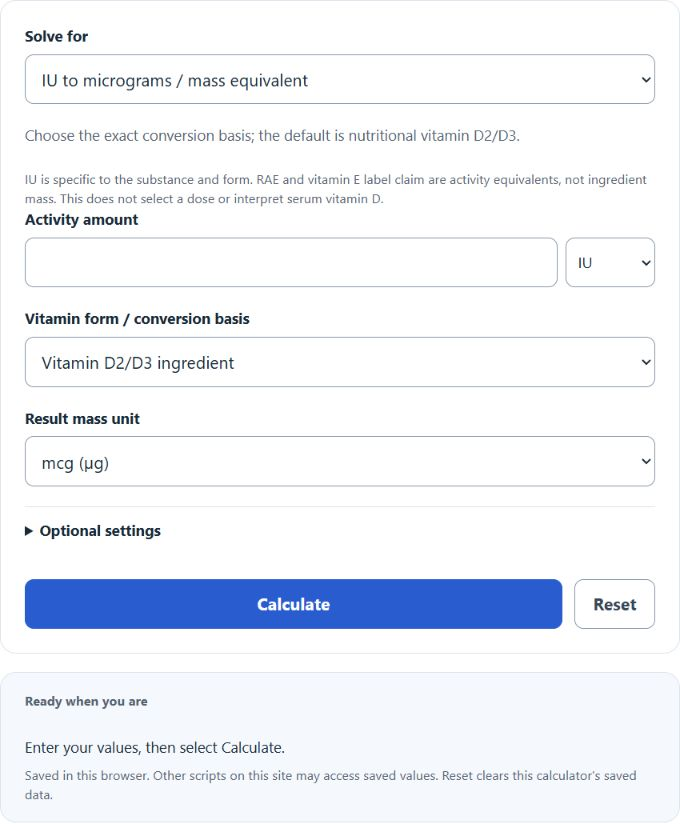
Convert IU to mcg or mg, or mcg to IU, for vitamin D (1 IU = 0.025 mcg), vitamin A and vitamin E, with a custom factor for other substances.
Calculator Functions
| Function | What it does | What it requires |
|---|---|---|
| IU to micrograms / mass equivalent | Converts an amount in IU to micrograms, milligrams or grams for the chosen vitamin form | Requires the activity amount in IU or kIU, the vitamin form or conversion basis, and the result unit |
| Micrograms / mass equivalent to IU | Converts an amount in micrograms, milligrams or grams to IU for the chosen vitamin form | Requires the amount in mcg, mg or g, the vitamin form or conversion basis, and the result unit |
The conversion basis starts as vitamin D2/D3. The other choices are vitamin A as retinol, beta-carotene by ingredient mass, beta-carotene as retinol activity equivalents (RAE) from a supplement or from food, vitamin E natural or synthetic, and a custom factor in mcg per IU for any other substance. Optional settings change the decimal places, add thousands separators and hide the extra mcg, mg and g lines.
IU To mcg Formulas
| mcg | Amount in micrograms |
| IU | Amount in international units |
| CF | Conversion factor in mcg per IU for the exact substance and form |
| Conversion basis | 1 IU equals | 1 mcg equals |
|---|---|---|
| Vitamin D2 or D3 | 0.025 mcg | 40 IU |
| Vitamin A as retinol | 0.3 mcg (also 0.3 mcg RAE) | 3.33 IU |
| Beta-carotene, ingredient mass | 0.6 mcg | 1.67 IU |
| Beta-carotene in a supplement, as RAE | 0.3 mcg RAE | 3.33 IU |
| Beta-carotene in food, as RAE | 0.05 mcg RAE | 20 IU |
| Vitamin E, natural | 670 mcg (0.67 mg) alpha-tocopherol | 0.00149 IU |
| Vitamin E, synthetic | 450 mcg (0.45 mg) alpha-tocopherol | 0.00222 IU |
These are the factors the U.S. Food and Drug Administration gives for converting vitamin amounts on food and supplement labels [1].
IU to micrograms / mass equivalent
The IU amount is multiplied by the factor. For vitamin D, 1,000 IU × 0.025 = 25 mcg, which is 0.025 mg [1]. For vitamin A as retinol, 3,000 IU × 0.3 = 900 mcg. For natural vitamin E, 30 IU × 0.67 = 20.1 mg of alpha-tocopherol, and for synthetic vitamin E, 30 IU × 0.45 = 13.5 mg [1].
Micrograms / mass equivalent to IU
The mass is divided by the same factor. For vitamin D, 1 mcg ÷ 0.025 = 40 IU, 12.5 mcg is 500 IU and 25 mcg is 1,000 IU. For retinol, 900 mcg ÷ 0.3 = 3,000 IU. The amount entered must be on the same basis as the form selected: a vitamin E amount is alpha-tocopherol, and an RAE amount is retinol activity, not the weight of the carotenoid.
Vitamin D IU to mcg Conversion Table
| Vitamin D (IU) | Micrograms (mcg) | Milligrams (mg) |
|---|---|---|
| 10 | 0.25 | 0.00025 |
| 100 | 2.5 | 0.0025 |
| 200 | 5 | 0.005 |
| 400 | 10 | 0.01 |
| 500 | 12.5 | 0.0125 |
| 600 | 15 | 0.015 |
| 800 | 20 | 0.02 |
| 1,000 | 25 | 0.025 |
| 1,500 | 37.5 | 0.0375 |
| 2,000 | 50 | 0.05 |
| 2,500 | 62.5 | 0.0625 |
| 3,000 | 75 | 0.075 |
| 4,000 | 100 | 0.1 |
| 5,000 | 125 | 0.125 |
| 10,000 | 250 | 0.25 |
| 20,000 | 500 | 0.5 |
| 50,000 | 1,250 | 1.25 |
| 60,000 | 1,500 | 1.5 |
The table applies to vitamin D2 (ergocalciferol) and vitamin D3 (cholecalciferol) only, at 1 mcg = 40 IU [1]. Read it right to left to turn mcg into IU.
IU vs mcg
A microgram is a unit of mass, one millionth of a gram. An international unit measures biological activity, and its size is set separately for each substance, so there is no single IU to mcg factor. One IU of vitamin D is the activity of 0.025 mcg of cholecalciferol, while one IU of vitamin A is 0.3 mcg of retinol [1]. A number in IU can only be turned into mcg once the substance and its form are known.
Limits of This Estimate
- The built-in factors cover vitamins D, A and E only. Other substances measured in IU or units, such as insulin, heparin, enzymes and vaccines, each have their own definition and need a verified factor entered as the custom basis.
- The RAE and vitamin E results are activity equivalents. They do not give the total weight of a carotenoid mixture or of a vitamin E ingredient such as tocopheryl acetate.
- The calculator converts units. It does not recommend a dose or interpret a blood test, and the amount on a product label takes priority.
Sources
- U.S. Food and Drug Administration, Converting Units of Measure for Folate, Niacin, and Vitamins A, D, and E on the Nutrition and Supplement Facts Labels: Guidance for Industry (August 2019), Tables 3, 4 and 6: conversion factors from IU for vitamin A, vitamin D and vitamin E