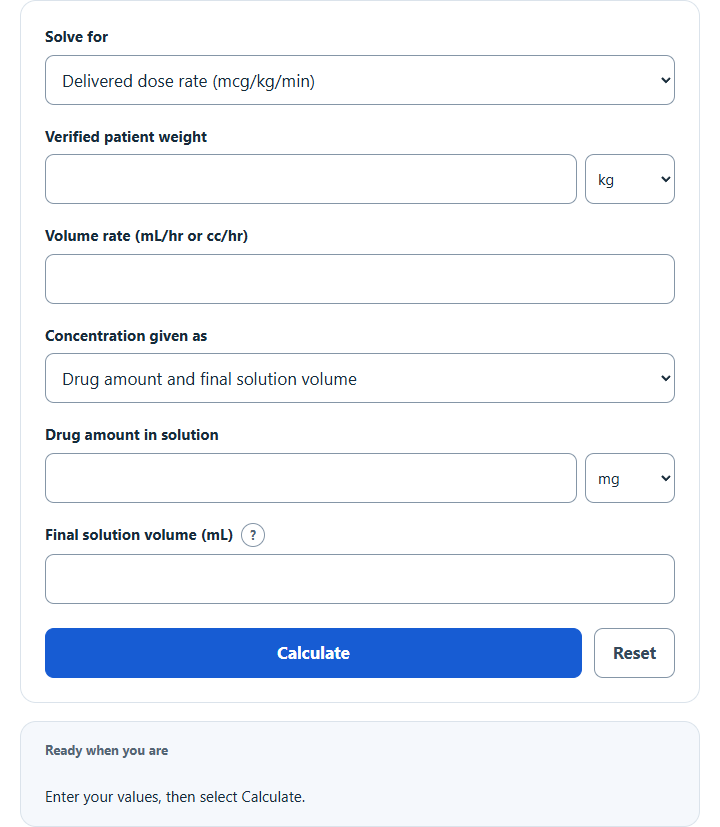
Convert an IV infusion rate from mL/hr to mcg/kg/min or solve for mL/hr using patient weight and medication concentration, amount, and solution volume.
- All Unit Converters
- Medical and Health Unit Converters
- Infusion Rate Calculator
- Drip Rate Calculator
- mL/hr to gtt/min Calculator
- Units/hr to mL/hr Calculator
- Heparin Units to mL Calculator
- Convert between mcg/min, mg/hr, and mcg/kg/min
Calculator Functions
| Function | What it does | What it requires |
|---|---|---|
| Delivered dose rate (mcg/kg/min) | Converts a pump rate in mL/hr to the dose rate it delivers per kilogram per minute | Requires the verified patient weight in kg or lb, the volume rate in mL/hr and the concentration, as a drug amount and final solution volume or as a labeled concentration |
| Volume rate (mL/hr) | Converts a prescribed dose rate in mcg/kg/min to the pump rate in mL/hr | Requires the verified patient weight in kg or lb, the prescribed dose rate in mcg/kg/min and the concentration, as a drug amount and final solution volume or as a labeled concentration |
The concentration can be given in two ways. Drug amount and final solution volume takes the drug in mg, mcg or g and the total volume in mL. Known labeled concentration takes mcg/mL or mg/mL. Each result also lists the dose in mcg/min, mcg/kg/hr and mg/kg/hr, the concentration in mcg/mL and the drug delivered in mg/hr.
mL/hr to mcg/kg/min Formulas
| D | Dose rate (mcg/kg/min), also written mcg/kg/minute or abbreviated mkm |
| R | Volume rate (mL/hr), the same number as cc/hr |
| C | Concentration of the solution (mcg/mL) |
| W | Patient weight (kg) |
The rate in mL/hr times the concentration in mcg/mL is the drug delivered per hour. Dividing by the weight gives the amount per kilogram, and dividing by 60 turns hours into minutes. This is the rearranged form of the infusion rate formula printed in drug labeling [1]. The conversion has no fixed factor, because it depends on the concentration in the bag or syringe and on the patient’s weight.
Delivered dose rate (mcg/kg/min)
The main formula applies directly. At 10 mL/hr of a 16 mcg/mL solution for a 70 kg patient, the dose rate is 10 × 16 ÷ (70 × 60) = 0.038095 mcg/kg/min. A weight in pounds is converted first, at 0.45359237 kg per lb [2].
Concentration from drug amount and volume
volume (mL)
The amount is converted to micrograms first: 1 mg is 1,000 mcg and 1 g is 1,000,000 mcg. A bag with 4 mg of drug in a final volume of 250 mL holds 4,000 ÷ 250 = 16 mcg/mL. The volume is the final total volume that contains the drug, not the volume of diluent before the drug was added.
Volume rate (mL/hr)
This is the form given in the dopamine prescribing information, which works two examples: 2 mcg/kg/min for a 60 kg patient with an 800 mcg/mL solution is 2 × 60 × 60 ÷ 800 = 9 mL/hr, and 5 mcg/kg/min for 70 kg with 3,200 mcg/mL is 6.56 mL/hr [1].
Other dose units in the result
mcg/kg/hr = D × 60
The first line is the dose rate before dividing by weight. The second gives the dose per hour, and dividing it by 1,000 gives mg/kg/hr. At 0.038095 mcg/kg/min the result shows 2.666667 mcg/min, 2.285714 mcg/kg/hr and 0.16 mg/hr.
Limits of This Estimate
- For educational use only; not medical advice. Do not use this tool as the sole source to dose medications. Always verify units and calculations and follow clinician or pharmacist guidance, facility protocols and the medication’s prescribing information, with extra caution in pediatrics, pregnancy, renal or hepatic impairment and critical care or high-alert infusions.
- The result is arithmetic on the numbers entered. It does not check the drug, the dose range, the weight used for dosing, compatibility or the pump’s limits.
- The formula assumes a uniform solution running at a constant rate, and a concentration that matches the bag or syringe actually in use. A different dilution of the same drug gives a different mL/hr for the same dose.
Sources
- U.S. Food and Drug Administration, Dopamine HCl in Dextrose Injection prescribing information (2021), Section 2: infusion rate formula and the two worked examples
- NIST, Guide for the Use of the International System of Units (SP 811), Appendix B.8: pound to kilogram factor