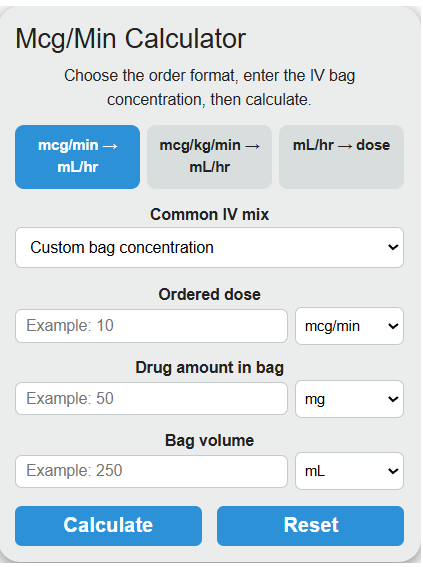
Calculate delivered mcg/min from infusion concentration and pump rate, or solve for mL/hr, concentration, and weight-based mcg/kg/min with unit conversions.
Related Calculators
- mEq Calculator
- Medication Days Supply Calculator
- Fluid Osmolarity Calculator
- Cost Per Dose Calculator
- All Health and Medical Calculators
Mcg/Min Formula
The calculator converts between an ordered dose and an IV pump rate using the bag concentration. There are three modes.
Mode 1: mcg/min to mL/hr
Mode 2: mcg/kg/min to mL/hr
Mode 3: mL/hr to mcg/min
Concentration is calculated from the bag:
- Dose = ordered infusion rate (mcg/min, mg/min, mcg/kg/min, or mg/kg/min)
- Weight = patient body weight in kg (lb is converted at 1 lb = 0.45359237 kg)
- Drug amount = total drug in the bag (mcg, mg, or g)
- Bag volume = total fluid volume (mL or L)
- Concentration = drug per mL of finished IV solution, in mcg/mL
- Rate = pump infusion rate (mL/hr or mL/min)
Assumptions: the bag is fully mixed, the labeled concentration is accurate, and no overfill is accounted for. Doses entered in mg are converted to mcg (× 1000), and grams are converted to mg (× 1000) before the math runs. Always verify the result against the order, the pump library, and your facility’s protocol before titrating.
The first mode answers “what rate do I set?” when the order is in mcg/min. The second mode does the same when the order is weight-based, multiplying by kg first. The third mode is a back-check: enter the running pump rate and the bag, and the calculator returns the dose the patient is actually getting. If you also enter a weight, it returns mcg/kg/min as well.
Common IV Drip Concentrations and Dose Ranges
These are typical adult mixes and dose ranges used in critical care. Confirm with your facility’s policy.
| Drug | Standard Mix | Concentration | Typical Dose |
|---|---|---|---|
| Nitroglycerin | 50 mg / 250 mL | 200 mcg/mL | 5 to 200 mcg/min |
| Norepinephrine | 4 mg / 1000 mL | 4 mcg/mL | 0.01 to 3 mcg/kg/min |
| Dopamine | 400 mg / 250 mL | 1600 mcg/mL | 2 to 20 mcg/kg/min |
| Dobutamine | 250 mg / 250 mL | 1000 mcg/mL | 2 to 20 mcg/kg/min |
| Epinephrine | 4 mg / 250 mL | 16 mcg/mL | 0.01 to 1 mcg/kg/min |
| Nitroprusside | 50 mg / 250 mL | 200 mcg/mL | 0.3 to 10 mcg/kg/min |
Unit Conversion Quick Reference
| From | To | Multiply By |
|---|---|---|
| mg | mcg | 1000 |
| g | mg | 1000 |
| lb | kg | 0.4536 |
| mL/min | mL/hr | 60 |
| mcg/min | mg/hr | 0.06 |
Worked Examples
Example 1: Nitroglycerin at 10 mcg/min. Bag is 50 mg in 250 mL. Concentration is (50 × 1000) ÷ 250 = 200 mcg/mL. Rate is (10 × 60) ÷ 200 = 3 mL/hr.
Example 2: Norepinephrine at 0.05 mcg/kg/min for a 70 kg patient. Dose in mcg/min is 0.05 × 70 = 3.5 mcg/min. Bag is 4 mg in 1000 mL, so concentration is 4 mcg/mL. Rate is (3.5 × 60) ÷ 4 = 52.5 mL/hr.
Example 3: Pump running at 15 mL/hr of dopamine 400 mg / 250 mL on an 80 kg patient. Concentration is 1600 mcg/mL. Dose is (15 × 1600) ÷ 60 = 400 mcg/min. Per kg: 400 ÷ 80 = 5 mcg/kg/min.
FAQ
Why multiply by 60? The dose is per minute, but pumps run in mL per hour. Multiplying mcg/min by 60 converts to mcg/hr, which then divides cleanly by mcg/mL to give mL/hr.
What if my order is in mg/hr? Convert to mcg/min first: mg/hr ÷ 0.06 = mcg/min. Then enter that number in the first tab.
Does overfill in the IV bag matter? Most premixed bags account for it on the label. For pharmacy-compounded bags, use the labeled volume the pharmacy prints on the bag, not the manufacturer’s nominal volume.
Can I use this for pediatric dosing? The math is the same, but pediatric concentrations and dose ranges differ. Confirm with a pediatric reference and your institution’s smart pump library.
Why does the reverse mode ask for weight as optional? Without weight, you only get mcg/min. Adding weight lets the calculator also report mcg/kg/min so you can compare the running rate to a weight-based order.