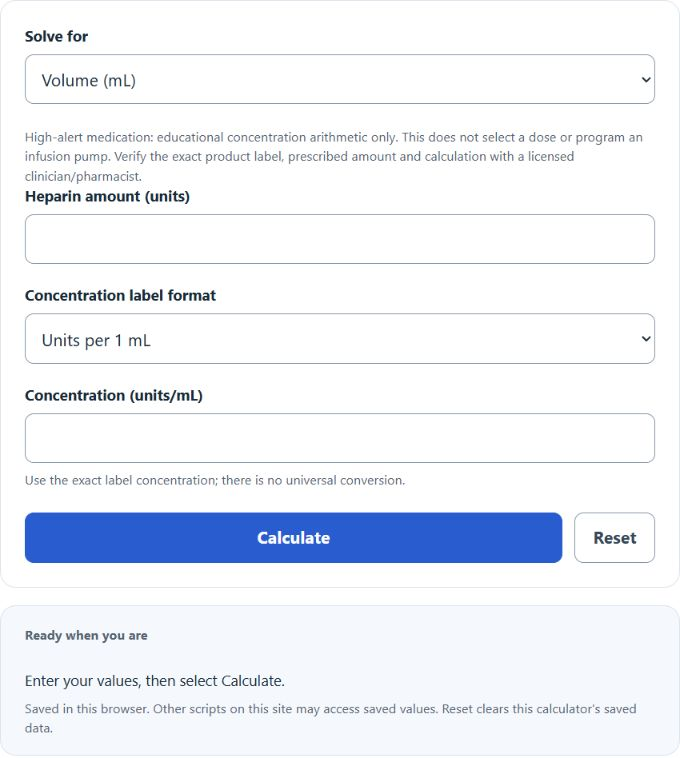
Convert heparin units to mL using the entered label concentration, or calculate units and U/mL from a known volume and strength values.
Safety notice (high‑alert medication): For educational use only and not medical advice. Heparin dosing and infusion pump programming must be ordered and verified by a licensed clinician/pharmacist. Always confirm the vial/bag label concentration (Units/mL) and follow your institution’s protocol; independently double-check calculations and rounding/device limits. If an overdose is suspected, seek urgent medical help or contact Poison Control.
- All Health and Medical Calculators
- All Medical and Health Unit Converters
- Semaglutide Dilution Calculator
- mg to ml Calculator
- ng/mL To nmol/L Calculator
- Units to mL
Heparin Units To mL Formula
The following formula is used to calculate the conversion of heparin units to milliliters.
Variables:
- mL is the volume in milliliters (mL)
- U is the amount of heparin in units (U)
- C is the concentration of heparin in units per milliliter (U/mL)
To calculate the volume in milliliters, divide the amount of heparin in units by the concentration of heparin in units per milliliter.
| Heparin Units (U) | Volume (mL) |
|---|---|
| 100 | 0.100 |
| 250 | 0.250 |
| 500 | 0.500 |
| 750 | 0.750 |
| 1000 | 1.000 |
| 1500 | 1.500 |
| 2000 | 2.000 |
| 2500 | 2.500 |
| 3000 | 3.000 |
| 4000 | 4.000 |
| 5000 | 5.000 |
| 6000 | 6.000 |
| 7500 | 7.500 |
| 10000 | 10.000 |
| 12500 | 12.500 |
| 15000 | 15.000 |
| 20000 | 20.000 |
| 25000 | 25.000 |
| 30000 | 30.000 |
| 50000 | 50.000 |
| ONLY valid for 1000 U/mL. Rounded to 3 decimals. Formula: Volume (mL) = Units (U) ÷ Concentration (U/mL). | |
Can heparin units be converted to mg?
There is no single fixed conversion from heparin units to milligrams. Units describe anticoagulant activity, while mg describes mass. The heparin sodium product label explains that potency is measured by a biological assay in units of activity per milligram. A mass conversion therefore requires the specific product’s verified potency in units/mg; units/mL alone is not enough. Do not substitute a generic mg factor or a different heparin product. Ask a pharmacist to verify the product-specific information.
Converting an ordered infusion rate
For an already prescribed rate, the Units/Hr to mL/Hr Calculator converts units/hr, or units/kg/hr with weight, using the actual solution concentration. It performs rate arithmetic; it does not choose a heparin dose, adjust treatment from blood tests, or replace a clinical protocol. Have the prescription, product strength and pump setting independently verified by a licensed clinician or pharmacist.
What does heparin units to mL mean?
Heparin units to mL refers to converting a heparin amount expressed in units (U) into a volume expressed in milliliters (mL) using the solution’s concentration (U/mL). The conversion factor depends on the specific concentration of the heparin solution being used. For example, if a solution is 5,000 U/mL and a dose is 10,000 U, the volume would be 2 mL.
How to Calculate Heparin Units To mL?
The following steps outline how to calculate the Heparin Units to mL.
- First, determine the amount of heparin in units (U).
- Next, determine the concentration of heparin in units per milliliter (C).
- Next, gather the formula from above = mL = U / C.
- Finally, calculate the volume in milliliters (mL).
- After calculating, cross-check using an independent method (for example, manual dimensional analysis).
Example Problem :
Use the following variables as an example problem to test your knowledge.
amount of heparin in units (U) = 150
concentration of heparin in units per milliliter (C) = 50. The arithmetic result is 150 ÷ 50 = 3 mL. This is an educational example, not a prescribed dose or administration instruction.