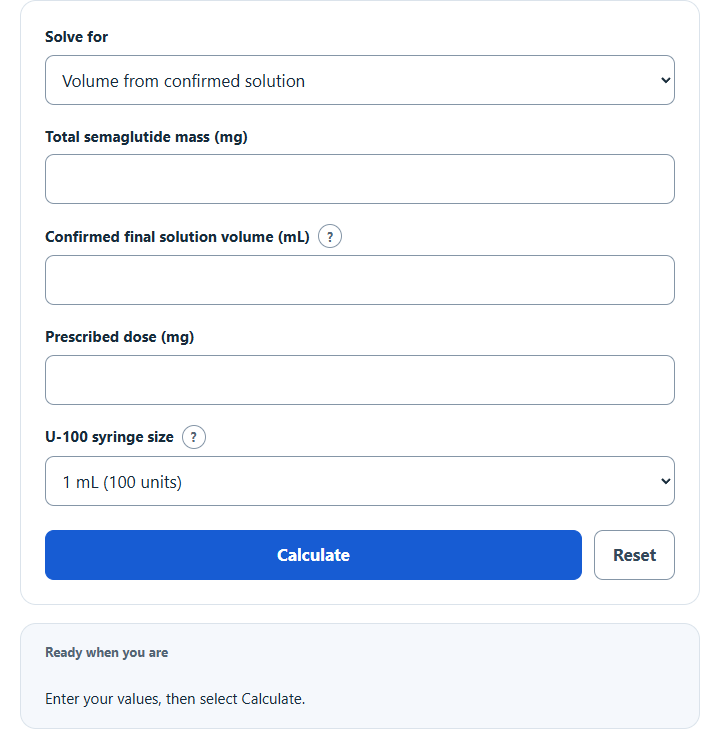
Calculate semaglutide dose volume and U-100 syringe units from total mg and pharmacist-confirmed final volume, or work out final volume and dilutions.
Related Calculators
- Units to mL Calculator (U-100, U-40, + More)
- Heparin Units To mL Calculator
- Medication Error Rate Calculator
- Carb to Insulin Ratio Calculator
- All Health and Medical Calculators
Calculator Functions
| Function | What it does | What it requires |
|---|---|---|
| Volume from confirmed solution | Converts a prescribed dose in milligrams to a volume and to marks on a U-100 syringe | Requires the total semaglutide mass in the vial, the confirmed final solution volume and the prescribed dose |
| Final-volume arithmetic | Finds the final solution volume at which a prescribed dose lines up with a chosen number of syringe marks | Requires the total semaglutide mass, the prescribed dose and the target U-100 scale marks |
| Solution dilution mass balance | Finds the final volume after an existing solution is diluted to a lower concentration | Requires the initial solution volume, the initial concentration and the target concentration |
The first two functions also take the U-100 syringe size: 1 mL (100 units), 0.5 mL (50 units), 0.3 mL (30 units) or a custom capacity. A dose volume larger than the syringe returns an error. Their results list the concentration in mg/mL, the dose volume in mL, the U-100 scale marks and the number of doses the entered mass divides into.
Semaglutide Dilution Formulas
| V | Dose volume (mL) |
| D | Prescribed dose (mg) |
| C | Concentration of the solution (mg/mL): total semaglutide mass ÷ final solution volume |
A dose is prescribed as a mass in milligrams, and a syringe measures volume. The concentration links the two, so the same dose is a different volume in every solution strength.
Volume from confirmed solution
The main formula gives the dose volume, and this line turns it into marks on a U-100 insulin syringe, which has 100 marks per mL. A vial holding 10 mg in a confirmed final volume of 2 mL has a concentration of 10 ÷ 2 = 5 mg/mL. A prescribed dose of 0.25 mg is then 0.25 ÷ 5 = 0.05 mL, which is 5 marks. That matches the FDA’s example of a 5-unit dose being 0.05 mL [1]. The marks are a measure of volume, not units of semaglutide: at 2.5 mg/mL the same 0.25 mg dose is 10 marks.
Final-volume arithmetic
Here V is the chosen number of marks ÷ 100, so D ÷ V is the concentration that puts one dose at that mark. For 5 mg of semaglutide and a 0.25 mg dose at 10 marks (0.1 mL), the concentration is 0.25 ÷ 0.1 = 2.5 mg/mL and the final solution volume is 5 ÷ 2.5 = 2 mL. This is the volume of the finished solution. It is not the amount of liquid to add, because the powder and any liquid already in the vial take up part of it.
Solution dilution mass balance
Diluting a solution does not change the amount of drug in it, so the starting concentration times the starting volume equals the final concentration times the final volume [3]. A hypothetical 10 mL at 5 mg/mL holds 50 mg; at 2 mg/mL that same 50 mg fills 10 × 5 ÷ 2 = 25 mL, an increase of 15 mL. A target concentration higher than the starting one returns an error, because dilution cannot raise concentration.
Limits of This Estimate
- This is arithmetic only. It does not choose a dose, a diluent, a preparation method or an injection technique, and nothing here should be used to prepare or inject a medicine. The prescriber or pharmacist who supplied the product sets the dose and the volume to draw.
- Ready-to-use semaglutide pens are not meant to be diluted or measured with a separate syringe. The functions apply only to the arithmetic of a vial whose mass and final volume are confirmed on the dispensing label.
- Compounded semaglutide is not FDA approved, and its concentration varies from one compounder and product to the next [2] [1]. The FDA has received reports of people taking 5 to 20 times the intended dose after mixing up milligrams, milliliters and syringe units [1] (FDA pages current as of July 26, 2024 and October 1, 2026).
- The results are not rounded to the marks printed on a syringe and do not show whether a volume can be measured accurately. The count of doses ignores the liquid left in the vial and needle, sterility and the beyond-use date.
- The dilution function assumes volumes add exactly and no drug is lost.
Sources
- U.S. Food and Drug Administration, FDA alerts health care providers, compounders and patients of dosing errors associated with compounded injectable semaglutide products: dosing errors with compounded semaglutide, the 5-unit (0.05 mL) example and why units depend on concentration (content current as of July 26, 2024)
- U.S. Food and Drug Administration, FDA’s Concerns with Unapproved GLP-1 Drugs Used for Weight Loss: compounded drugs are not FDA approved, and reports of harm tied to dosing errors (content current as of October 1, 2026)
- Harvey, Analytical Chemistry 2.1, Section 2.5, Preparing Solutions: the dilution equation and the reason it holds