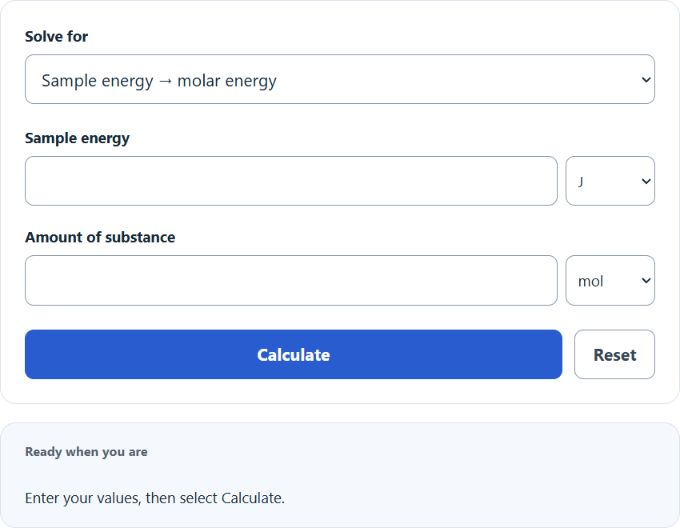
Convert J to kJ/mol by dividing a sample’s energy in joules by its moles, convert J or eV per atom to kJ/mol, or turn kJ/mol back into J per particle.
Related Calculators
- Eyring Equation Calculator
- Adiabatic Flame Temperature Calculator
- Molar Heat Capacity Calculator
- Heat of Vaporization Calculator
- kJ/g, J/g or kJ/kg to kJ/mol and Back
- All Chemistry Calculators
Calculator Functions
| Function | What it does | What it requires |
|---|---|---|
| Sample energy → molar energy | Converts the energy of a whole sample to kJ/mol | Requires the sample energy in J or kJ and the amount of substance in mol, mmol or µmol |
| Per-atom/particle energy (J or eV) → kJ/mol | Converts the energy of one atom, molecule or photon to kJ/mol | Requires the energy per particle in J or eV |
| kJ/mol → per-particle energy | Converts a molar energy to joules and electronvolts per particle | Requires the molar energy in kJ/mol, J/mol or kcal/mol |
Negative energies are accepted and keep their sign, so an energy released can be entered as a negative change. Every result also gives J/mol, the energy per particle in J and eV, and kcal/mol in the calculation details.
J to kJ/mol Formula
| Em | Molar energy (kJ/mol) |
| E | Energy of the sample (J) |
| n | Amount of substance in the sample (mol) |
Dividing by 1,000 turns joules into kilojoules, and dividing by the amount puts the energy on a per-mole basis. Joules alone cannot be turned into kJ/mol: the amount of substance, or the fact that the energy belongs to a single particle, has to be known.
Sample energy → molar energy
The main formula applies directly. A 2 mol sample that takes in 34 J has a molar energy of 34 ÷ 1000 ÷ 2 = 0.017 kJ/mol. A reaction that releases 250 kJ from 0.5 mol is 250 ÷ 0.5 = 500 kJ/mol.
Per-atom/particle energy (J or eV) → kJ/mol
ε is the energy of one particle in joules and NA is the Avogadro constant, exactly 6.02214076 × 10²³ particles per mole [1]. A photon or bond energy of 3.0 × 10⁻¹⁹ J per particle is 3.0 × 10−19 × 6.02214076 × 1023 ÷ 1000 = 180.66 kJ/mol. An energy in electronvolts is first multiplied by 1.602176634 × 10⁻¹⁹ J per eV [2], which makes 1 eV per particle equal to 96.485 kJ/mol.
kJ/mol → per-particle energy
A molar energy of 100 kJ/mol is 100 × 1000 ÷ (6.02214076 × 10²³) = 1.6605 × 10⁻¹⁹ J per particle, or 1.0364 eV. An entry in kcal/mol is converted with 1 kcal = 4.184 kJ, the thermochemical calorie [3], so 100 kJ/mol is also 23.90 kcal/mol.
How to Convert J to kJ/mol
Divide the joules by 1,000 to get kilojoules, then divide by the number of moles the energy belongs to. For 5,000 J absorbed by 0.25 mol: 5,000 ÷ 1000 = 5 kJ, and 5 ÷ 0.25 = 20 kJ/mol. When the energy is for exactly 1 mol, the kJ/mol value is the joules divided by 1,000. Going from kJ to kJ/mol skips the first step: divide the kilojoules by the moles.
What Is kJ/mol?
kJ/mol, also written kJ mol−1, is kilojoules per mole: the energy in kilojoules for every mole of a substance, where one mole is 6.02214076 × 10²³ particles [1]. It is a unit of molar energy, so it describes the substance or reaction and not the size of the sample.
Limits of This Estimate
- The conversion only changes units. It does not say whether a value is a heat, an enthalpy change, a bond energy or a free energy, or which reaction it belongs to.
- The per-mole basis has to be stated with the result. The same reaction gives a different kJ/mol figure per mole of each reactant or product when their coefficients differ.
- kcal uses the thermochemical calorie of 4.184 J. Other calories, such as the International Table calorie, differ slightly [3].
Sources
- NIST, CODATA Value: Avogadro constant: the exact value 6.02214076 × 10²³ per mole
- NIST, CODATA Value: electron volt: the exact value 1.602176634 × 10⁻¹⁹ J
- NIST Special Publication 811, Appendix B.8: thermochemical calorie and kilocalorie in joules, and the other calorie definitions