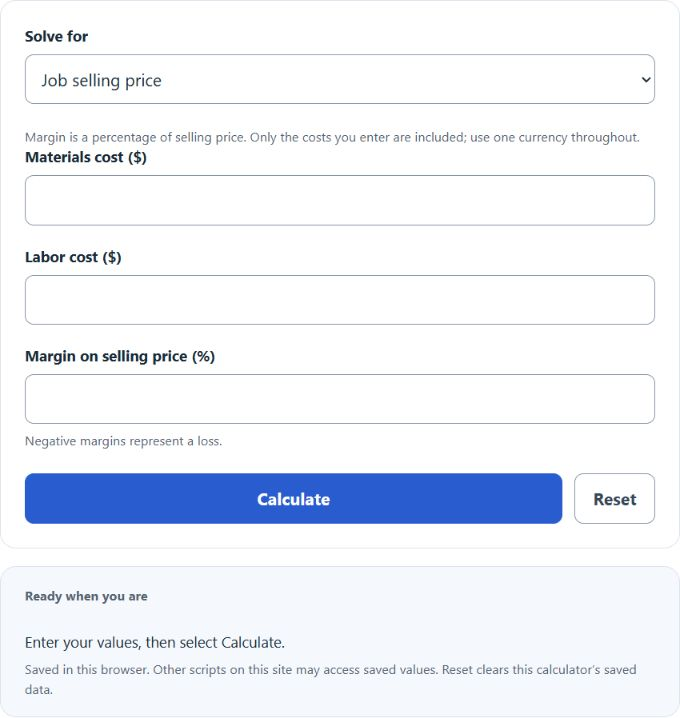
Calculate job price, labor costs, materials cost or target margin by choosing the value to solve and entering the remaining inputs.
- All Business Calculators
- All Price Calculators
- Job Cost Calculator
- Target Price Calculator
- Relative Price Calculator
Job Price (Selling Price) Formula
The Job Price Calculator helps you determine the selling price required to cover job costs and still hit a chosen gross margin. It is useful for quotes, bids, contractor estimates, service jobs, fabrication work, and any project where materials and labor make up the core direct cost.
- JP = job price or selling price
- MC = materials cost
- LC = labor cost
- M = target margin percentage on the final selling price
This calculator uses margin, not markup. That distinction matters because margin is based on the final selling price, while markup is based on cost.
How to Use the Calculator
- Choose Job selling price to calculate a quote, then enter the total materials cost for the job.
- Enter the total labor cost.
- Enter the target margin you want to earn on the final selling price.
- The calculator returns the required job price.
If your workflow starts with a known selling price instead of a known margin, you can also use the same relationship to check the margin your quote actually earns.
Rearranged Forms
If you know any three values, you can solve for the missing one.
| Missing Value | Formula |
|---|---|
| Job Price | JP = (MC + LC) / (1 - M / 100) |
| Target Margin | M = 100(1 - (MC + LC) / (JP)) |
| Materials Cost | MC = JP(1 - M / 100) - LC |
| Labor Cost | LC = JP(1 - M / 100) - MC |
How Margin Changes the Required Price
As the target margin increases, the required selling price rises faster than many people expect. A small increase in margin can create a much larger increase in the quote because less of the final price is available to recover cost.
| Target Margin | Price Multiplier on Total Cost | Price Needed for $1,000 in Total Cost |
|---|---|---|
| 10% | 1.1111 | $1,111.11 |
| 20% | 1.2500 | $1,250.00 |
| 30% | 1.4286 | $1,428.57 |
| 40% | 1.6667 | $1,666.67 |
| 50% | 2.0000 | $2,000.00 |
Examples
Example 1: A job has $500 in materials, $300 in labor, and a target margin of 20%. The total direct cost is $800, so the required selling price is $1,000.
Example 2: A job has $600 in materials, $700 in labor, and a target margin of 50%. The total direct cost is $1,300, so the required selling price is $2,600.
Pricing Tips for Better Quotes
- Include all direct costs before pricing the job, such as materials, labor, subcontractors, delivery, disposal, permits, and equipment rental if you plan to absorb them.
- Add overhead into your cost basis if it is not billed separately. Otherwise, the calculated price may look profitable on paper but still underperform in practice.
- Use margin consistently across estimates. Mixing margin and markup can lead to underpricing or overpricing.
- Check competitiveness when using high target margins. The formula is correct, but the market may not accept the resulting price.
- Keep taxes separate if sales tax is passed directly through to the customer rather than absorbed into the quote.
Common Questions
What does a 0% target margin mean?
A 0% target margin means the selling price equals the direct job cost. That is effectively break-even on the cost inputs used in the calculator.
Can the target margin be 100%?
A 100% target margin cannot determine a selling price by division because the denominator is zero. At a known positive selling price, a 100% margin is possible only when total entered cost is zero. Use a target below 100% when solving a quote from positive costs.
Should overhead be included?
If overhead must be recovered through the quote, include it in your cost estimate before calculating the final selling price. If you leave it out, the result only covers the costs you entered.
When should I use this calculator instead of a markup calculator?
Use this calculator when your pricing goal is based on a desired profit percentage of the final sale price. Use a markup calculator when your pricing method is based on adding a percentage to cost.
What if I already know the selling price?
You can calculate the implied margin and test whether the quote meets your profitability target.