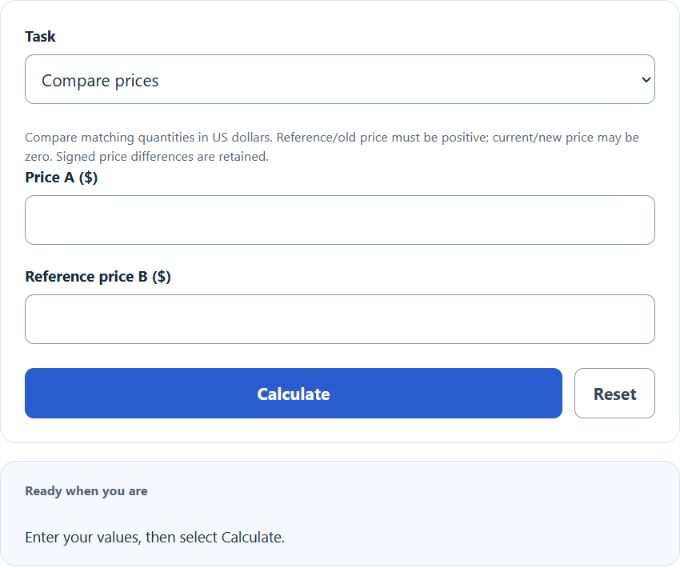
Compare two prices or calculate percent change between an old price and a new price, with ratio, dollar difference, and multiplier.
- All Business Calculators
- All Price Calculators
- Target Price Calculator
- Market Price Calculator
- Relative Change Calculator
Relative Price Formula
A relative price compares a current price to a reference price and expresses that comparison as a ratio. Because both inputs are prices measured in the same units, the result is unitless. This makes relative price useful for benchmarking, pricing analysis, cost comparisons, and tracking how far a value has moved from a baseline.
- RP = relative price ratio
- CP = current price
- Ref = reference price or base price
Interpret the result as follows:
- RP = 1: the current price is exactly equal to the reference price
- RP < 1: the current price is below the reference price
- RP > 1: the current price is above the reference price
Relative Price as a Percentage
If you want to express the ratio as a percentage of the reference price, multiply the ratio by 100.
For example, a relative price of 0.80 means the current price is 80% of the reference price. A relative price of 1.25 means the current price is 125% of the reference price.
Connection to Percent Change
Relative price and percent change are closely related. Relative price tells you the size of the current price relative to the base, while percent change tells you the increase or decrease from that base.
This means:
- RP = 1.10 corresponds to a 10% increase
- RP = 0.90 corresponds to a 10% decrease
- RP = 2.00 corresponds to a 100% increase
How to Calculate Relative Price
- Identify the current price.
- Identify the reference price you want to compare against.
- Divide the current price by the reference price.
- Read the result as a ratio or convert it to a percentage of the reference price.
Examples
Example 1: If the current price is $30 and the reference price is $200, the ratio is:
This means the current price is 15% of the reference price.
So the current price is 85% lower than the reference price.
Example 2: If the current price is $70 and the reference price is $150, the ratio is:
This means the current price is about 46.67% of the reference price.
So the current price is about 53.33% lower than the reference price.
Quick Interpretation Table
| Relative Price | Meaning | Equivalent Percent Change |
|---|---|---|
| 0.50 | Current price is 50% of the reference | -50% |
| 0.75 | Current price is 75% of the reference | -25% |
| 1.00 | Current price equals the reference | 0% |
| 1.20 | Current price is 120% of the reference | +20% |
| 1.50 | Current price is 150% of the reference | +50% |
| 2.00 | Current price is double the reference | +100% |
Common Uses of Relative Price
- Comparing a sale price to an original list price
- Measuring how a market price compares to a historical price
- Benchmarking a supplier quote against a standard cost
- Evaluating product pricing across stores or vendors
- Tracking movement from a target, forecast, or budgeted price
Important Notes
Select Compare prices or Price change, enter the two prices, then select Calculate. Reference or old price must be positive; current or new price may be zero. This comparison uses US dollars and excludes negative-price contracts.
- Use the same currency for both prices.
- Compare the same item, unit size, or quantity for a meaningful result.
- A reference price of 0 makes the calculation undefined.
- Relative price is a ratio, not a profit margin or markup.
- When communicating results to others, it is often helpful to report both the ratio and the percent change.
Relative Price vs. Absolute Price Difference
Relative price measures proportional change, while absolute price difference measures the simple dollar gap between two prices. Both can be useful, but they answer different questions. Absolute difference tells you how many dollars apart two prices are, while relative price tells you how large one price is compared to the other.
If two prices differ by $20, that difference can be minor or significant depending on the reference price. Relative price adds that context.