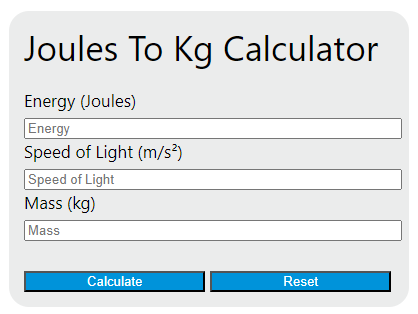
Calculate mass, energy, or speed of light from E=mc² using joules, kilojoules, calories, BTU, and unit conversions for kg, g, lb, or ton.
Joules To Kg Formula
The following formula is used to calculate mass from energy.
Variables:
- m is the mass (kg)
- E is the energy (Joules)
- c is the speed of light in a vacuum (m/s), approximately 3.00 x 10^8 m/s (exactly 299,792,458 m/s)
To calculate the mass, divide the energy by the square of the speed of light. This will give you the mass equivalent of the energy in kilograms.
| Energy (J) | Mass (kg) |
|---|---|
| 0.5 | 5.56×10⁻¹⁸ |
| 1 | 1.11×10⁻¹⁷ |
| 2 | 2.23×10⁻¹⁷ |
| 5 | 5.56×10⁻¹⁷ |
| 10 | 1.11×10⁻¹⁶ |
| 20 | 2.23×10⁻¹⁶ |
| 50 | 5.56×10⁻¹⁶ |
| 100 | 1.11×10⁻¹⁵ |
| 200 | 2.23×10⁻¹⁵ |
| 500 | 5.56×10⁻¹⁵ |
| 1000 | 1.11×10⁻¹⁴ |
| 2000 | 2.23×10⁻¹⁴ |
| 5000 | 5.56×10⁻¹⁴ |
| 10000 | 1.11×10⁻¹³ |
| 20000 | 2.23×10⁻¹³ |
| 50000 | 5.56×10⁻¹³ |
| 100000 | 1.11×10⁻¹² |
| 200000 | 2.23×10⁻¹² |
| 500000 | 5.56×10⁻¹² |
| 1000000 | 1.11×10⁻¹¹ |
| * Rounded to 3 significant figures. Uses mass–energy equivalence: 1 J ≈ 1.11×10⁻¹⁷ kg. | |
What is Joules To Kg?
Joules to Kg is a conversion from energy (measured in Joules) to mass (measured in kilograms) based on Einstein’s equation E=mc^2, which relates energy and mass. This conversion is not common in everyday scenarios but is used in relativity and high-energy physics (for example, when discussing mass–energy equivalence in particle processes). It’s important to note that this conversion is typically a way of expressing an energy amount as an equivalent mass; actual conversion between energy and matter requires specific physical processes (such as pair production).
How to Calculate Joules To Kg?
The following steps outline how to calculate the mass (m) in kilograms using the formula: m = E / c^2.
- First, determine the energy (E) in Joules.
- Next, determine the speed of light in a vacuum (c) in meters per second (m/s). Use the value of approximately 3.00 x 10^8 m/s.
- Next, substitute the values of E and c into the formula: m = E / c^2.
- Finally, calculate the mass (m) in kilograms.
- After inserting the variables and calculating the result, check your answer with the calculator above.
Example Problem:
Use the following variables as an example problem to test your knowledge.
energy (E) = 2.5 x 10^9 Joules
speed of light in a vacuum (c) = 3.00 x 10^8 m/s