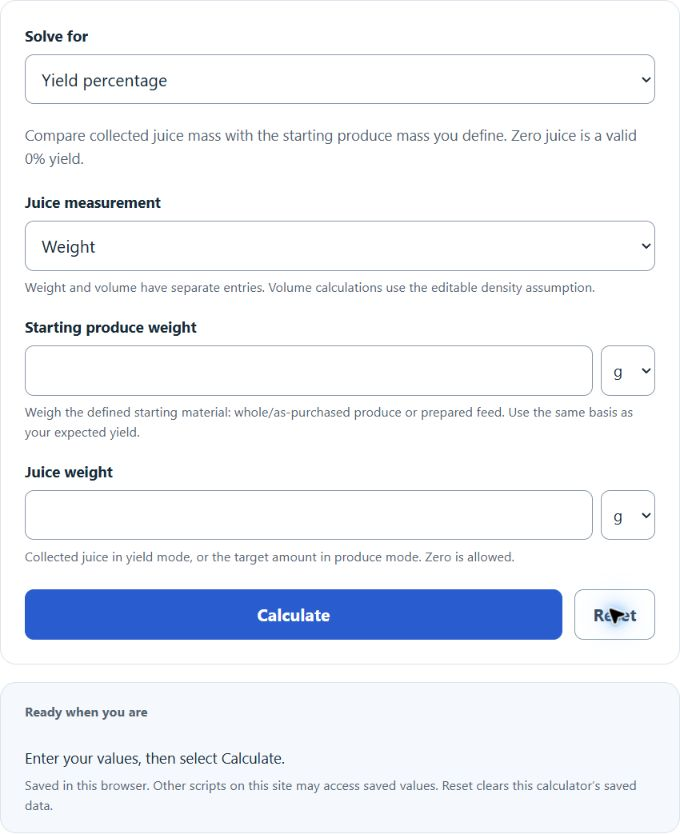
Calculate juice yield percentage, estimate juice from produce weight, or find fruit and vegetable weight needed for a target batch using weight or volume units.
Related Calculators
- Food Waste Percentage Calculator
- Moisture Loss Calculator
- Brix To Grams Of Sugar Calculator
- Wine Sugar Calculator
- All Food and Cooking Calculators
Juice Yield by Produce
Juice yield is collected juice mass divided by a defined starting mass, expressed as a percentage. State whether you weigh whole/as-purchased produce or prepared feed after peeling and trimming; these bases give different percentages. For example, a banana extraction study used prepared pulp rather than whole fruit. The tables below are rough planning examples, not validated yield guarantees for a particular juicer. Cold press includes masticating and hydraulic press methods.
| Produce | Typical Home Yield | Cold Press Yield | Notes |
|---|---|---|---|
| Apple | 45–65% | 60–75% | Fuji and Gala yield more than Granny Smith; variety gap can reach 20% |
| Orange (Valencia) | 44–55% | 50–60% | Commercial standard ~48–50%; Valencia outperforms Navel |
| Lemon | 28–38% | 35–45% | Warming to room temperature increases yield 5–10%; Eureka ~32% |
| Lime | 32–42% | 38–48% | Persian limes yield more than Key limes |
| Grapefruit | 44–54% | 50–58% | Ruby Red slightly higher than white grapefruit |
| Watermelon | 60–80% | 80–92% | Seedless varieties preferred; cold press approaches full water content (92%) |
| Pineapple | 40–55% | 85–92% | Illustrative planning values; verify starting-weight basis, preparation, equipment and conditions |
| Grape | 55–70% | 65–78% | Seedless green/red varieties outperform Concord |
| Strawberry | 25–38% | 35–48% | Overripe berries yield more; remove hulls before juicing |
| Tomato | 50–65% | 58–70% | Roma/plum varieties yield more than beefsteak |
| Carrot | 44–55% | 55–65% | Smaller Nantes-type carrots yield more per gram than large storage carrots |
| Celery | 44–55% | 55–65% | Inner stalks yield slightly more than outer |
| Cucumber | 60–72% | 68–78% | English cucumber unpeeled; regular cucumber yields less |
| Beet | 38–55% | 50–65% | Small to medium beets preferred; golden beets similar yield to red |
| Ginger | 18–30% | 28–40% | Highest fiber-to-yield ratio of common produce; young rhizomes yield more |
| Kale / Spinach | 30–42% | 40–52% | Remove thick stems; baby leaf varieties have higher yield |
Juice Yield Formula
Variables:
- JY is the Juice Yield (%)
- JW is the juice weight (g)
- FW is the fruit weight (g)
To calculate Juice Yield, divide the juice weight by the fruit weight, then multiply by 100. Juice weight can be measured directly on a scale or derived from volume using juice density (available in the volume-based tab above). For volume-based workflows: Juice Weight (g) = Volume (ml) x Density (g/ml).
Extraction Method and Yield
| Method | Typical Yield Range | RPM | Heat Generated | Best For |
|---|---|---|---|---|
| Hand reamer / citrus press | 45–55% | None | None | Citrus only |
| Centrifugal | 40–60% | 6,000–14,000 | Moderate | Hard produce, speed |
| Masticating (slow/cold press) | 55–75% | 80–120 | Minimal | All produce, leafy greens |
| Hydraulic cold press | 65–85% | 0 | None | Commercial, maximum yield |
| Enzyme-assisted (commercial) | 75–95% | Variable | Minimal | Industrial scale; pectinase adds 10–20% |
Extraction method can affect recovery, but a numerical comparison also depends on produce preparation, starting-weight basis, equipment and test conditions. The 92% cold-press versus 47% centrifugal pineapple comparison is not established here as a general benchmark. Measure a trial batch with the same preparation and denominator before using any planning range for your setup.
Factors That Affect Juice Yield
- Ripeness: Fully ripe fruit has lower pectin content and higher free water, increasing yield directly. Under-ripe fruit can reduce yield by 15–25% compared to peak ripeness.
- Temperature: Warming citrus to room temperature increases yield 5–10%. Cold fruit has higher juice viscosity and lower cell membrane permeability. This is the easiest single-step improvement for citrus yield.
- Variety: Within a single fruit type, yield can vary 15–25% across cultivars. Valencia oranges yield more than Navel; Fuji apples yield more than Granny Smith; Nantes carrots yield more than Danvers-type.
- Enzyme treatment: Adding pectinase at 20–30°C for 30–120 minutes before pressing improves yield by 10–20% by breaking down pectin in cell walls. Used commercially for apple, grape, and berry juices. Optimized pectinase application on banana juice has documented yields reaching 92.4%.
- Press duration and pressure: A single centrifugal pass recovers approximately 60–70% of available juice in the mash. Commercial multi-press operations or longer hydraulic press cycles recover more of the remaining liquid.
- Particle size: Finer mash grinding before pressing increases surface area and juice release. Grinding too fine causes the filter bed to compact and reduce flow, so industrial operations target a specific mash size per fruit type.
FAQs
What is a good juice yield percentage?
For home juicing, 45–65% is typical for most fruits and vegetables. High-water produce like watermelon and cucumber can exceed 70%. Yields below 30% (common for ginger, leafy greens, and over-dried produce) are normal for fibrous ingredients. Commercial operations using enzyme treatment and hydraulic pressing routinely achieve 80–95% for apple, grape, and pineapple.
Why does pineapple yield so much more with cold press than centrifugal?
Different juicers can recover different amounts from pineapple, but a universal 92% versus 47% comparison requires a supporting study with the same preparation, starting mass and operating conditions. Those conditions are not established here. Use measured results for your produce and equipment rather than treating the illustrative ranges as a guaranteed method advantage.
Can I use the juice yield formula for any type of produce?
Yes. The formula JY = JW / FW x 100 applies to any fruit or vegetable when the starting mass is defined consistently. Weigh either whole/as-purchased produce or prepared feed (FW), state which basis you use, then weigh the collected juice (JW). A positive starting mass with no collected juice gives 0% yield. For volume-based workflows, use the calculator’s volume measurement with the appropriate sample density to convert volume to mass first.
Does juice density affect the yield percentage?
Juice density affects volume-based calculations but not weight-based ones. Multiply volume (mL) by density (g/mL) to obtain juice mass before applying the yield formula. Density changes with soluble solids and temperature; fruit name alone does not establish a universal value. The calculator’s 1.045 g/mL default is an editable example. For a measured sample, divide its mass by a known volume at the relevant temperature.
How do commercial juice yields compare to home juicing?
Commercial operations typically achieve yields 15–30% higher than home juicing for the same produce. Industrial presses apply higher pressure, enzyme treatments break down pectin, and mash grinding is more consistent. For citrus, commercial extraction reaches approximately 48–52% versus 40–50% at home. For apple, commercial enzyme-assisted pressing reaches 85–95% versus a typical home yield of 50–65%.