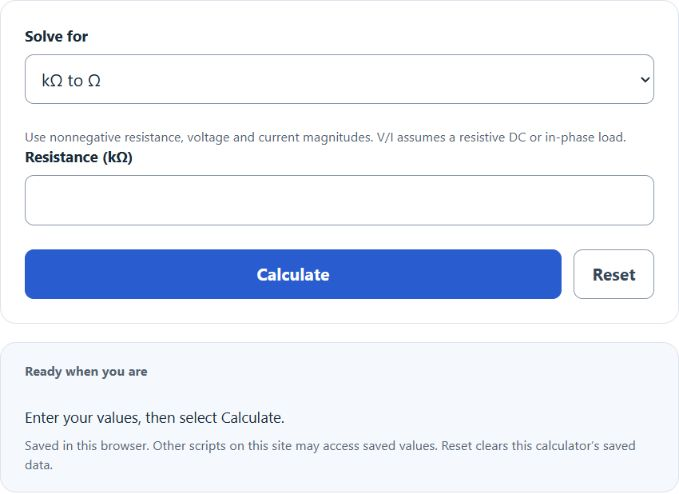
Convert kΩ to Ω, view resistance in Ω, kΩ, MΩ, mΩ, or µΩ, or calculate resistance from voltage and current with Ohm’s law and see the result.
- All Unit Converters
- Ohm’s Law Calculator
- Watts to Ohms Calculator
- Ohms to Watts Calculator
- Ohms to Volts Calculator
- Henry to Ohms Calculator
- Farads to Ohms Calculator
- Inductance to Ohms Calculator
K to Ohms Formula
The calculator uses one of three formulas depending on the mode you select.
Mode 1: kΩ to Ω
R(Ω) = R(kΩ) × 1,000.
Mode 2: Any ohm unit to ohms
R(Ω) = Value × UnitFactor.
Mode 3: From voltage and current (Ohm’s Law)
R = V / I, using nonnegative magnitudes for a resistive DC or in-phase load.
Variables:
- R = resistance in ohms (Ω)
- R(kΩ) = resistance in kilo-ohms
- UnitFactor = multiplier for the chosen unit (GΩ = 1e9, MΩ = 1e6, kΩ = 1e3, Ω = 1, mΩ = 1e-3, µΩ = 1e-6)
- V = voltage in volts
- I = current in amperes
The kΩ to Ω mode multiplies your input by 1,000. The any-unit mode applies the matching SI factor and also reports the result in Ω, kΩ, MΩ, and mΩ. The V/I mode converts voltage and current to base units first, then divides.
Reference Tables
Use these tables to check conversions and read common resistor markings.
| Kilo-ohms (kΩ) | Ohms (Ω) | Mega-ohms (MΩ) |
|---|---|---|
| 0.1 | 100 | 0.0001 |
| 1 | 1,000 | 0.001 |
| 2.2 | 2,200 | 0.0022 |
| 4.7 | 4,700 | 0.0047 |
| 10 | 10,000 | 0.01 |
| 100 | 100,000 | 0.1 |
| 470 | 470,000 | 0.47 |
| 1,000 | 1,000,000 | 1 |
Resistors are sometimes printed with a letter that stands in for the decimal point. Here is how those markings translate.
| Marking | Meaning | Value in Ω |
|---|---|---|
| R47 | 0.47 Ω | 0.47 |
| 4R7 | 4.7 Ω | 4.7 |
| 470R | 470 Ω | 470 |
| 4K7 | 4.7 kΩ | 4,700 |
| 10K | 10 kΩ | 10,000 |
| 1M0 | 1.0 MΩ | 1,000,000 |
Examples and FAQ
Example 1. A resistor reads 4.7K. Convert to ohms.
R = 4.7 × 1000 = 4,700 Ω.
Example 2. A circuit drops 9 V across a resistor with 3 mA flowing through it. Find R in kΩ.
R = V / I = 9 / 0.003 = 3,000 Ω = 3 kΩ.
Is 1K the same as 1000 ohms? Yes. The K stands for kilo, meaning 1,000.
What does the K mean on a resistor? It marks the kilo-ohm position and replaces the decimal point. So 4K7 reads as 4.7 kΩ, or 4,700 Ω.
How do you convert kΩ to MΩ? Divide by 1,000. For example, 470 kΩ = 0.47 MΩ.
Why does the result switch to scientific notation sometimes? Very large or very small values are easier to read in exponential form. The calculator switches automatically at 1 GΩ or above, or below 100 µΩ.