Reduce every birth-date digit to the primary karmic number with a visible chain, then report 13, 14, 16, or 19 debt patterns as secondary notes.
Life Path Number Formula
Birth mode adds every digit of a real birth date together, then repeatedly sums the total’s digits. The default endpoint is 1 to 9; an explicit option preserves 11, 22 or 33 when reached. This is the full-date digit-sum convention requested for this page, sometimes labeled a Life Path or karmic number. Numerology is a symbolic belief practice without scientific predictive validity.
Where:
- LPN = Life Path Number
- m1, m2 = month digits
- d1, d2 = day digits
- y1, y2, y3, y4 = year digits
- dr = repeated digit reduction until one digit remains
With the default setting, 11, 22 and 33 reduce to one digit. The master-endpoint option stops at those values in the same full-digit chain. Other traditions, including Numerology.com’s component-reduction method, reduce month, day and year separately and may give different master results. This tool does not substitute that method.
How the Calculator Works
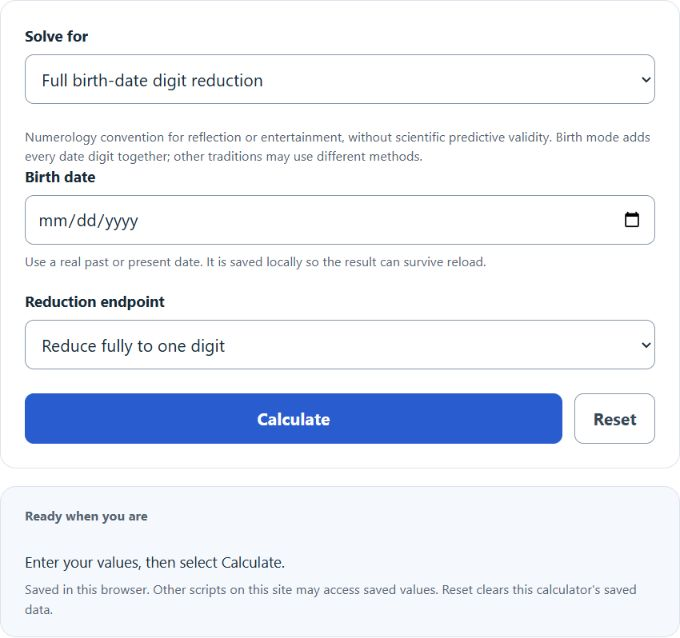
- Enter a valid birth date using the labeled date control. In a text-based date entry, use YYYY-MM-DD.
- Add every digit in the birthdate together.
- If the result has two or more digits, add those digits together again.
- Continue to one digit, or stop at 11, 22 or 33 if you explicitly selected the master endpoint.
Input conventions: use the date control’s real calendar date, such as 1998-03-04 for March 4, 1998. Whole-number mode accepts up to 200 digits without a sign, decimal or exponent. Name mode maps A–Z cyclically to 1–9, removes common combining accents and listed punctuation, and rejects unsupported letters until you supply an explicit A–Z transliteration.
Example
Suppose the birthdate is 03/14/1992.
With the default fully reduced endpoint, the result is 2. With the master-endpoint option, the same chain stops at 11. The birthday chain 14 → 5 adds a separate 14/5 symbolic marker; it does not replace the primary result.
Life Path Number Meanings
The table below preserves symbolic themes used in numerology. They are cultural or reflective interpretations, not evidence about an individual’s personality, ability or future.
| Number | Common Themes | Typical Strengths | Common Challenges |
|---|---|---|---|
| 1 | Independence, initiative, leadership | Self-starting, decisive, ambitious | Impatience, stubbornness, over-control |
| 2 | Cooperation, balance, sensitivity | Diplomatic, supportive, intuitive | Overthinking, passivity, people-pleasing |
| 3 | Expression, creativity, communication | Charismatic, imaginative, social | Scattered focus, inconsistency, emotional swings |
| 4 | Structure, discipline, stability | Reliable, methodical, practical | Rigidity, resistance to change, narrow focus |
| 5 | Freedom, change, adaptability | Versatile, adventurous, energetic | Restlessness, impulsiveness, lack of routine |
| 6 | Responsibility, care, harmony | Nurturing, protective, dependable | Perfectionism, worry, taking on too much |
| 7 | Reflection, analysis, spirituality | Insightful, thoughtful, observant | Isolation, skepticism, emotional distance |
| 8 | Achievement, authority, material focus | Strategic, resilient, goal-driven | Work imbalance, pressure, attachment to outcomes |
| 9 | Compassion, completion, service | Generous, idealistic, broad-minded | Difficulty letting go, emotional intensity, burnout |
Life Path Number vs. Karmic Debt Numbers
People sometimes use the phrase karmic number loosely, but there are two different ideas that are often mixed together:
- Life Path Number: the reduced value from your full birthdate, which is what this calculator returns.
- Karmic Debt Numbers: values such as 13, 14, 16, and 19 in some numerology traditions, usually interpreted under separate rules.
This tool reports 13/4, 14/5, 16/7 and 19/1 only when the whole total 13, 14, 16 or 19 occurs in the checked chains. Birth mode scans the birthday chain and the full-date sum chain; number and name modes scan their own reduction chain. These are secondary symbolic notes, not the primary output or a complete numerology chart.
Manual Check Tips
- Use the date control in birth mode; use plain digits in whole-number mode.
- Double-check the date order. Text date input uses year-month-day; a localized calendar control may display the components in a different order.
- If the result looks unexpected, verify that you included every digit, especially leading zeros.
- If you prefer to preserve master numbers, stop your manual reduction at 11, 22, or 33 instead of continuing.
Frequently Asked Questions
Why does the calculator reduce to one digit?
The default adds all digits repeatedly until one digit remains. You can instead select the explicit 11/22/33 endpoint option. The result follows the displayed convention; no universally correct numerology result is claimed.
Can two different birthdays have the same result?
Yes. Many different dates reduce to the same final number because the calculation only depends on the repeated sum of digits.
Does a Life Path Number predict the future?
No scientific predictive validity is established for this number. Treat it as reflection or entertainment, not evidence of personal debt, past lives or future events, and do not use it for consequential decisions.
What happens if I enter an invalid date?
Birth mode rejects impossible Gregorian dates, missing values and future birth dates. Leap-year validation uses the actual year, including century rules.