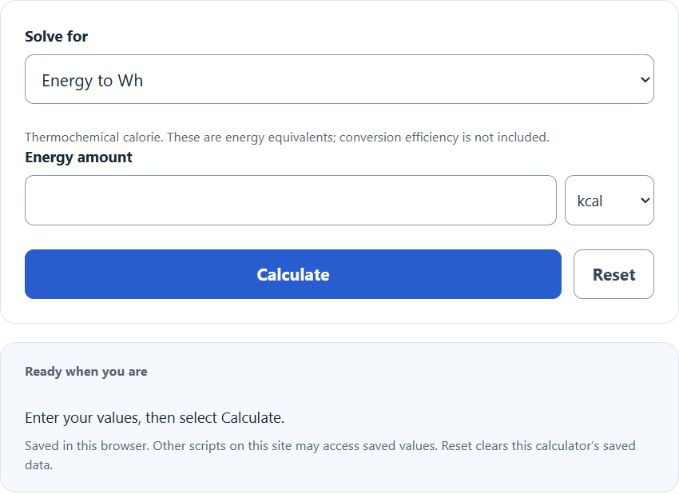
Convert kcal, cal, kJ or J to watt-hours, or convert kcal/hour, Wh/hour, kJ/hour and J/hour to watts with energy equivalents for quick comparison.
- All Unit Converters
- kcal to kW Conversion Calculator
- Cal to kWh Conversion Calculator
- kJ to Calories Calculator
- BTU to Calories Conversion Calculator
- Cal to BTU Conversion Calculator
kcal to Wh Conversion Formula
The calculator uses two formulas, one for each mode.
Energy mode (kcal to Wh):
Wh = kcal × 4184 / 3600 ≈ kcal × 1.162222.
Rate mode (kcal/hour to W):
W = (kcal/hour × 4184) / 3600 ≈ kcal/hour × 1.162222.
- Wh = energy in watt-hours
- W = power in watts
- kcal = kilocalorie, also called food Calorie (Cal with a capital C)
- 4184 = joules in one kilocalorie (thermochemical kcal)
- 3600 = seconds in one hour, used to convert joules to watt-hours
The exact thermochemical factor is 4,184/3,600 Wh per kcal, approximately 1.162222. The international table calorie uses 4,186.8 J per kcal, giving 1.163 Wh per kcal; the two definitions are slightly different. The calculator assumes input values are non-negative. Energy is conserved in the conversion, so no efficiency or loss factor is applied. If you need the electrical energy a device actually delivers, multiply the result by the device efficiency.
The kcal to Wh tab converts a fixed energy amount. Enter kcal, cal, kJ, or J and the calculator first converts to joules, then divides by 3600 to get Wh. The kcal/hour to W tab converts an energy rate to continuous power. It applies the same joule conversion, then divides by 3600 seconds per hour to give watts. One kcal per hour equals 1.162222 watts because a watt is defined as one joule per second.
Reference Tables
Common kcal values converted to Wh:
| Energy (kcal) | Energy (Wh) | Energy (kJ) |
|---|---|---|
| 1 | 1.162 | 4.184 |
| 10 | 11.62 | 41.84 |
| 100 | 116.2 | 418.4 |
| 250 | 290.6 | 1,046 |
| 500 | 581.1 | 2,092 |
| 1,000 | 1,162 | 4,184 |
| 2,000 | 2,324 | 8,368 |
Illustrative kcal/hour rates and their watt equivalents. The activity labels are examples, not individualized calorie estimates; human activity entries refer to metabolic power, not mechanical output:
| Activity or source | kcal/hour | Watts |
|---|---|---|
| Resting adult (BMR) | 70 | 81 |
| Walking (3 mph) | 240 | 279 |
| Cycling (moderate) | 500 | 581 |
| Running (6 mph) | 700 | 814 |
| Trained cyclist (sustained) | 860 | 1,000 |
Examples and FAQ
Example 1. A meal contains 600 food Calories. How much energy is that in watt-hours?
Wh = 600 × 1.162222 = 697.3 Wh, or about 0.70 kWh. That is roughly the energy a 100 W bulb uses in 7 hours.
Example 2. A cyclist burns 450 kcal in one hour. What is the average metabolic power in watts?
W = 450 × 1.162222 = 523 W. This is metabolic power. Mechanical power at the pedals requires a measured or explicitly assumed conversion efficiency and cannot be determined from metabolic energy alone.
Why is 1 kcal not exactly 1 Wh? The kilocalorie and the watt-hour come from different definitions. A kcal is defined by heat (joules), and a Wh is defined by power times time. The fixed ratio between joules and seconds gives the 1.162 conversion factor.
Is a food Calorie the same as a kcal? Yes. The Calorie with a capital C used on nutrition labels equals one kilocalorie, or 1,000 small calories.
Can I use this for battery sizing? The result is the raw energy. Real batteries lose energy to heat, charge controllers, and inverters. Multiply the Wh result by your system efficiency, chosen for the actual battery and equipment, to estimate usable output.
What is the difference between Wh and W? Wh is energy, the total amount used or stored. W is power, the rate of use. Energy equals power multiplied by time, so 100 W running for 1 hour equals 100 Wh.