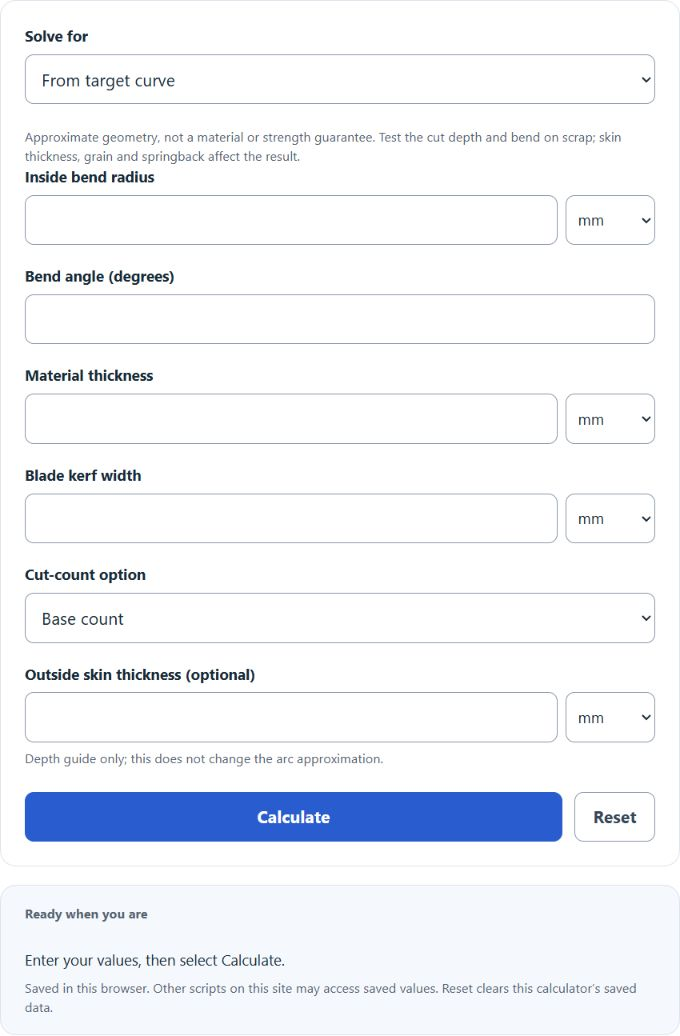
Calculate kerf spacing, cut count, bend-zone length, and cut-depth guidance for bending plywood, MDF, or wood from a target curve.
Related Calculators
- Curb Radius Calculator
- Swing Radius Calculator
- Welding Time Calculator
- Elbow Weight Calculator
- All Construction Calculators
Kerf Bend Formula
For this approximate arc-difference model, let θ = A × π / 180. The target-curve mode calculates a rounded cut count and center-to-center spacing:
Nbase = ceil(θ × t / k); N = ceil((θ × t / k) × selected extra-cut factor); pitch = θ × (R + t) / N.
The outside/inside arc difference is θ × t. This assumes negligible outer skin and ignores material deformation. Rounding up or adding cuts leaves partly open kerfs at the target angle. Extra-cut options are heuristics, not guaranteed finish ratings. For an existing layout with fully closed kerfs: θ = N × k / t; R = t × pitch / k − t. Allocate one pitch-length cell per cut, with half a pitch at each bend-zone edge. Optional skin thickness only supplies the depth guide t − skin. Test the setup on scrap.
Variables:
- N is the selected integer cut count
- t is the material thickness
- R is the inside radius
- k is the blade kerf width; A is the angle in degrees; pitch is center-to-center cut spacing
What is a Kerf Bend?
A Kerf Bend is a technique used in woodworking and metalworking to create a bend in a solid material. This is achieved by making a series of cuts, known as kerfs, along the line where the bend is desired. These kerfs remove a small amount of material, which allows the remaining material to bend without breaking or cracking. The depth and spacing of the kerfs determine the flexibility and radius of the bend. This technique is often used in furniture design and manufacturing, as well as in the creation of custom shapes for architectural and artistic applications. It is particularly useful when working with thick or rigid materials that would otherwise be difficult to bend.
How to Calculate Kerf Bend?
The following steps outline how to calculate the Kerf Bend:
- First, determine the thickness of the material (T).
- Next, determine the bend radius (R).
- Measure the blade kerf width and choose the bend angle, then use the arc-difference formulas above.
- Finally, calculate the Kerf Bend.
- After inserting the variables and calculating the result, check your answer with the calculator above.
Example Problem :
Use the following variables as an example problem to test your knowledge.
Material thickness t = 18 mm; blade kerf k = 3.2 mm; angle A = 90°; base cut-count option.
Inside radius R = 150 mm. The model gives 9 cuts, pitch ≈29.321531 mm and outside bend-zone length ≈263.893783 mm. Leaving 1.5 mm of skin gives a 16.5 mm cut-depth guide; it does not change this approximation.