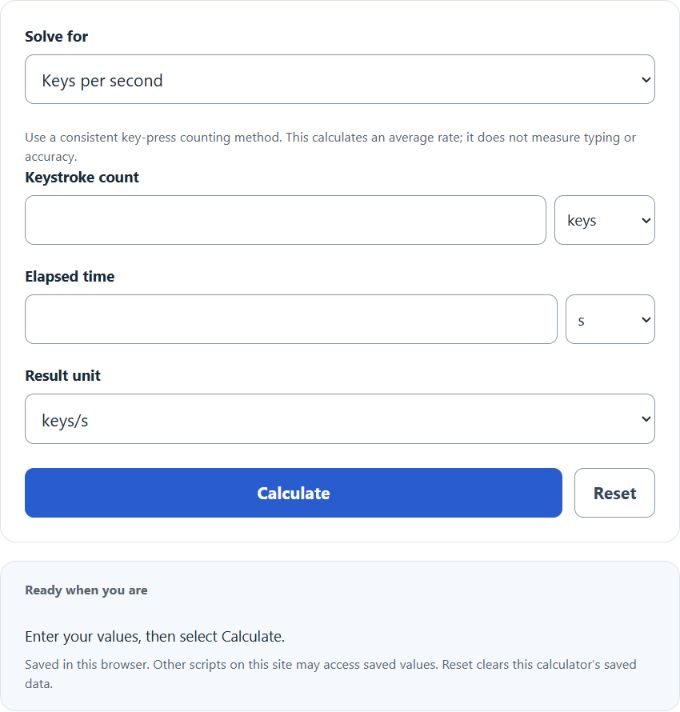
Calculate keys per second, total keystrokes, or typing time by entering any two values with seconds, minutes, hours, keys, dozens, or hundreds.
- GWAM (Gross Words Per Minute) Calculator
- Letters Per Minute Calculator
- Characters Per Minute Calculator
- Handwriting Speed Calculator
- APM Calculator
- Every Day Life And Education Calculators
Keys Per Second Formula
The keys per second calculator measures input rate by comparing total keystrokes to elapsed time. It is useful for typing practice, keyboard benchmarking, gaming input analysis, macro testing, and any workflow where rapid key entry matters. Select the quantity to solve for and enter the other two values: keys per second, total keystrokes, or elapsed time. Known counts must represent whole key presses; rate-time estimates may be fractional.
| Variable | Meaning | Typical Unit | Notes |
|---|---|---|---|
| KPS | Keys per second | keys/s | The average number of key presses made each second. |
| KS | Total keystrokes | keys | Count all key presses using one consistent counting method. |
| T | Elapsed time | seconds | Time should be converted to seconds before applying the formula. |
Rearranged Forms
If you know the rate and one other value, the same relationship can be rewritten to solve for the missing variable.
How to Calculate Keys Per Second
- Count the total number of key presses made during the session.
- Measure the full time interval used for the count.
- Convert the time to seconds if it was recorded in minutes or hours.
- Divide total keystrokes by total seconds.
- Use the result to compare sessions, devices, or input performance over time.
Time Unit Conversions
Keys per second is a rate based on seconds, so unit consistency matters. If the time is entered in minutes or hours, convert it first or let the calculator handle the unit conversion for you.
| Starting Time Unit | Convert to Seconds | Equivalent KPS Formula |
|---|---|---|
| Seconds |
Tₛ = T |
KPS = (KS) / (T) |
| Minutes |
Tₛ = Tₘᵢₙ × 60 |
KPS = (KS) / (Tₘᵢₙ × 60) |
| Hours |
Tₛ = Tₕᵣ × 3600 |
KPS = (KS) / (Tₕᵣ × 3600) |
Related Rate Conversions
Keys per second is often compared with keys per minute or estimated words per minute.
The standardized word-rate convention uses five output characters per word, including spaces and punctuation. The expression above only applies when counted key presses correspond one-to-one with those characters. Modifier keys, corrections and multi-stroke input break that equivalence; raw key activity is not automatically text-entry speed.
Examples
If 240 keystrokes are made in 60 seconds:
The rate is 4 keys per second.
If 900 keystrokes are made in 3 minutes, convert the time to seconds first:
The rate is 5 keys per second.
If your target is 6 keys per second over a 45 second interval, the required number of keystrokes is:
You would need 270 keystrokes in that time window.
What Counts as a Keystroke?
A keystroke is usually each discrete key press, but the exact counting rule should stay consistent. Depending on your use case, you may choose to include or exclude certain actions.
- Letters, numbers, and symbols are typically counted.
- Spaces, enter, and punctuation may be counted if they are part of normal text entry.
- Backspace and delete can be included when measuring total keyboard activity.
- Modifier keys such as shift, control, and alt should only be counted if your test or software records them explicitly.
- For fair comparisons, always use the same counting method across sessions.
Speed vs. Accuracy
Keys per second measures pace, not correctness. A very high rate is less meaningful if many keystrokes are errors. If you also track accuracy, you can estimate an accuracy-adjusted input rate.
In this expression, A is the accuracy percentage. This assumes accuracy is the fraction of the same counted key presses that are correct. Text-character accuracy with a different denominator cannot automatically be applied to all keyboard activity.
Common Uses for a Keys Per Second Calculator
- Typing practice: compare sessions and track improvement over time.
- Gaming: measure rapid input frequency for rhythm, action, or combo-heavy games.
- Hardware testing: evaluate keyboards, switches, or macros under repeated input.
- Accessibility analysis: study comfortable input speed and fatigue limits.
- Productivity benchmarking: measure repetitive data entry or command input tasks.
Common Mistakes
- Using minutes or hours directly without converting to seconds.
- Comparing results from different counting rules.
- Recording only output characters instead of actual key presses.
- Rounding time too early, which can distort short-duration measurements.
- Ignoring accuracy when comparing overall performance.
Practical Tips
- Measure over longer intervals for a more stable average rate.
- Use the same keyboard, software, and test length when comparing results.
- Track both raw KPS and accuracy for a more complete performance picture.
- Review peak bursts separately from sustained typing speed if endurance matters.