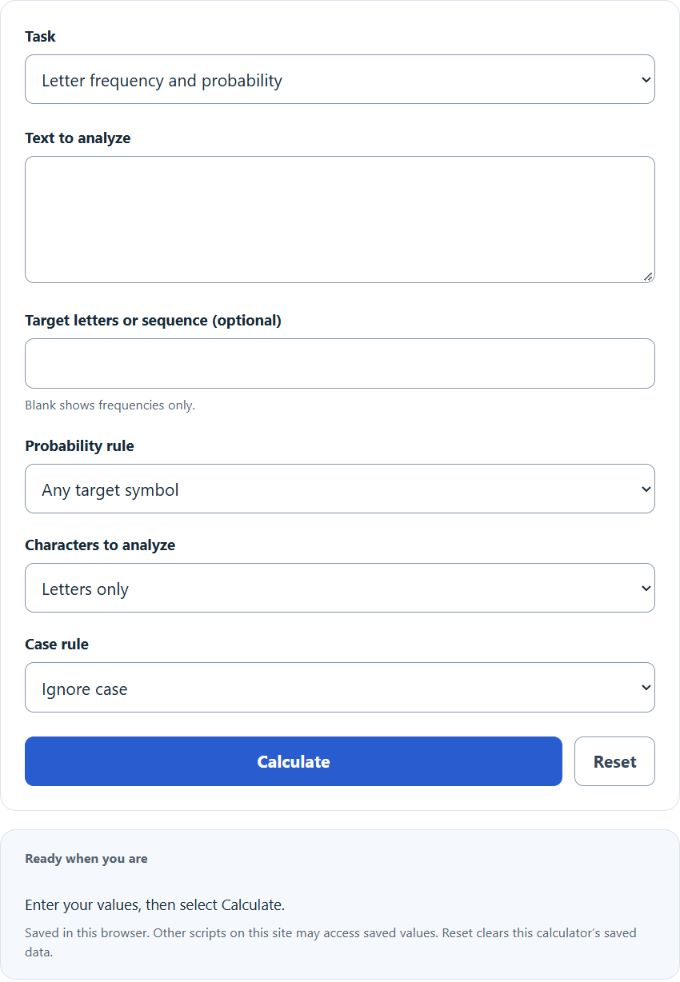
Calculate letter frequencies, target probabilities, and unique word arrangements from text, letters, or a word with repeated-character handling.
Related Calculators
- Compound Probability Calculator
- Posterior Probability Calculator
- Marginal Frequency Calculator
- Frequency Percentage Calculator
- All Statistics Calculators
Letter Probability Formula
The letter probability tells you how often a specific letter appears relative to the total number of letters in a text. It is commonly expressed as a percentage, though it can also be written as a decimal probability.
In decimal form, the same relationship is:
- LP = letter probability as a percentage
- p = letter probability as a decimal
- L = frequency of the target letter
- T = total number of letters in the text
Choose Letter frequency and probability to count symbols or calculate any-target and ordered-sequence draw probabilities, with or without replacement. Ordered draws model a uniformly random sample; they do not count existing text substrings. Unique word arrangements uses n! divided by repeated-symbol factorials, for up to 500 characters. A whole-number length assumes distinct items and cannot validate a textual target.
How to Calculate Letter Probability
- Choose the letter you want to analyze.
- Count how many times that letter appears in the text.
- Count the total number of letters in the same text sample.
- Divide the letter count by the total letter count.
- Multiply by 100 if you want the result as a percent.
If you already know the probability and total letters, you can rearrange the formula to estimate the expected frequency of the letter:
If you know the frequency and probability, you can solve for the total number of letters:
Example
Suppose the letter e appears 8 times in a passage containing 100 letters total.
This means the letter e makes up 8% of all letters in the sample.
How to Interpret the Result
- Higher percentage: the letter appears more frequently in the text.
- Lower percentage: the letter is relatively rare in the sample.
- 0%: the letter does not appear at all.
- 100%: every letter in the sample is the same letter, which is possible only in very unusual text.
What Counts as a Letter?
The calculator is most useful when the counting rule is consistent. In many text analyses, only alphabetic characters are counted as letters, while spaces, punctuation, and numbers are excluded.
| Character Type | Usually Counted? | Notes |
|---|---|---|
| Alphabetic letters | Yes | Unicode letters are included after NFC normalization. |
| Spaces | No | Spaces are separators, not letters. |
| Punctuation | No | Characters such as commas, periods, and question marks are usually excluded. |
| Numbers | No | Digits are not letters unless your analysis specifically includes all characters. |
| Uppercase and lowercase | Usually combined | For example, A and a are generally treated as the same letter. |
Why Letter Probability Matters
Letter probability is a simple but powerful statistic used in several areas:
- Linguistics: compare letter usage across words, passages, or languages.
- Cryptography: frequency analysis can help identify likely substitutions in encoded text.
- Text analytics: measure distribution patterns in writing samples.
- Education: practice basic probability, ratios, and percentages with real text.
- Game analysis: estimate useful letters in puzzles and word games.
Common Mistakes
- Using total characters instead of total letters: this changes the denominator and can distort the result.
- Mixing case rules: counting uppercase separately in one step and combining them in another creates errors.
- Forgetting to convert to percent: a decimal like 0.08 equals 8%.
- Using inconsistent text samples: the letter count and total letters must come from the same exact text.
Letter Probability vs. Frequency
These two terms are related but not identical:
- Frequency is the raw count of how many times the letter appears.
- Probability is that count relative to the total number of letters.
For example, a frequency of 12 does not mean much by itself unless you also know whether the text contains 50 letters, 500 letters, or 5,000 letters.
Quick Reference
| Situation | Formula | Use |
|---|---|---|
| Find probability as a percent |
LP = ((L) / (T)) × 100 |
When frequency and total letters are known |
| Find probability as a decimal |
p = (L) / (T) |
When you want the raw probability from 0 to 1 |
| Find expected letter count |
L = (LP × T) / (100) |
When total letters and probability are known |
| Find total letters |
T = (L × 100) / (LP) |
When letter count and probability are known |
Frequently Asked Questions
Is letter probability the same as percentage of occurrence?
Yes. In most basic text analysis, letter probability expressed as a percent is simply the percentage of the text made up by that letter.
Can the calculator be used for any language?
Unicode letters are supported. Counts use normalized code points rather than visual grapheme clusters; Ignore case uses Unicode lowercase rather than language-specific case folding.
Should spaces be included in the total?
Usually no. Most letter probability calculations use only letters in the denominator.
Can I use a very short text sample?
You can, but shorter samples are less stable. A larger sample generally gives a more representative probability for the letter.
What if the letter never appears?
If the frequency is zero, then the probability is 0%.