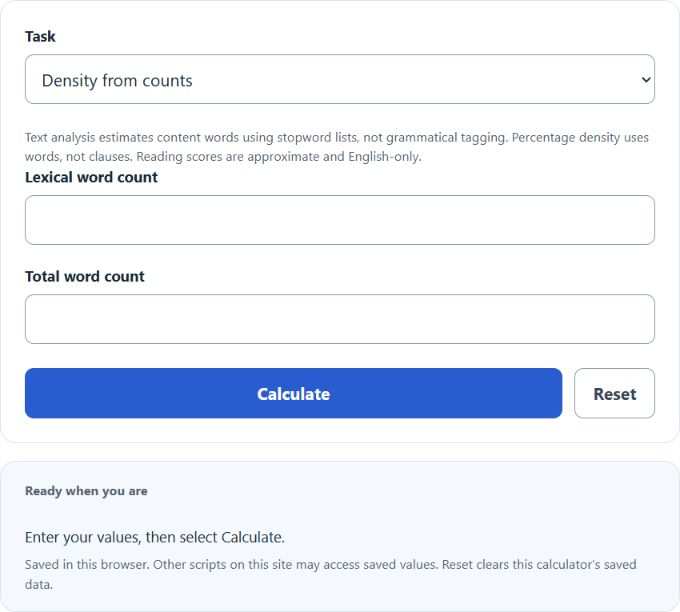
Enter the lexical word count and total word count, or select text analysis or comparison, in the Lexical Density Calculator. The calculator will evaluate and display the Lexical Density.
- All Density Calculators
- Lexical Diversity Calculator
- Type-Token Ratio (TTR) Calculator
- Words to Pages Calculator
- Words to Minutes Calculator
- Characters Per Page Calculator
- All Miscellaneous Calculators
Lexical Density Formula
The following formula is used to calculate the Lexical Density.
- Where LD is the Lexical Density (%)
- I is the number of lexical (content) word tokens
- W is the total number of word tokens
For percentage lexical density, divide content-word tokens by all word tokens and multiply by 100. Lexical items per clause is a separate measure without the percentage multiplier. Automated analysis here uses stopwords as an estimate; manually review grammatical classifications.
How to Calculate Lexical Density?
The following example problems outline how to calculate Lexical Density.
Example Problem #1:
- First, determine the number of lexical items.
- The number of lexical items is given as 45.
- Next, determine the total number of words.
- The total number of words is provided as 100.
- Finally, calculate the Lexical Density using the equation above:
LD = I / W * 100
The values given above are inserted into the equation below:
LD = 45 / 100 * 100 = 45 (%)
Example Problem #2:
For this problem, the variables needed are provided below:
number of lexical items = 12
total number of words = 523
This example problem is a test of your knowledge on the subject. Use the calculator above to check your answer. LD = I / W * 100 = ?